1. Why Sterilization Resistance of Plastics Matters
Plastics are widely used in medical devices, including single-use consumables and reusable instruments, as well as in laboratory systems and packaging, where maintaining sterility is essential to ensure patient safety and regulatory compliance.
Sterilization eliminates microorganisms by disrupting metabolic activity or preventing replication, yet the process must not compromise the physical, chemical, or mechanical integrity of the plastic components. In practical terms, sterilization resistance refers to a polymer’s ability to maintain its performance over one or multiple sterilization cycles without degradation or loss of functionality.
2. Common Sterilization Methods and Their Effects on Plastics
2.1 Heat Sterilization – Steam and Dry Heat
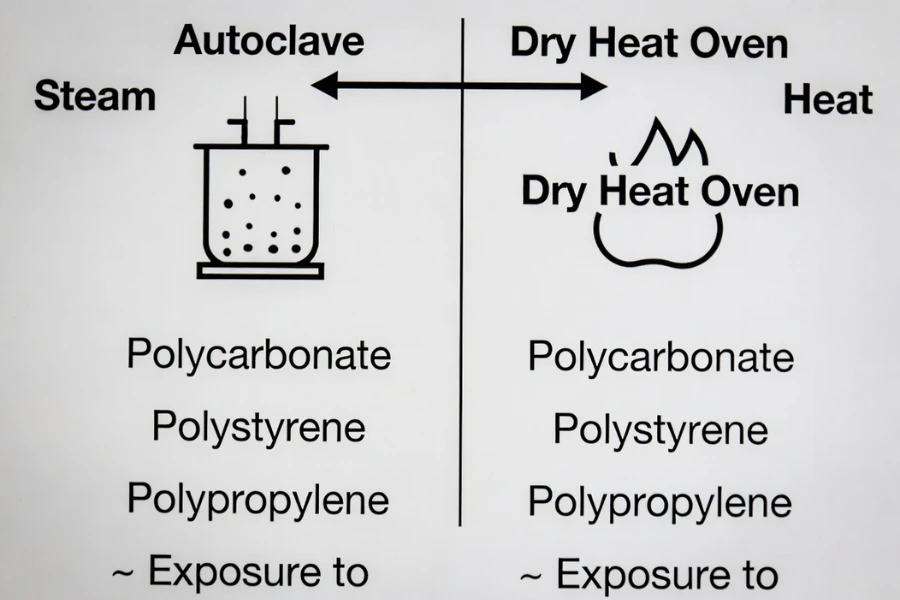
Steam sterilization, typically performed at temperatures between 121°C and 134°C under pressure, is one of the most widely used methods due to its efficiency, non-toxic nature, and strong microbial inactivation capability, yet it imposes strict requirements on plastics because only materials with sufficiently high heat deflection or glass transition temperatures can maintain dimensional stability.
Dry heat sterilization operates at higher temperatures, generally between 150°C and 170°C for extended durations, and while it avoids hydrolysis caused by moisture, it introduces oxidative degradation and volatilization of low molecular weight components, which further limits its compatibility with most thermoplastics.
For plastics with insufficient thermal stability, repeated exposure to these conditions can accelerate chain mobility and structural relaxation, ultimately leading to dimensional instability and loss of mechanical strength.
2.2 Ethylene Oxide (EtO) Sterilization
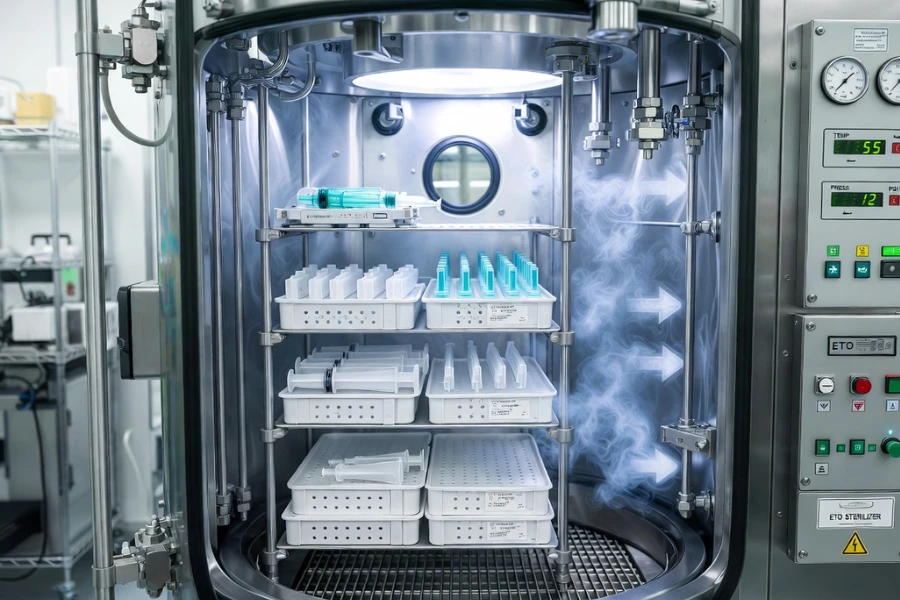
Ethylene oxide sterilization is conducted at relatively low temperatures, usually between 30°C and 50°C with controlled humidity and gas concentration, allowing it to be widely applied to heat-sensitive plastics and complex medical assemblies that cannot tolerate thermal stress.
Because EtO gas can diffuse through packaging and intricate geometries, it is particularly effective for assembled devices; however, the process requires extended aeration to remove residual gas, and certain polymers may absorb moisture or retain trace chemicals that must be evaluated during validation.
From a material perspective, EtO generally causes minimal structural change, but its interaction with polymer morphology and additives still requires careful assessment under real processing conditions. This makes collaboration with an experienced partner like SeaSkyMedical for material selection advantageous when selecting compatible polymers.
2.3 Plasma Sterilization – Hydrogen Peroxide Systems
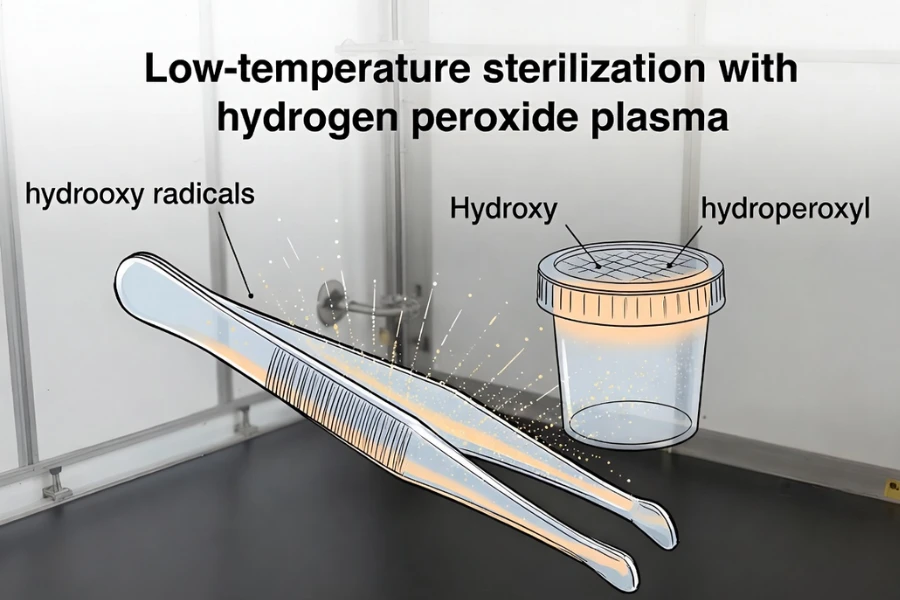
Hydrogen peroxide plasma sterilization relies on reactive species generated in a low-temperature plasma environment, which interact with microorganisms at the surface level without exposing materials to high thermal loads.
Although the material impact is typically minimal, the limited penetration depth restricts effectiveness in devices with internal cavities or complex assemblies, which means product design and mold-making considerations are critical for process compatibility.
For most engineering plastics, the primary effect is surface-level modification rather than bulk structural change, yet compatibility must still be verified for specific formulations and stabilizer systems.
2.4 Radiation Sterilization – Gamma and Electron Beam
Radiation sterilization, including gamma irradiation and electron beam processing, operates at ambient temperature and is widely used for pre-packaged medical devices.
Gamma radiation offers deep penetration suitable for bulk processing, while electron beam provides faster processing with limited depth, making it more suitable for thin components or surface-focused applications.
Ionizing radiation can cause chain scission or crosslinking, which may result in discoloration, embrittlement, or reduced elongation at break, particularly in sensitive polymers. Evaluating polymers with medical plastic injection molding expertise ensures material stability under these conditions.
2.5 Chemical Sterilization
Liquid chemical sterilants such as glutaraldehyde, formaldehyde, and chlorine dioxide are used for heat-sensitive materials, but they can introduce residuals or surface changes that affect long-term performance. This method is suitable only when thermal or radiation-based sterilization is not viable.
3. Classification of Plastics by Sterilization Resistance
3.1 High-Performance Plastics – Excellent to Good Resistance
| Material | Steam | EtO | Gamma / E-Beam | Plasma / H₂O₂ | Notes |
|---|---|---|---|---|---|
| PEEK | Excellent | Excellent | Excellent | Excellent | Maintains properties after >1000 steam cycles |
| PPSU | Excellent | Good | Good | Good | Stable up to ~800 cycles, slight discoloration may occur |
| PEI | Excellent | Good | Good | Good | Used in respiratory devices, infusion pumps |
| PSU | Good | Good | Fair | Good | May embrittle after repeated steam exposure |
| PVDF | Excellent | – | – | – | Strong chemical and thermal resistance |
| LCP | Excellent | – | – | – | Excellent thermal and radiation stability |
| PI | Excellent | – | – | – | High-temperature and radiation resistance |
High-performance polymers are preferred for reusable devices due to their dimensional stability and mechanical integrity over repeated sterilization, supporting extended product lifespan.
3.2 Engineering Plastics – Moderate Resistance
| Material | Steam | EtO | Gamma / E-Beam | Plasma | Notes |
|---|---|---|---|---|---|
| POM | Fair | Good | Poor | Good | Radiation causes chain degradation |
| PC | Poor | Good | Good | Good | Not suitable for repeated steam cycles |
| PP-H | Good | Good | Poor | Good | Discoloration occurs after repeated cycles |
| COC | Fair | – | – | – | Limited compatibility |
| SAN | Fair | – | – | – | Limited compatibility |
Engineering plastics provide a balance of cost and performance, yet their sterilization compatibility is method-dependent, and improper selection can lead to hydrolysis, oxidation, or radiation-induced degradation.
3.3 Commodity Plastics – Limited Resistance
ABS, polyethylene, polyamide, PET, PMMA, PVC, and polystyrene generally exhibit poor resistance to high-temperature and radiation sterilization. While some tolerate EtO or plasma processes, these are primarily suitable for single-use applications.
These materials often experience melting, warping, discoloration, or mechanical degradation under aggressive sterilization conditions.
4. Key Factors in Selecting the Appropriate Sterilization Method
Selecting a sterilization method requires evaluating material behavior, product geometry, cycle frequency, residual requirements, and regulatory compliance. Collaboration with a partner experienced in medical device contract manufacturing can integrate material selection, secondary operations like assembly and packaging, and validation testing into the design stage, ensuring device performance is maintained throughout its lifecycle.
High-penetration methods such as gamma or EtO are suitable for complex devices, whereas surface-focused techniques like plasma are appropriate for accessible geometries. Cycle count, allowable performance variation, and potential residuals must be considered to ensure compliance with ISO 11135, ISO 11137, and ISO 17665 standards.
In practice, early collaboration with a manufacturing partner like SeaSkyMedical for product development allows integrated decision-making covering material selection, mold design, and sterilization validation within ISO-class cleanrooms.
5. Relevant Standards and Regulatory Considerations
Sterilization processes must comply with international standards to ensure reproducibility and safety. ISO 14937 provides general guidance, ISO 11135 covers ethylene oxide, ISO 11137 addresses radiation sterilization, ISO 17665 specifies steam sterilization requirements, and ISO 10993 evaluates post-sterilization biocompatibility.
6. FAQ
Q1 What plastic performs best under repeated steam sterilization
PEEK provides the highest resistance and can withstand more than one thousand autoclave cycles while maintaining mechanical stability, followed by PPSU and PEI, which also perform well under repeated sterilization conditions.
Q2 Can polycarbonate be used in steam sterilization
Polycarbonate is not recommended for repeated steam sterilization because exposure to high temperature and moisture leads to hydrolytic degradation, which reduces toughness and dimensional stability after a limited number of cycles.
Q3 Why do some plastics become brittle after radiation sterilization
Radiation can break polymer chains through chain scission, reducing molecular weight and leading to embrittlement, or induce crosslinking that alters flexibility, both negatively affecting mechanical performance.
Q4 Why is POM not suitable for gamma sterilization
Polyoxymethylene is highly sensitive to radiation-induced degradation; chain scission rapidly reduces impact strength and increases the risk of cracking, making it unsuitable for gamma or electron beam sterilization.
Q5 How should manufacturers select a sterilization method for plastic components
Selection involves evaluating thermal limits, radiation tolerance, chemical compatibility, and product geometry, followed by validation testing to confirm that the material maintains performance after sterilization under defined ISO standards.