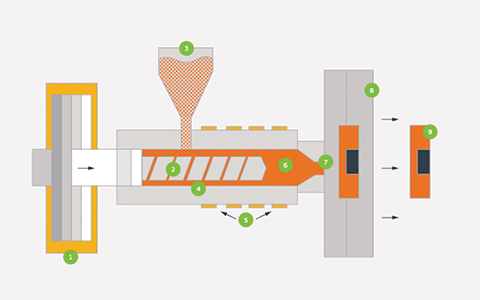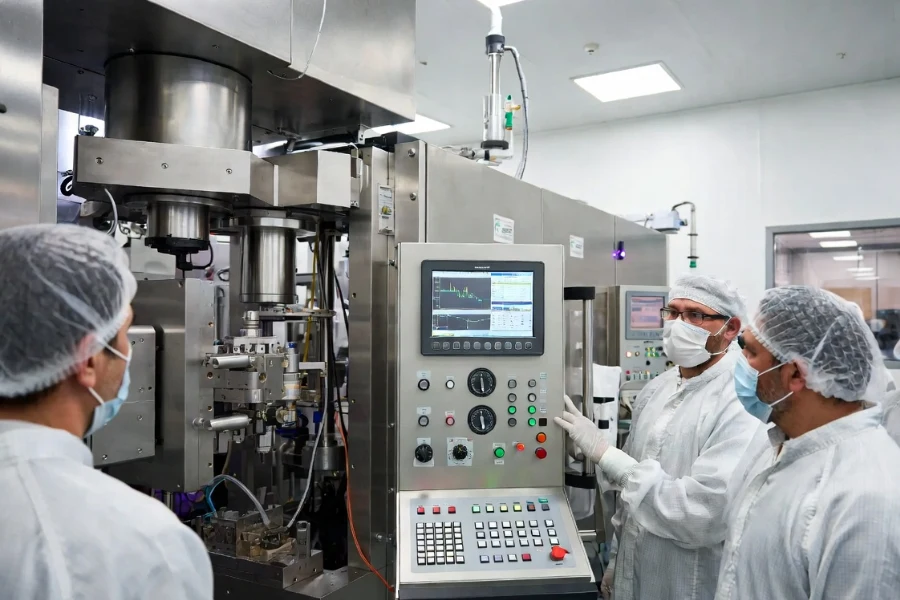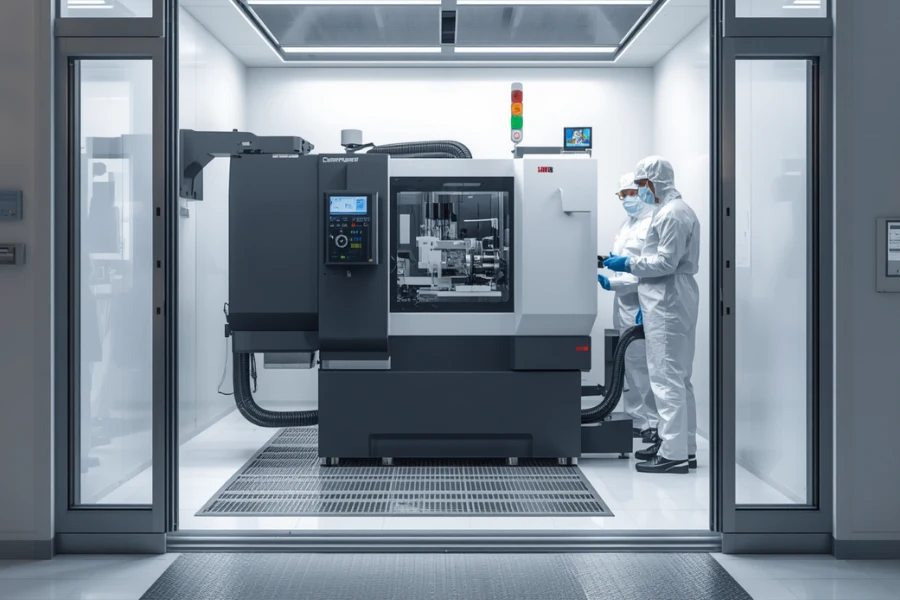
Choosing a medical injection molding supplier is one of the most important decisions during medical device development, yet it is also one of the easiest to underestimate. During supplier selection, multiple manufacturers may appear equally qualified. They often present similar certifications, comparable lead times, competitive quotations, and polished company profiles. However, the real differences rarely become visible until tooling is built, engineering validation begins, or pilot production starts. By then, changing suppliers can delay product launches, increase tooling costs, complicate regulatory submissions, and create significant risks for both manufacturers and patients.
Many supplier-related problems do not originate on the production floor. Instead, they begin much earlier during supplier evaluation. Incomplete material traceability, inadequate engineering support, poor process validation, inconsistent quality documentation, or insufficient change control frequently remain hidden during quotation reviews because procurement teams often focus on price, certifications, and delivery commitments. These weaknesses usually surface during T1 mold trials, First Article Inspection (FAI), or process validation, when correcting them becomes considerably more expensive than identifying them during supplier qualification.
For medical OEMs, supplier qualification is therefore not an administrative approval exercise—it is a structured, risk-based engineering evaluation designed to determine whether a supplier can consistently manufacture components that satisfy technical specifications, regulatory requirements, and long-term production objectives. While certifications such as ISO 9001 or ISO 13485 demonstrate that a quality management system has been established, they do not automatically confirm that the supplier possesses validated manufacturing processes, effective engineering change control, robust material traceability, or stable process capability. As supplier qualification guidance consistently emphasizes, certification should be viewed as the baseline requirement rather than evidence of manufacturing excellence.
An effective qualification program combines document verification, technical capability assessments, factory audits, mold validation, first article inspections, and continuous supplier performance monitoring. Instead of asking whether a supplier simply meets today’s requirements, experienced medical manufacturers evaluate whether the supplier can continue meeting those requirements after engineering changes, capacity expansion, regulatory inspections, or multi-year production programs. This philosophy aligns closely with purchasing control principles described in FDA Quality System Regulation and ISO 13485 while reducing long-term manufacturing risk.
Industry experience also shows that investing additional effort during supplier qualification often saves substantially more time and cost later in the project lifecycle. Thorough due diligence can significantly reduce supplier-related project failures because many manufacturing risks—including unstable processes, inadequate documentation, and insufficient technical capability—can be identified before production tooling is released.
This guide provides a practical supplier qualification checklist specifically for medical injection molding projects. Drawing upon supplier qualification best practices together with engineering considerations unique to medical injection molding services, it explains how procurement professionals, supplier quality engineers, and project managers can systematically evaluate suppliers—from initial document review through factory audits, mold trials, process validation, and ongoing supplier performance management. If your project also involves early-stage medical product development, integrating supplier qualification into the development process can significantly reduce downstream validation risks.
Why Supplier Qualification Matters for Medical Injection Molding
Medical injection molded components are manufactured for applications where dimensional consistency, material integrity, biocompatibility, and process repeatability directly influence product performance and, in many cases, patient safety. Unlike general industrial plastic products, medical components frequently require validated manufacturing processes, complete lot traceability, controlled production environments, documented inspection records, and strict change management throughout the product lifecycle. For products manufactured in cleanroom injection molding environments, supplier discipline becomes even more critical because contamination control must be maintained alongside dimensional accuracy.
This means supplier qualification cannot simply verify whether a factory owns advanced equipment or holds internationally recognized certifications. Instead, it must answer a more important question:
Can this supplier repeatedly manufacture compliant medical components under controlled and validated conditions over the entire life of the project?
Answering that question requires evaluating both documentation and manufacturing capability.
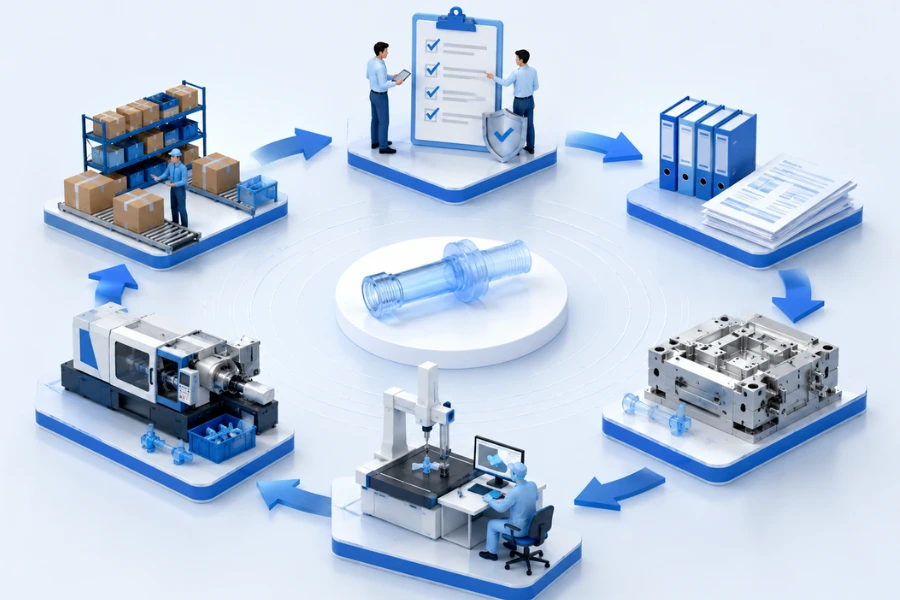
A typical supplier qualification program for medical injection molding progresses through five connected stages:
- Initial supplier pre-screening and document review
- On-site technical and quality system assessment
- Quality agreement and process validation planning
- Mold trials and First Article Inspection (FAI)
- Continuous supplier monitoring, performance reviews, and periodic requalification
Each stage reduces uncertainty before additional investment is made. Rather than discovering process instability after production begins, manufacturers progressively verify legal compliance, engineering capability, manufacturing readiness, and production consistency throughout supplier approval.
Medical device regulations reinforce this risk-based approach. FDA purchasing controls require manufacturers to evaluate suppliers according to their ability to satisfy specified purchasing requirements, while ISO 13485 requires organizations to establish documented criteria for supplier evaluation, selection, monitoring, and re-evaluation. Consequently, supplier qualification becomes an integral component of the overall Quality Management System rather than an isolated purchasing activity.
The increasing complexity of modern medical devices further elevates the importance of supplier qualification. Today’s projects often involve engineered medical polymers, precision multi-cavity molds, cleanroom molding, medical insert molding, secondary assembly, sterilization validation, and global regulatory submissions. Weakness in any upstream supplier can affect downstream validation activities, increase regulatory risk, or compromise production continuity.
Engineering Insight
One of the most common misconceptions during supplier selection is assuming that certification automatically reflects manufacturing capability.
In practice, two suppliers may both hold valid ISO 13485 certification while demonstrating significantly different engineering maturity. One supplier may provide comprehensive DFM reports, validated mold trials, documented process capability studies, and effective engineering change management. Another may rely primarily on manual inspections and reactive problem-solving despite holding the same certification.
Certification confirms that a quality management system exists. Supplier qualification determines whether that system is effectively implemented during tooling development, validation, and routine production.
Procurement Decision Tip
Before releasing tooling to a new supplier, request evidence that extends beyond certification. Documents such as recent mold trial reports, process capability studies (Cpk), material traceability records, calibration certificates, and engineering change procedures often provide a much more reliable indication of long-term manufacturing capability than certificates alone.
Trade-off
Large manufacturing capacity does not automatically translate into lower project risk. For many medical device contract manufacturing programs, suppliers with strong engineering support, validated manufacturing processes, and disciplined documentation systems often outperform larger factories that prioritize production volume over process control. Supplier qualification should therefore evaluate manufacturing maturity and engineering capability alongside capacity, pricing, and delivery commitments.
Stage 1 – Review Documentation Before Visiting the Supplier
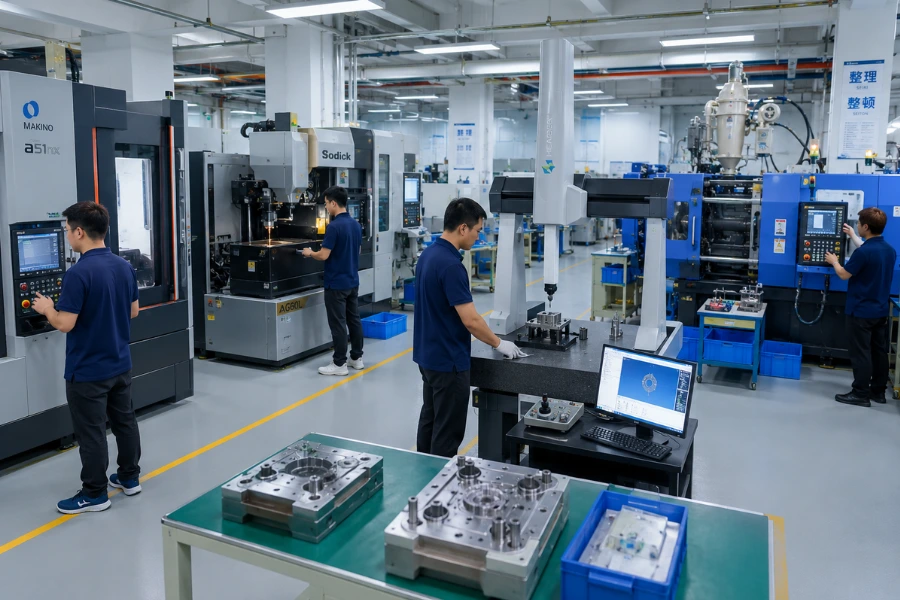
The document review stage establishes the foundation of supplier qualification. Before scheduling an on-site audit or releasing engineering drawings, medical device manufacturers should verify whether a supplier has the legal, technical, and quality infrastructure necessary to support regulated manufacturing. Completing this work early allows procurement and quality teams to eliminate unsuitable suppliers before investing time in factory assessments or tooling discussions.
An effective document review is not simply about collecting certificates. It is about determining whether the supplier can provide objective evidence that its manufacturing system is stable, traceable, and capable of supporting medical production throughout the product lifecycle. This stage should verify company legitimacy, regulatory compliance, technical documentation, and overall quality system readiness before proceeding to the next phase.
Verify Business Legitimacy and Manufacturing Capability
The first step is confirming that the supplier is genuinely capable of performing the manufacturing activities it claims.
Basic company information—including business registration, factory location, manufacturing scope, and organizational structure—should be verified before technical discussions begin. Procurement teams should also determine whether they are dealing directly with the manufacturer or with a trading company coordinating production through subcontractors.
For medical injection molding projects, this distinction is particularly important. Trading companies may provide excellent commercial support, but they usually have limited control over tooling maintenance, process validation, engineering changes, or production scheduling. If multiple subcontractors participate in manufacturing, traceability and regulatory oversight become more difficult to maintain.
Useful verification documents include:
- Business license and manufacturing registration
- Factory address and production locations
- Organization chart and key technical contacts
- Medical manufacturing experience
- Customer references for comparable projects
- Years of operation and production capacity
When possible, compare the company’s documented capabilities with publicly available information and customer references. Consistency across multiple sources generally provides greater confidence than relying solely on marketing materials.
Engineering Insight
Medical device projects often require engineering collaboration throughout development rather than only during production. Identifying the supplier’s engineering team, quality manager, and project management structure during early discussions provides valuable insight into how efficiently technical issues will be resolved later.
A supplier that introduces engineering personnel during early discussions usually demonstrates stronger cross-functional collaboration than one where all communication passes exclusively through sales representatives.
Review Quality Certifications and Regulatory Compliance
After confirming business legitimacy, the next step is evaluating whether the supplier operates under an appropriate quality management system.
Common certifications include:
- ISO 9001
- ISO 13485
- ISO 14001
- FDA registration (where applicable)
- RoHS compliance
- REACH compliance
Medical projects frequently require ISO 13485 because it establishes requirements for supplier control, traceability, document management, risk management, and continual improvement. However, procurement teams should verify that certificates remain valid, cover the correct manufacturing scope, and have been issued by recognized certification bodies rather than assuming every certificate carries the same level of credibility.
It is equally important to understand how certifications are applied in daily operations. During later audit stages, documented procedures should correspond with actual production practices, calibration records, inspection activities, and engineering change management.
Trade-off
ISO 13485 certification significantly strengthens supplier confidence, but it should never replace technical qualification.
Some suppliers maintain excellent documentation while lacking mature process validation or engineering support. Others possess outstanding manufacturing capability but have less experience preparing regulatory documentation for medical OEM customers.
Effective supplier qualification evaluates both management systems and manufacturing execution.
Assess Material Traceability and Technical Documentation
Material traceability represents one of the defining characteristics of medical manufacturing.
Every production lot should be traceable from incoming raw material through molding, inspection, packaging, and shipment. During document review, suppliers should demonstrate how they manage material identification, batch records, and production history.
Typical documentation includes:
- Material Certificates of Analysis (COA)
- Resin lot traceability records
- Incoming inspection reports
- Calibration certificates
- Mold maintenance records
- First Article Inspection reports
- Previous mold trial reports
- Dimensional inspection reports
- Process validation documentation where applicable
Well-organized technical documentation generally reflects mature manufacturing discipline. Suppliers capable of rapidly retrieving historical records often maintain stronger process control than organizations relying on manually reconstructed documentation.
Medical projects frequently involve specialized engineering polymers, so reviewing the supplier’s medical material selection capability is equally important. The supplier should be able to explain why a particular material is selected, how it is validated, and how lot traceability is maintained throughout production.
Engineering Insight
Documentation quality often mirrors manufacturing discipline.
Suppliers capable of producing comprehensive mold trial reports, structured dimensional studies, and complete traceability records usually maintain more standardized engineering processes than suppliers that prepare documentation only when requested by customers.
For this reason, document review should evaluate both what documents exist and how consistently those documents are generated and maintained.
Evaluate Risk Before Moving to the Factory Audit
Not every supplier requires the same qualification effort.
After completing document review, procurement and quality teams should perform an initial risk assessment to determine the appropriate level of oversight during subsequent qualification stages.
Factors commonly considered include:
- Whether the component affects patient safety
- Material criticality
- Manufacturing complexity
- Regulatory requirements
- Supplier experience with medical devices
- Previous supplier performance
- Geographic and supply chain risks
Suppliers providing critical molded components, implant-related parts, or products requiring validated manufacturing generally warrant more comprehensive factory audits and ongoing monitoring than suppliers providing non-critical accessories or indirect materials. A risk-based qualification approach allows organizations to focus resources where supplier performance has the greatest potential impact on product quality and regulatory compliance.
Procurement Decision Tip
Before approving an on-site audit, confirm that the supplier can provide recent examples of:
- Medical project documentation
- Mold trial reports
- Material traceability records
- Calibration certificates
- Process validation evidence
- Engineering change procedures
If these documents cannot be produced during the document review stage, the supplier may require substantially deeper evaluation before progressing to tooling development or production approval.
Stage 2 – Conduct an On-Site Technical Assessment
Document review determines whether a supplier appears qualified on paper. An on-site technical assessment verifies whether those documented systems are actually implemented on the production floor.
This distinction is particularly important for medical injection molding. A supplier may maintain complete procedures, quality manuals, and certification records, yet still struggle with process consistency because of outdated equipment, inadequate preventive maintenance, weak engineering support, or poor production discipline. Factory audits bridge this gap by evaluating how manufacturing systems perform under real operating conditions.
Rather than inspecting every aspect of a facility equally, experienced supplier quality engineers focus on the manufacturing factors that directly influence medical product quality, process validation, and long-term production stability.
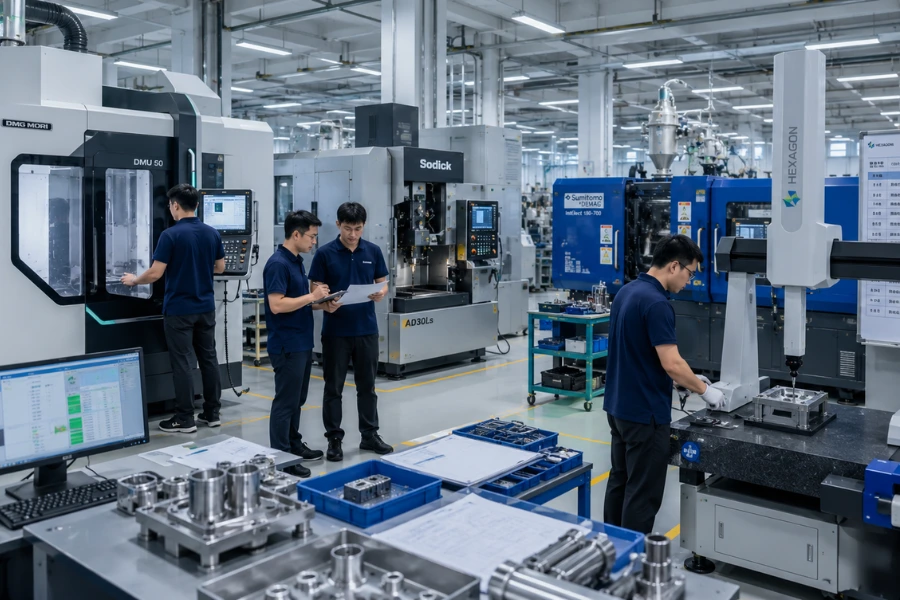
Assess Manufacturing Equipment and Production Capability
Injection molding machines are only one part of a medical manufacturing system. Equally important are the supporting resources that allow molds to be built, maintained, measured, and continuously improved.
During an audit, evaluate whether the supplier possesses equipment capable of supporting the precision required for medical components, including:
- CNC machining centers
- EDM equipment
- Wire-cut EDM
- CMM inspection systems
- Injection molding machines
- Drying systems
- Material handling systems
- Preventive maintenance programs
- Equipment calibration records
Instead of simply counting machines, assess whether equipment selection matches the complexity of the proposed project.
For highly complex products such as micro injection molding components, manufacturing capability should include ultra-precision tooling, micro-feature inspection, and highly stable process control rather than only larger production capacity.
Production planning should also be reviewed.
Questions worth asking include:
- How is machine utilization managed?
- How are preventive maintenance schedules controlled?
- What contingency plans exist if critical equipment fails?
- Can production capacity expand without affecting validated processes?
Engineering Insight
Production capacity should never be evaluated independently from process stability.
A factory operating hundreds of injection molding machines may still struggle with engineering change implementation or validation consistency if equipment maintenance, process control, and documentation are poorly managed. Conversely, a medium-sized supplier with disciplined production systems may deliver significantly better long-term quality performance.
Verify Mold Manufacturing Capability and Tooling Standards
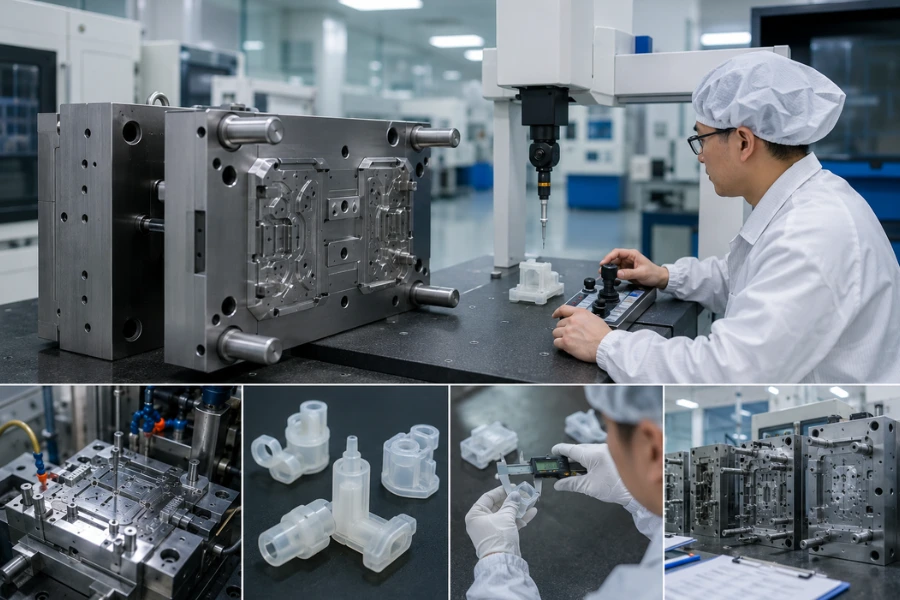
For medical injection molding, tooling capability deserves separate evaluation because mold quality directly influences dimensional stability, cycle consistency, cosmetic appearance, and validation repeatability.
Factory audits should review:
- Internal mold design capability
- Mold manufacturing processes
- Mold assembly procedures
- Mold maintenance programs
- Spare component management
- Tool life planning
- Preventive maintenance schedules
A capable supplier should also demonstrate professional mold making expertise supported by structured DFM reviews and optimized tooling layouts before machining begins. Reviewing previous free mold tool design reports is an excellent way to evaluate the supplier’s engineering thinking rather than simply judging finished molds.
Common mold steels include:
| Mold Steel | Typical Application |
|---|---|
| P20 | Prototype and medium-volume production |
| 718H | Improved wear resistance and polished surfaces |
| H13 | High-volume production and demanding molding conditions |
| S136 | Corrosion-resistant molds for medical and optical applications |
Where material authenticity is critical, some manufacturers verify mold steel using X-ray fluorescence (XRF) testing before machining begins, reducing the risk of material substitution.
The audit should also examine whether mold documentation includes:
- Steel certificates
- Heat treatment records
- Mold drawings
- Cooling layout
- Maintenance history
- Engineering revision control
The audit should also examine whether mold documentation includes:
- Steel certificates
- Heat treatment records
- Mold drawings
- Cooling layout
- Maintenance history
- Engineering revision control
These records become increasingly valuable during mold transfers, engineering modifications, or long-term production programs.
Trade-off
Selecting the highest-grade mold steel does not automatically produce the best tooling solution.
For example, H13 offers excellent durability for high-volume production but may be unnecessary for early-stage prototype projects. Likewise, corrosion-resistant steels such as S136 provide advantages when processing aggressive resins or manufacturing high-polish medical components but also increase tooling cost.
The appropriate tooling material should be selected according to production volume, resin characteristics, regulatory requirements, and expected mold life—not simply by choosing the most expensive option.
Evaluate How the Quality Management System Operates
After reviewing documentation during Stage 1, the factory audit should confirm whether quality procedures are consistently followed throughout production.
Areas to evaluate include:
- Incoming material inspection
- Production documentation
- Batch traceability
- Nonconforming product control
- Corrective and Preventive Action (CAPA)
- Engineering change management
- Internal audit activities
- Employee training records
- Calibration management
- Document revision control
Rather than asking whether procedures exist, auditors should verify whether operators understand them and whether records demonstrate consistent implementation.
For example, if a work instruction specifies first-piece inspection, observe whether operators actually perform and document the inspection before production begins. Small inconsistencies between documented procedures and shop-floor execution often reveal weaknesses that are difficult to identify during document review alone.
Medical manufacturers also benefit from evaluating how suppliers manage deviations. Strong organizations investigate root causes, implement preventive measures, and verify effectiveness instead of repeatedly correcting identical problems.
Engineering Insight
A mature Quality Management System is characterized by consistency rather than paperwork.
Well-qualified suppliers typically demonstrate the same process discipline during customer visits as they do during routine production. If documentation appears exceptionally organized only during scheduled audits, additional verification may be warranted.
Assess Process Capability and Production Stability
Ultimately, supplier qualification should confirm that manufacturing processes are capable of producing consistent results over time.
Process capability assessment commonly includes:
- Statistical Process Control (SPC)
- Process Capability Index (Cpk)
- First-pass yield
- Scrap rate
- Overall Equipment Effectiveness (OEE)
- Process parameter monitoring
- Preventive maintenance effectiveness
For critical medical dimensions, suppliers should be able to provide historical capability data demonstrating that validated processes remain within specification.
Stable processes reduce the need for extensive inspection because quality is built into manufacturing rather than relying solely on end-of-line verification.
When reviewing capability studies, consider whether:
- Sample sizes are representative
- Measurements are repeatable
- Control charts remain stable over time
- Corrective actions are documented when capability declines
Suppliers with mature statistical process control generally identify variation before it develops into customer complaints.
Procurement Decision Tip
During factory audits, ask suppliers to present capability studies from production parts similar to your project—not demonstration samples prepared specifically for the audit.
Historical Cpk reports, process control charts, and production yield data often provide a more realistic picture of long-term manufacturing performance than isolated sample inspections.
Evaluate Engineering Communication and Project Support
Technical capability alone is not sufficient for successful medical OEM projects. Effective communication between customer and supplier frequently determines how quickly engineering issues are resolved and how efficiently projects progress from design to commercial production.
Areas to assess include:
- Engineering response time
- DFM review capability
- Mold flow analysis support
- Design change management
- Root cause investigation
- Corrective action implementation
- English communication for international projects
- Cross-functional collaboration between engineering, quality, and production
Medical projects commonly involve design revisions, validation updates, material substitutions, or regulatory documentation requests. Suppliers that communicate clearly and respond proactively generally reduce project delays and improve engineering efficiency.
A supplier capable of supporting complete secondary operations—including machining, assembly, inspection, marking, bonding, and finishing—can often simplify supplier management and reduce quality risks caused by transferring semi-finished components between multiple vendors.
Engineering Insight
Many supplier-related delays are caused not by manufacturing limitations, but by communication failures.
A supplier that proactively performs DFM reviews, identifies molding risks early, and recommends design improvements often prevents weeks of tooling modifications later. Engineering transparency is therefore a valuable qualification criterion alongside manufacturing capability.
Likewise, engineering teams capable of supporting CNC plastic machining for prototype refinement or precision secondary processing can accelerate design iterations before mass production begins.
Trade-off
The supplier with the fastest quotation response is not necessarily the supplier with the strongest engineering support.
Medical OEM programs typically benefit more from suppliers that ask detailed technical questions, challenge manufacturability assumptions, and participate in design optimization than from suppliers that simply promise the shortest lead time.
Instead of measuring responsiveness only by quotation speed, evaluate how thoroughly the supplier reviews drawings, identifies risks, proposes improvements, and supports engineering decisions throughout the product development process.
Stage 3 – Validate Through Mold Trials and First Article Inspection
Once documentation has been reviewed and the factory audit is complete, supplier qualification moves into the validation stage. This is where engineering assumptions are tested under real production conditions. For medical injection molding projects, mold trials and First Article Inspection (FAI) provide objective evidence that the supplier can manufacture parts consistently—not just produce acceptable samples.
A successful validation program should confirm that tooling, materials, processing parameters, and inspection methods work together as an integrated manufacturing system.
Conduct Structured Mold Trials
Medical molds are typically validated through multiple trial stages such as T1, T2, and T3.
Although terminology varies between manufacturers, the objective remains consistent:
| Trial Stage | Primary Objective |
|---|---|
| T1 | Verify mold function, filling behavior, cooling performance, and major dimensional issues |
| T2 | Optimize process parameters, improve dimensional stability, and resolve engineering changes |
| T3 | Demonstrate production readiness and confirm repeatable manufacturing capability |
Rather than focusing only on dimensional compliance, engineering teams should evaluate:
- Filling balance
- Flash
- Short shots
- Sink marks
- Warpage
- Gate performance
- Cooling efficiency
- Cycle time consistency
- Cosmetic appearance
- Mold repeatability
Comprehensive mold trial reports should document process parameters, material batches, inspection results, corrective actions, and engineering decisions made during each validation stage.
Engineering Insight
Passing a single mold trial does not prove manufacturing capability.
Supplier qualification should confirm that acceptable parts can be produced repeatedly under validated process windows rather than only under carefully adjusted demonstration conditions.
Stable production is built on repeatability—not isolated success.
Perform First Article Inspection (FAI)
Following successful mold optimization, the supplier should complete a comprehensive First Article Inspection.
FAI verifies that molded components conform to engineering drawings, customer specifications, and regulatory requirements before production approval.
Typical inspection items include:
- Critical dimensions
- GD&T requirements
- Surface finish
- Cosmetic appearance
- Material verification
- Weight
- Assembly fit
- Functional characteristics
Inspection should normally be performed using calibrated equipment such as CMM systems, optical measurement equipment, gauges, and functional fixtures where appropriate.
For products requiring medical device assembly, FAI should also verify assembly compatibility, component interfaces, and functional performance to ensure downstream manufacturing proceeds smoothly.
Trade-off
FAI confirms that sampled parts satisfy engineering drawings.
It does not automatically demonstrate that the production process is statistically stable.
Process validation, capability studies, and ongoing production monitoring remain essential even after First Article approval.
Verify Material Traceability and Production Documentation
During validation, traceability should be demonstrated throughout the complete manufacturing process.
Suppliers should be capable of linking:
- Resin lot numbers
- Drying records
- Machine parameters
- Mold identification
- Operator information
- Inspection reports
- Packaging records
- Shipment documentation
Medical OEMs frequently request complete Device History Record (DHR) support or equivalent manufacturing documentation. Suppliers with disciplined traceability systems simplify regulatory audits while reducing investigation time should quality issues occur.
If the finished product includes sterile barrier systems or customer-ready packaging, suppliers should also demonstrate controlled medical device packaging processes with documented inspection and traceability records.
Evaluate Process Capability Before Production Release
Before approving mass production, suppliers should demonstrate that validated manufacturing processes consistently achieve required quality levels.
Common evidence includes:
- Cpk studies
- Process validation reports
- SPC charts
- Process window documentation
- Control plans
- Measurement System Analysis (MSA)
Rather than reviewing only the latest reports, procurement teams should evaluate historical trends.
Consistently stable capability over multiple production runs generally provides stronger confidence than isolated high Cpk values obtained under ideal conditions.
Procurement Decision Tip
Request evidence showing how the supplier responded when validation identified problems.
Corrective action history often reveals more about engineering capability than perfect validation reports because it demonstrates how effectively the supplier investigates root causes, implements improvements, and prevents recurrence.
Stage 4 – Monitor Supplier Performance After Approval
Supplier qualification should not end when production begins.
Medical manufacturing environments evolve continuously. Personnel change, molds require maintenance, production volumes increase, materials change, equipment is upgraded, and customer requirements develop over time. Without continuous monitoring, even highly qualified suppliers may gradually experience declining performance.
Ongoing supplier management therefore becomes an extension of supplier qualification rather than a separate quality activity.
Establish Supplier Performance Metrics
Performance should be evaluated using measurable indicators rather than subjective impressions.
Typical supplier scorecards include:
- Product quality
- On-time delivery
- Customer complaints
- CAPA effectiveness
- Process capability
- Documentation accuracy
- Responsiveness
- Engineering support
- Audit findings
Trend analysis is generally more valuable than isolated monthly results because long-term patterns provide earlier warning of emerging risks.
Engineering Insight
The objective is not identifying occasional defects.
The objective is identifying deteriorating manufacturing trends before they affect customer production or regulatory compliance.
Suppliers capable of detecting process variation early usually experience fewer major quality incidents over the lifetime of a medical program.
Review Corrective Actions and Continuous Improvement
Supplier qualification should include periodic review of:
- Supplier Corrective Action Requests (SCAR)
- Root cause investigations
- CAPA implementation
- Verification of effectiveness
- Engineering change history
- Customer complaint trends
Well-managed suppliers treat quality issues as opportunities for process improvement rather than isolated production problems.
Trade-off
Zero customer complaints do not necessarily indicate outstanding supplier performance.
Sometimes they simply reflect limited production volume.
Conversely, suppliers producing millions of medical components annually may occasionally experience quality issues while maintaining excellent engineering discipline and exceptionally effective corrective action systems.
The speed and effectiveness of problem resolution often provide a better indicator of long-term supplier reliability than complaint counts alone.
Perform Periodic Requalification
Supplier approval should be periodically reassessed, particularly after:
- Significant engineering changes
- Mold transfers
- New production lines
- Facility expansion
- Material changes
- Regulatory inspections
- Repeated quality issues
Periodic audits help ensure that validated processes remain effective throughout the product lifecycle.
Procurement Decision Tip
Requalification should focus on changes that may influence validated manufacturing processes rather than repeating every element of the original supplier audit.
Common Supplier Qualification Mistakes
Many supplier qualification failures result from incomplete evaluation rather than poor supplier performance.
Common mistakes include:
- Selecting suppliers based primarily on price.
- Assuming ISO certification guarantees manufacturing capability.
- Skipping on-site engineering audits.
- Evaluating samples without validating production processes.
- Ignoring engineering communication quality.
- Overlooking traceability and change management.
- Failing to monitor supplier performance after approval.
Avoiding these mistakes significantly reduces long-term quality and regulatory risks.
Medical Injection Molding Supplier Qualification Checklist
| Qualification Area | Verification Status |
|---|---|
| Business legitimacy verified | □ |
| ISO 13485 documentation reviewed | □ |
| Factory audit completed | □ |
| Manufacturing equipment evaluated | □ |
| Mold manufacturing capability verified | □ |
| Material traceability confirmed | □ |
| Mold trials completed | □ |
| First Article Inspection approved | □ |
| Process capability demonstrated | □ |
| CAPA system evaluated | □ |
| Supplier performance metrics established | □ |
| Periodic requalification planned | □ |
Why Partner with SeaSkyMedical?
Successful supplier qualification extends beyond passing an audit. The right manufacturing partner should provide engineering expertise that helps reduce development risk from the earliest design stage through full-scale production.
SeaSkyMedical supports customers with integrated medical device contract manufacturing solutions, combining medical injection molding, professional mold making, DFM-driven free mold tool design, secondary operations, medical device assembly, controlled medical device packaging, and complete OEM medical components manufacturing support.
From early product development and DFM optimization to mold validation, process qualification, cleanroom production, assembly, and packaging, our engineering teams work closely with customers to establish robust manufacturing processes that support regulatory compliance, consistent product quality, and long-term supply stability.
Conclusion
Supplier qualification is far more than a purchasing requirement. It is a systematic engineering process that verifies whether a manufacturer can consistently produce compliant medical components throughout the entire product lifecycle.
A comprehensive qualification program should combine documentation review, technical audits, mold validation, First Article Inspection, process capability assessment, traceability verification, and continuous supplier monitoring. Together, these activities reduce technical uncertainty before production begins and help prevent costly quality issues after commercialization.
For medical OEMs, selecting the right supplier is not simply about finding a factory with modern equipment or internationally recognized certifications. It is about choosing an engineering partner capable of delivering validated manufacturing processes, transparent communication, disciplined quality management, and continuous improvement over years of production.
Organizations that invest in thorough supplier qualification typically experience fewer validation delays, stronger regulatory readiness, improved manufacturing consistency, and more resilient supply chains—making supplier qualification one of the highest-value activities in any medical injection molding project.