Introduction
Medical device manufacturers often select polypropylene (PP) because it provides a balanced combination of lightweight construction, chemical resistance, sterilization compatibility, and cost-efficient production.
However, choosing polypropylene for a medical component is not only a material selection decision. Successful medical PP components require coordination between resin selection, product design, mold engineering, injection molding parameters, and quality control processes.
Unlike general industrial plastic parts, medical components usually require tighter control of dimensional accuracy, cleanliness, repeatability, and long-term reliability. Polypropylene provides many advantages for healthcare applications, but its semi-crystalline structure and relatively high shrinkage behavior also create specific manufacturing challenges.
For medical OEMs, understanding how polypropylene behaves during injection molding helps reduce development risks and improve production consistency. A complete manufacturing strategy, such as medical device contract manufacturing, integrates material evaluation, tooling development, molding processes, and quality management to support reliable medical product production.
What Is Medical Grade Polypropylene (PP)?
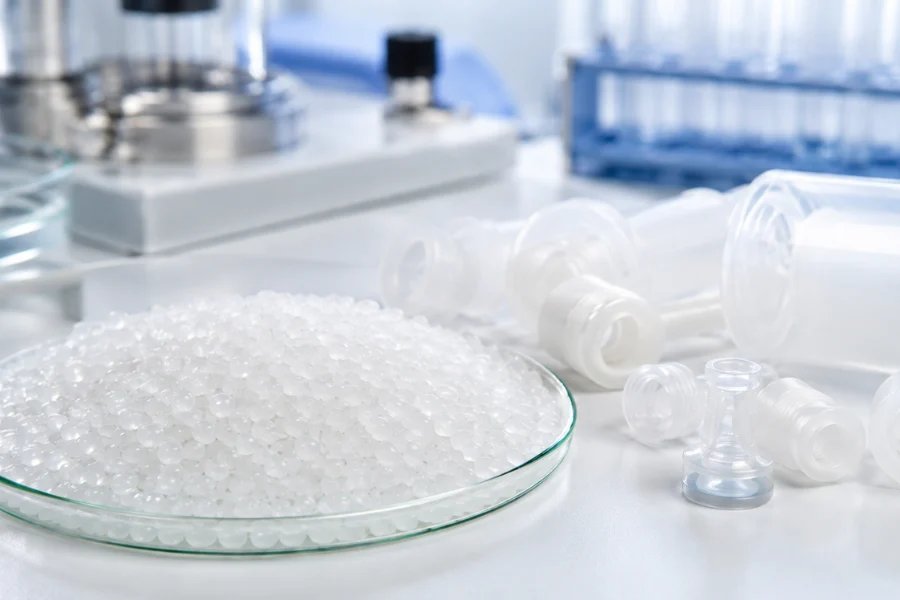
Medical grade polypropylene is a polypropylene-based thermoplastic material selected for healthcare applications where controlled performance, reliability, and manufacturing consistency are required.
Polypropylene belongs to the polyolefin family and is produced through the polymerization of propylene monomers. Compared with polyethylene, PP provides improved tensile strength, hardness, elasticity, and resistance to repeated bending.
One of the most important characteristics of polypropylene is its lightweight structure.
The density of polypropylene is approximately 0.90–0.91 g/cm³, making it one of the lightest commonly used thermoplastic materials.
For medical manufacturing, this low density provides several advantages:
- Reduced component weight
- Efficient material consumption
- Improved handling of disposable products
- Cost advantages for high-volume production
However, medical grade polypropylene is not defined only by the polymer itself. Engineers must evaluate the complete material performance, including:
- Resin formulation
- Additives
- Sterilization compatibility
- Chemical resistance
- Mechanical requirements
- Manufacturing repeatability
Selecting the appropriate polymer is usually part of a structured medical plastic material selection process, where engineers compare material properties against application requirements.
The final PP grade selection depends on the intended medical application, product lifecycle, and manufacturing conditions.
Key Properties of Medical Grade Polypropylene
Lightweight Structure and Low Moisture Absorption
Polypropylene has very low moisture absorption compared with many engineering plastics.
Because PP does not readily absorb water, its physical and electrical properties remain relatively stable in humid environments.
This characteristic is valuable for medical applications involving:
- Fluid contact
- Pharmaceutical solutions
- Laboratory environments
- Cleaning processes
The lightweight nature of PP also makes it suitable for disposable healthcare products where reducing material usage and maintaining production efficiency are important.
For high-volume medical components, the combination of low density and injection molding efficiency provides manufacturers with a practical solution for scalable production.
Mechanical Performance and Flexural Fatigue Resistance
Polypropylene provides a useful balance between flexibility and mechanical durability.
According to material references, PP offers better mechanical properties than polyethylene in areas including:
- Yield strength
- Tensile strength
- Compression strength
- Hardness
- Elasticity
One of the most valuable characteristics of polypropylene is its excellent resistance to repeated bending fatigue.
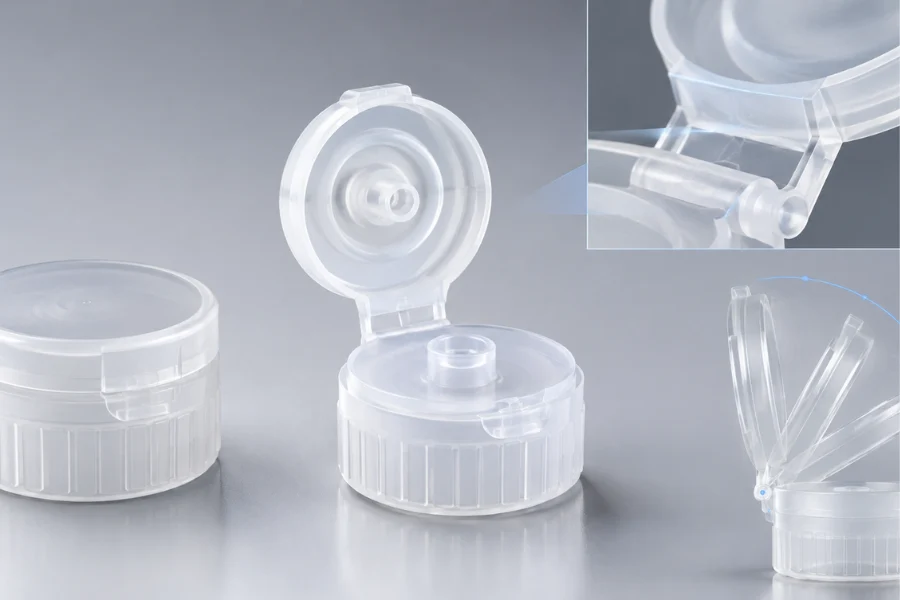
This property allows PP to be used for living hinge designs, where the hinge and main body are produced as a single molded component.
Material references indicate that injection molded polypropylene hinges can achieve extremely high cycle durability, with examples reaching approximately 70 million opening and closing cycles without failure under specific test conditions.
For medical products, this fatigue resistance supports designs such as:
- Hinged caps
- Integrated closures
- Reusable containers
- Flexible connection features
However, living hinge performance depends on several engineering factors, including:
- Hinge geometry
- Material orientation
- Gate location
- Residual stress
- Processing conditions
Therefore, early product development and DFM evaluation are important before production tooling begins.
Heat Resistance and Sterilization Compatibility
Polypropylene has a melting point of approximately 164–170°C, providing good heat resistance compared with many commodity plastics.
This thermal performance allows selected medical PP grades to be considered for components exposed to elevated temperatures, including certain sterilization processes.
Medical polypropylene components may be used in products requiring:
- Heat resistance
- Steam exposure resistance
- Chemical cleaning compatibility
However, melting point alone does not determine sterilization suitability.
Engineers must evaluate:
- Resin grade
- Additive package
- Sterilization method
- Exposure duration
- Mechanical property retention after repeated cycles
A PP material suitable for one healthcare application may not provide identical performance under different environmental conditions.
Chemical Resistance and Electrical Insulation
Polypropylene provides strong resistance to many chemical substances.
It can maintain performance when exposed to:
- Acids
- Alkalis
- Cleaning chemicals
- Medical fluids
This chemical stability makes PP suitable for many medical containers and fluid-handling components.
PP also provides good electrical insulation because its electrical properties are less affected by humidity due to its low moisture absorption.
For medical device housings and protective components, these characteristics provide a practical balance between functional performance and manufacturing efficiency.
Limitations of Polypropylene in Medical Applications
Although polypropylene offers many advantages, it is not suitable for every medical application.
One limitation is its sensitivity to oxidation, heat, and light exposure. Without appropriate stabilizers, PP may experience aging and degradation over time.
Polypropylene also provides lower stiffness compared with high-performance engineering plastics such as polycarbonate and PEEK.
For applications requiring:
- High structural rigidity
- Extreme temperature resistance
- Long-term mechanical loading
engineers may need to evaluate alternative materials.
The best material choice depends on balancing:
- Performance requirements
- Manufacturing feasibility
- Product lifecycle
- Cost considerations
Understanding these trade-offs is an important part of developing reliable medical plastic components.
Medical Applications of Polypropylene Components and Engineering Considerations
Polypropylene is widely used in medical injection molding because it provides a practical balance between material performance, manufacturing efficiency, and cost control.
Unlike high-performance polymers designed for extreme environments, PP is typically selected for medical applications where manufacturers need:
- Reliable mass production
- Chemical resistance
- Lightweight construction
- Sterilization compatibility
- Stable injection molding performance
The final material decision depends not only on PP properties but also on the functional requirements of the medical component.
A reliable production process often requires support from experienced OEM medical components manufacturers that understand material behavior, tooling requirements, and medical manufacturing expectations.
Medical PP Injection Molding Applications
Syringe Components
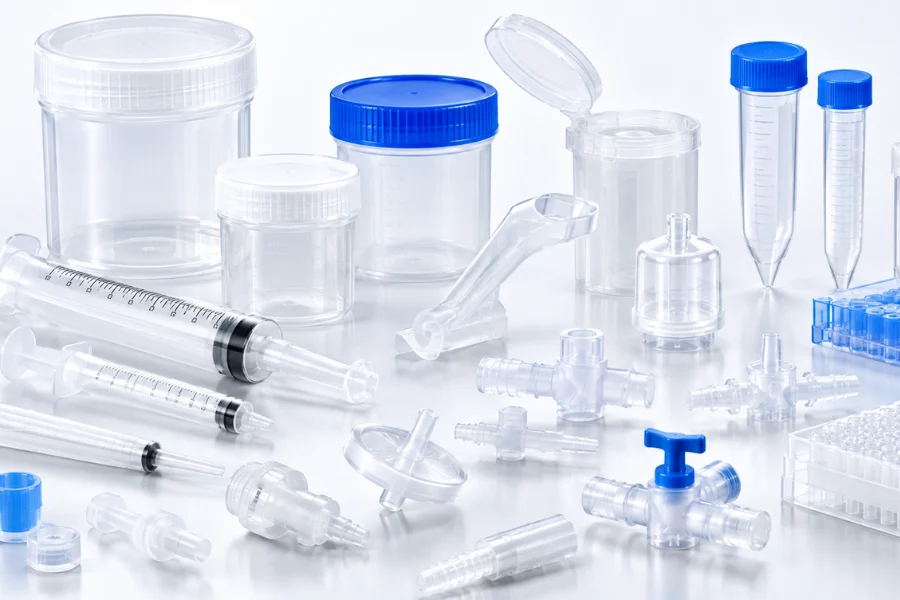
Disposable syringes are one of the most common medical applications for polypropylene.
PP is suitable for syringe-related components because it provides:
- Lightweight structure
- Good chemical resistance
- Low moisture absorption
- Efficient high-volume injection molding capability
During syringe production, dimensional consistency is critical because small variations may affect:
- Component assembly
- Plunger movement
- Sealing performance
- Product reliability
For syringe components, engineers typically evaluate:
- Shrinkage control
- Surface quality
- Gate location
- Mold filling balance
- Production repeatability
Because polypropylene has a shrinkage range of approximately 1.0–2.5%, tooling compensation and process optimization are important during mold development.
Medical Containers and Storage Components
Polypropylene is commonly used for medical containers because of its chemical stability and resistance to moisture absorption.
Applications may include:
- Specimen containers
- Laboratory containers
- Pharmaceutical containers
- Storage components
For these products, material performance must be evaluated against the intended operating environment.
Important considerations include:
- Chemical compatibility
- Sterilization exposure
- Dimensional stability
- Closure performance
For example, container caps often require precise fit and reliable sealing. Excessive shrinkage or warpage can affect assembly accuracy and product performance.
For projects requiring complex tooling and high production consistency, medical manufacturers often combine material expertise with professional medical mold making capabilities to achieve stable part quality.
Fluid Handling Components
Medical fluid systems often require plastics that can maintain stable performance when exposed to liquids.
Polypropylene can be considered for:
- Fluid connectors
- Tubing-related components
- Disposable fluid management parts
The advantages of PP in these applications include:
- Chemical resistance
- Low moisture absorption
- Lightweight design
However, fluid-related components often have strict dimensional requirements.
Manufacturing teams must carefully control:
- Mold temperature
- Cooling balance
- Holding pressure
- Part tolerances
because dimensional variation may influence connection performance or sealing reliability.
For precision medical plastic components, injection molding process development may include detailed medical plastic injection molding evaluations covering material behavior, mold design, and production parameters.
Laboratory and Diagnostic Components
Polypropylene is also used in laboratory products because it combines chemical resistance with injection molding efficiency.
Typical applications may include:
- Laboratory containers
- Sample handling products
- Disposable testing components
For laboratory applications, consistency between production batches is particularly important.
A stable molding process helps maintain:
- Product dimensions
- Surface quality
- Functional performance
This is especially important for medical products manufactured at scale, where small variations can affect assembly, packaging, or downstream use.
PP Homopolymer vs Copolymer for Medical Applications
Selecting the correct polypropylene grade is an important step during medical product development.
Different PP structures provide different combinations of stiffness, toughness, impact resistance, and processing characteristics.
| Material Type | Characteristics | Suitable Considerations |
|---|---|---|
| PP Homopolymer | Higher stiffness, strength, and hardness | Rigid medical components requiring structural stability |
| PP Copolymer | Improved toughness and impact resistance | Components requiring better flexibility and impact performance |
PP Homopolymer
Homopolymer polypropylene generally provides higher stiffness and mechanical strength.
It is often considered when the component requires:
- Higher rigidity
- Good chemical resistance
- Structural stability
Potential applications include:
- Rigid medical containers
- Structural plastic components
- Parts requiring dimensional stability
However, engineers should also consider impact requirements because higher stiffness may reduce toughness under certain conditions.
For components exposed to repeated handling or mechanical impact, copolymer grades may provide advantages.
PP Copolymer
Copolymer polypropylene is modified to improve toughness and impact resistance.
Compared with homopolymer PP, copolymer grades typically provide:
- Better impact performance
- Improved resistance to cracking
- Better low-temperature behavior
This makes copolymer PP suitable for components where durability during handling and transportation is important.
The final selection between homopolymer and copolymer should consider:
- Mechanical loading
- Temperature conditions
- Sterilization requirements
- Injection molding behavior
- Product lifecycle
How PP Crystallization Influences Medical Part Quality
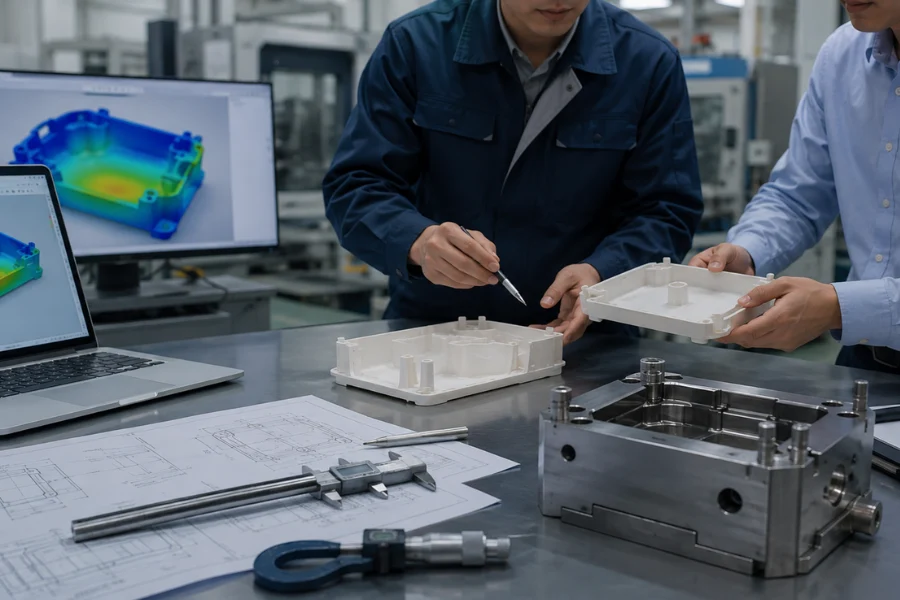
One of the most important engineering characteristics of polypropylene is its semi-crystalline structure.
Unlike amorphous plastics such as polycarbonate, polypropylene undergoes crystallization during cooling after injection molding.
This crystallization process directly influences:
- Shrinkage
- Stiffness
- Warpage
- Dimensional stability
During molding, molten PP fills the cavity and begins cooling.
As polymer chains organize into crystalline regions, the material contracts.
The cooling rate and temperature distribution inside the mold affect how much crystallization occurs and how evenly it develops.
Cooling Rate and Dimensional Stability
Cooling conditions have a significant impact on final part performance.
Rapid and uneven cooling may create differences in crystallization throughout the component.
This can lead to:
- Uneven shrinkage
- Internal stress
- Warpage
- Dimensional variation
For medical components requiring accurate assembly or sealing performance, controlling cooling behavior is essential.
This is why PP injection molding requires carefully designed cooling channels and balanced thermal management.
Relationship Between Crystallization and Shrinkage
Because polypropylene is semi-crystalline, it generally has higher shrinkage compared with many amorphous engineering plastics.
The typical shrinkage range of PP is:
1.0–2.5%
Compared with:
| Material | Typical Shrinkage |
|---|---|
| PP | 1.0–2.5% |
| Glass-filled PP | 0.4–0.8% |
| ABS | 0.3–0.8% |
| PC | 0.5–0.8% |
For medical components requiring tight dimensional control, engineers need to consider:
- Material grade
- Mold compensation
- Cooling system design
- Holding pressure
- Processing window
Medical PP Material Selection Workflow
Choosing medical grade polypropylene should follow a structured engineering evaluation rather than selecting material based only on general properties.
A typical decision process includes:
Step 1: Define Application Requirements
Engineers first evaluate:
- Product function
- Disposable or reusable use
- Mechanical loading
- Contact environment
For example, a syringe component, container closure, and fluid connector may all use PP but require different performance priorities.
Step 2: Evaluate Sterilization Requirements
The selected PP grade should match the intended sterilization process.
Considerations include:
- Temperature exposure
- Chemical exposure
- Number of sterilization cycles
- Property retention after sterilization
Step 3: Review Mechanical Requirements
Material selection should consider:
- Stiffness
- Impact resistance
- Fatigue performance
- Flexibility requirements
A rigid medical container may prioritize stiffness, while a hinged closure may prioritize fatigue resistance.
Step 4: Evaluate Injection Molding Performance
Engineers should review:
- Shrinkage behavior
- Flow characteristics
- Cooling requirements
- Mold design complexity
A material that performs well in laboratory testing may still create manufacturing challenges if the molding process is not properly controlled.
Step 5: Confirm Quality and Validation Requirements
Medical applications require consideration of:
- Material traceability
- Inspection requirements
- Process controls
- Validation strategy
A structured material selection process helps ensure that the selected PP grade supports both product performance and scalable commercial manufacturing.
Medical Polypropylene Injection Molding Process Optimization
Selecting the correct polypropylene grade is only the first step in producing reliable medical components.
In medical injection molding, final part quality depends on how effectively the material, mold design, and processing conditions work together. For polypropylene, this relationship is especially important because PP has semi-crystalline behavior and a relatively wide shrinkage range.
A stable molding process requires careful control of:
- Melt temperature
- Injection pressure
- Holding pressure
- Mold temperature
- Cooling performance
- Dimensional inspection
For medical applications, the objective is not simply increasing production speed. The priority is creating a repeatable molding window that maintains consistent quality throughout commercial manufacturing.
PP Injection Molding Parameters and Their Quality Impact
Polypropylene injection molding parameters directly influence filling behavior, crystallization, shrinkage, and final part performance.
The following ranges are commonly used as processing references:
| Parameter | Typical PP Range | Quality Impact |
|---|---|---|
| Nozzle temperature | 170–190°C | Influences melt flow and filling consistency |
| Barrel temperature | 150–220°C | Controls material melting and flow behavior |
| Mold temperature | 40–80°C | Affects surface quality, crystallization, and dimensional stability |
| Injection pressure | 70–100 MPa | Influences cavity filling and weld line formation |
| Holding pressure | 40–50 MPa | Helps compensate shrinkage during cooling |
| Cooling time | 15–50 seconds | Influences crystallization and final dimensions |
These values provide general processing guidance. Actual molding parameters depend on:
- Part geometry
- Wall thickness
- Mold structure
- Resin grade
- Required tolerances
- Production requirements
For medical components, process optimization focuses on maintaining repeatability rather than simply maximizing cycle speed.
Injection Pressure Control in Medical PP Molding
Injection pressure determines how effectively molten polypropylene fills the mold cavity.
Insufficient injection pressure may result in:
- Short shots
- Incomplete filling
- Increased weld lines
- Poor surface replication
Excessive injection pressure may increase:
- Internal stress
- Flash risk
- Material orientation effects
- Mold wear
For medical PP components, injection pressure should be optimized based on the relationship between material flow and part design.
During process development, engineers typically evaluate:
- Flow length
- Gate location
- Filling balance
- Pressure distribution
A balanced filling process helps reduce variation between production cycles.
Holding Pressure and Shrinkage Compensation
Holding pressure plays an important role in controlling polypropylene shrinkage.
After cavity filling, molten PP continues to cool and contract. Holding pressure allows additional material to enter the cavity during solidification, compensating for volume reduction.
Insufficient holding pressure may increase the risk of:
- Sink marks
- Internal voids
- Dimensional variation
However, excessive holding pressure may create:
- Higher residual stress
- Difficult ejection
- Longer cycle time
For medical components, holding pressure must be optimized together with:
- Gate design
- Cooling performance
- Wall thickness
- Material grade
This is especially important for components requiring precise assembly or sealing performance.
Mold Temperature Optimization
Mold temperature has a strong influence on polypropylene surface quality and crystallization behavior.
According to material references, the suitable mold temperature range for PP injection molding is approximately 40–80°C.
A mold temperature that is too low may cause:
- Poor surface gloss
- Increased weld line visibility
- Reduced surface replication quality
Material references indicate that mold temperatures below approximately 50°C may increase surface quality problems.
On the other hand, excessively high mold temperatures may increase:
- Cooling time
- Warpage risk
- Production cycle duration
The goal is to achieve a balanced thermal condition that supports:
- Stable crystallization
- Good surface appearance
- Dimensional consistency
Cooling System Design for Medical PP Components
Cooling design is one of the most important factors affecting polypropylene part quality.
Because PP has relatively high heat capacity, the mold must provide sufficient and uniform cooling performance.
An ineffective cooling system can lead to:
- Uneven crystallization
- Different shrinkage rates
- Warpage
- Dimensional instability
A well-designed cooling system considers:
- Cooling channel layout
- Distance between channels and cavity surface
- Heat transfer balance
- Part geometry
For medical components with strict dimensional requirements, cooling performance should be evaluated during mold development rather than adjusted only after production issues appear.
Professional medical plastic injection molding processes typically integrate material analysis, mold design, cooling optimization, and production validation to improve long-term consistency.
DFM Considerations for Medical PP Injection Molding
Design for Manufacturability (DFM) plays an important role in reducing production risks before tooling begins.
For polypropylene medical components, many molding challenges can be reduced during the design stage through proper evaluation of:
- Wall thickness
- Gate location
- Flow behavior
- Cooling strategy
- Dimensional requirements
A well-designed component reduces the likelihood of tooling modifications and production instability.
Wall Thickness Design
Uniform wall thickness helps create predictable filling and cooling behavior.
Uneven wall thickness can increase:
- Cooling differences
- Shrinkage variation
- Sink marks
- Warpage
For medical PP components, engineers need to balance:
- Structural requirements
- Material flow
- Cooling efficiency
- Product function
A consistent wall thickness design helps improve molding repeatability and dimensional control.
Gate Location and Flow Path Design
Gate design directly influences polypropylene filling behavior.
A poorly positioned gate may create:
- Uneven material flow
- Increased filling pressure
- Weld lines in critical areas
- Higher residual stress
During mold design, engineers evaluate:
- Melt flow direction
- Gate location
- Weld line position
- Filling sequence
For medical components, weld lines should ideally be positioned away from areas requiring:
- High mechanical strength
- Sealing performance
- Repeated loading resistance
Mold Flow Analysis Before Tooling
Simulation tools help predict potential molding challenges before production tooling begins.
Mold flow analysis can evaluate:
- Filling behavior
- Pressure distribution
- Cooling performance
- Weld line location
- Warpage tendency
For medical PP components, simulation reduces development risks by identifying potential issues before expensive tooling modifications are required.
This type of engineering review is often combined with free mold tool design support to evaluate manufacturability before mold production.
Medical PP Injection Molding Defects and Solutions
Medical components require a higher level of process control because defects may affect:
- Assembly performance
- Product reliability
- Functional accuracy
- Quality acceptance
Even defects that appear cosmetic in general plastic products may become significant concerns in medical applications.
Sink Marks and Internal Voids
Sink marks occur when localized areas of the molded part shrink more than surrounding regions during cooling.
Common Causes
- Thick wall sections
- Insufficient holding pressure
- Poor cooling efficiency
- High material shrinkage
Control Methods
Manufacturers can reduce sink marks through:
- More uniform wall thickness
- Improved cooling design
- Optimized holding pressure
- Better gate positioning
For medical parts requiring smooth surfaces or accurate assembly, sink mark prevention should be considered during the initial design stage.
Warpage and Deformation
Warpage occurs when different areas of the molded component shrink unevenly.
For polypropylene, warpage is strongly related to:
- Semi-crystalline behavior
- Cooling imbalance
- Material orientation
- Uneven wall thickness
Control Methods
Common approaches include:
- Balanced cooling channels
- Uniform part design
- Optimized mold temperature
- Improved filling balance
For precision medical components, preventing warpage during DFM review is usually more effective than correcting dimensional issues after production begins.
Weld Lines and Flow Defects
Weld lines occur when separate polymer flow fronts meet during cavity filling.
Although weld lines are common in injection molding, their location and strength must be carefully evaluated in medical applications.
Common Causes
- Low mold temperature
- Complex flow paths
- Multiple filling fronts
- Improper gate placement
Control Methods
Solutions include:
- Optimizing gate design
- Adjusting mold temperature
- Improving flow balance
- Using simulation during development
For medical products, weld line locations should be reviewed because they may influence mechanical performance in critical areas.
Dimensional Variation Control
Dimensional consistency is one of the most important requirements for medical PP injection molding.
Potential causes of dimensional variation include:
- Material shrinkage differences
- Cooling inconsistency
- Process fluctuations
- Resin variation
Control strategies include:
- Stable molding windows
- Process monitoring
- Dimensional inspection
- Material traceability
A controlled molding process helps ensure that medical components remain consistent during long-term commercial production.
Quality and Regulatory Considerations for Medical PP Components
For medical injection molded polypropylene components, material performance alone does not determine product success.
A reliable medical plastic component requires control across the complete manufacturing process, including:
- Material qualification
- Mold development
- Injection molding validation
- Dimensional inspection
- Traceability management
- Documentation control
Medical manufacturing requires repeatable processes because product performance depends not only on polymer characteristics but also on consistent production conditions.
For companies developing polypropylene medical parts, a complete manufacturing solution may include medical device contract manufacturing services that integrate material evaluation, tooling, molding, secondary operations, and quality management.
ISO 13485 and Medical PP Manufacturing Control
ISO 13485 provides a quality management framework commonly used in medical device manufacturing.
For polypropylene injection molded components, ISO 13485 is not only related to documentation. It also supports systematic control of manufacturing processes and product consistency.
Important areas include:
- Material traceability
- Process documentation
- Production record control
- Risk management
- Corrective and preventive actions
For medical PP components, manufacturers may need to control information such as:
- Resin batch records
- Injection molding parameters
- Mold maintenance history
- Inspection results
- Process validation records
These controls help ensure that production remains stable throughout the product lifecycle.
ISO 10993 and Medical PP Material Evaluation
For medical devices involving human contact, polypropylene materials may require biological evaluation according to ISO 10993.
The suitability of medical grade PP depends on multiple factors, including:
- Intended application
- Contact type
- Contact duration
- Resin formulation
- Additives
- Manufacturing conditions
The polymer name alone does not determine whether a material is suitable for a specific medical application.
For example, different polypropylene formulations may contain different additives or colorants, which can influence material evaluation requirements.
Therefore, medical PP selection should consider the complete application environment rather than only basic polymer properties.
Controlled Manufacturing Environment and Cleanliness Requirements
Some medical polypropylene injection molding projects require controlled manufacturing environments depending on product requirements.
Production controls may address:
- Airborne particles
- Material contamination
- Clean assembly practices
- Packaging conditions
For products requiring controlled cleanliness levels, cleanroom injection molding helps manufacturers manage contamination risks during production.
A reliable medical molding process combines:
- Suitable material selection
- Controlled injection molding
- Clean manufacturing practices
- Documented quality systems
PP Compared With Other Medical Plastics
Polypropylene is widely selected for medical applications because it provides a practical balance between performance, processability, and cost.
However, PP is not always the best choice for every medical component.
Engineers should compare material options based on:
- Mechanical requirements
- Temperature exposure
- Chemical environment
- Transparency needs
- Production volume
Polypropylene vs Polycarbonate (PC)
Polypropylene and polycarbonate are both used in medical manufacturing, but they provide different performance advantages.
| Property | Polypropylene (PP) | Polycarbonate (PC) |
|---|---|---|
| Density | 0.90–0.91 g/cm³ | Approximately 1.20 g/cm³ |
| Chemical resistance | Excellent | Moderate |
| Moisture absorption | Very low | Higher than PP |
| Transparency | Limited | Excellent |
| Impact resistance | Good | Very high |
| Typical applications | Disposable components, containers, fluid systems | Transparent housings, protective covers, observation components |
PP is often selected when manufacturers prioritize:
- Lightweight construction
- Chemical resistance
- Cost efficiency
- High-volume production
Polycarbonate may be preferred when applications require:
- Optical transparency
- Higher impact strength
- Greater rigidity
For example, a disposable medical container may benefit from PP’s chemical stability, while a transparent diagnostic housing may require PC’s optical performance.
Polypropylene vs PEEK
PEEK represents a different category of medical polymer designed for demanding environments.
Compared with polypropylene, PEEK provides:
- Higher temperature resistance
- Superior mechanical performance
- Excellent chemical resistance
- Long-term durability in harsh conditions
However, these advantages come with:
- Higher material cost
- More demanding processing requirements
- Different tooling considerations
| Property | Polypropylene (PP) | PEEK |
|---|---|---|
| Cost | Lower | Higher |
| Temperature resistance | Moderate | Very high |
| Mechanical performance | General medical applications | High-performance applications |
| Processing difficulty | Easier injection molding | More demanding processing |
| Typical use | Disposable and high-volume components | Advanced medical and demanding applications |
PP is generally preferred when the project requires:
- Large production volumes
- Cost efficiency
- Reliable molding performance
- Good chemical resistance
PEEK is considered when extreme performance requirements justify the additional cost.
When Polypropylene May Not Be the Best Choice
A complete material evaluation should also identify situations where polypropylene may not provide the required performance.
High Structural Rigidity Requirements
Applications requiring high stiffness under continuous mechanical loading may require alternatives such as:
- Polycarbonate
- PEEK
- Reinforced engineering polymers
High Optical Transparency Requirements
When visual inspection through the component is important, transparent materials such as polycarbonate may provide better performance.
Extreme Temperature Applications
Although PP provides good heat resistance compared with many commodity plastics, applications involving continuous exposure to extreme temperatures may require higher-performance polymers.
The correct material choice depends on balancing:
- Performance requirements
- Manufacturing feasibility
- Product lifecycle
- Cost considerations
Why DFM Matters in Medical PP Injection Molding
Design for Manufacturability (DFM) plays an important role in reducing risks before tooling begins.
For polypropylene medical components, early engineering review helps identify potential issues related to:
- Shrinkage
- Material flow
- Cooling performance
- Assembly requirements
- Dimensional stability
During DFM review, engineers typically evaluate:
- Wall thickness distribution
- Gate location
- Mold filling behavior
- Cooling strategy
- Tolerance requirements
A well-designed component reduces the likelihood of tooling modifications and production problems.
For medical projects, SeaSkyMedical applies a DFM-focused approach to evaluate polypropylene material behavior, tooling considerations, and manufacturing risks before production begins.
How to Select the Right Medical Grade PP for Injection Molding
Selecting the appropriate polypropylene grade requires evaluating the relationship between material properties and product requirements.
A practical selection workflow includes:
1. Define Product Function
Engineers first evaluate:
- Disposable or reusable application
- Fluid contact requirements
- Mechanical loading
- Assembly requirements
A syringe component, container closure, and fluid connector may all use PP but require different performance priorities.
2. Evaluate Environmental Conditions
Consider:
- Sterilization method
- Chemical exposure
- Temperature range
- Storage environment
The selected PP grade should maintain performance throughout the expected product lifecycle.
3. Select Appropriate PP Grade
Material selection should consider:
- Homopolymer vs copolymer
- Stiffness requirements
- Impact resistance
- Fatigue performance
The best PP grade is not necessarily the strongest option, but the one that provides the right balance of performance and manufacturability.
4. Confirm Injection Molding Feasibility
Engineers should review:
- Shrinkage behavior
- Flow characteristics
- Cooling requirements
- Mold complexity
A material that performs well during laboratory evaluation may still create manufacturing challenges if the molding process is not properly controlled.
5. Establish Validation and Quality Strategy
Medical production requires consideration of:
- Material traceability
- Inspection methods
- Process controls
- Documentation requirements
This ensures that the selected polypropylene material can support both product performance and scalable commercial production.
Conclusion
Medical grade polypropylene remains one of the most important materials for injection molded healthcare components because it provides a practical balance between lightweight design, chemical resistance, fatigue performance, sterilization compatibility, and manufacturing efficiency.
Its applications include disposable syringes, medical containers, fluid-handling components, and laboratory products where reliable high-volume production is required.
However, successful polypropylene medical injection molding depends on more than selecting the right resin.
Engineers must carefully manage:
- Material selection
- Semi-crystalline behavior
- Shrinkage control
- Mold design
- Cooling performance
- Process validation
- Quality management
By combining material expertise with controlled manufacturing processes, medical manufacturers can produce polypropylene components with consistent performance and scalable production capability.
SeaSkyMedical supports medical device companies through material evaluation, DFM review, tooling development, injection molding, and manufacturing process control to help transform medical product concepts into reliable production solutions.