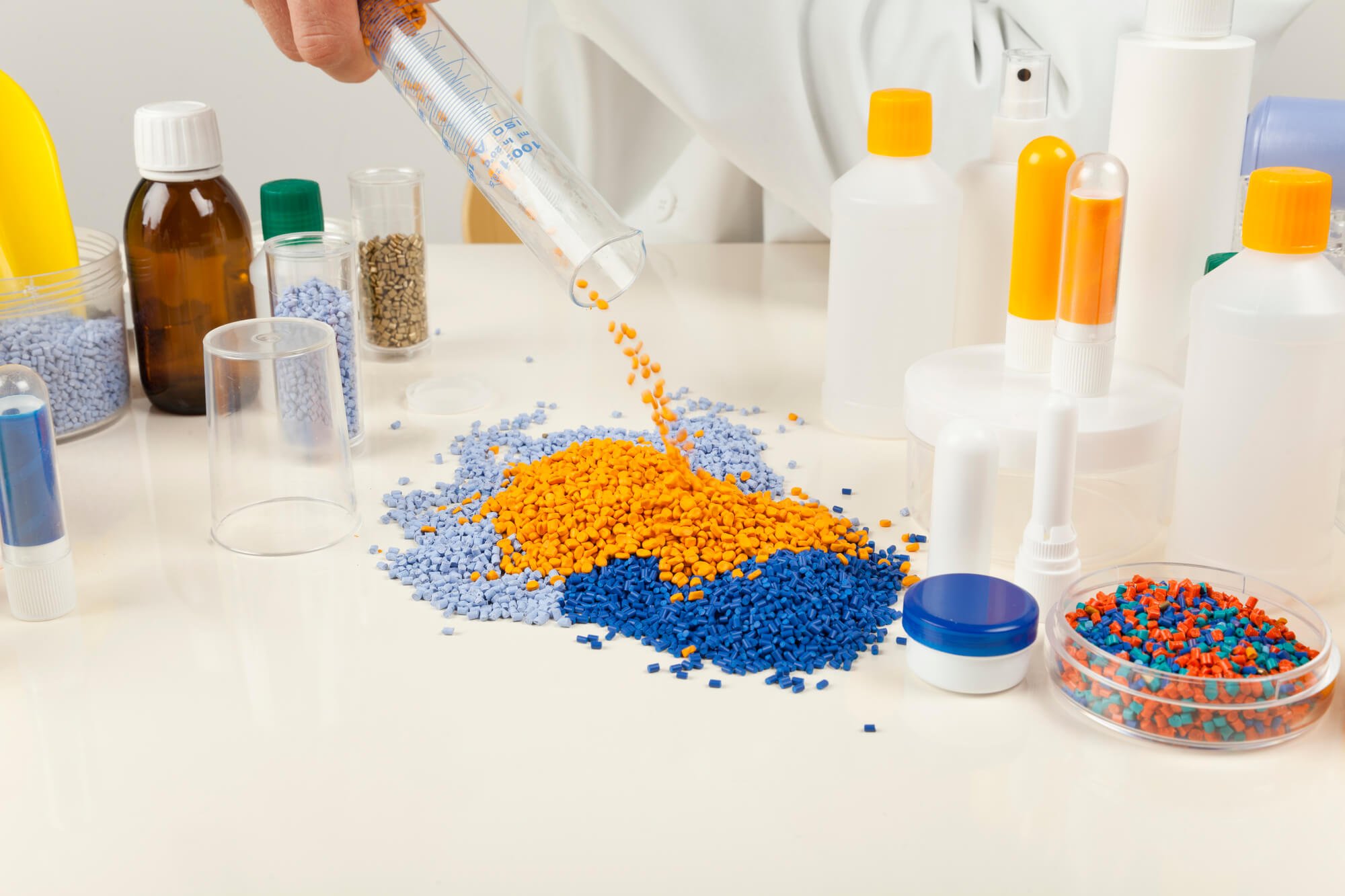
Selecting a plastic for a medical device requires more than comparing tensile strength or maximum temperature. Reusable components may need to withstand repeated sterilization, cleaning chemicals, mechanical loading, and dimensional changes while remaining suitable for a controlled manufacturing process.
Polyetherimide, or PEI, is a high-performance amorphous thermoplastic that can address several of these requirements at the same time. Commercially associated with the ULTEM™ family, PEI offers high rigidity, dimensional stability, elevated-temperature performance, electrical insulation, and resistance to several sterilization environments.
The important question isn’t whether PEI is simply a high-temperature plastic. The more useful question is whether a specific PEI grade provides enough thermal, sterilization, mechanical, dimensional, regulatory, and manufacturing margin for the intended medical device.
What Is PEI (Ultem)?
PEI stands for polyetherimide, an amorphous engineering thermoplastic. ULTEM™ is a commercial brand associated with the PEI material family, which includes grades with different reinforcement levels, flow characteristics, and application profiles.
Unfilled PEI is typically transparent amber or translucent, while reinforced grades can have different appearances and mechanical characteristics. PEI can be processed through injection molding and extrusion, with selected forms also suitable for machining.
For medical device development, this distinction matters because PEI is a polymer family rather than a single material specification. A general-purpose PEI grade shouldn’t automatically be treated as equivalent to a medical-grade formulation.
PEI Temperature Terms That Should Not Be Confused
Several temperature values can appear in PEI technical data, but they describe different aspects of material behavior.
| Temperature term | What it indicates |
|---|---|
| Glass transition temperature | The temperature at which the polymer transitions from a rigid glassy state toward a more rubber-like state |
| Processing temperature | The temperature range required to melt and mold the resin |
| Service temperature | The temperature range associated with intended long-term use under defined conditions |
| Sterilization temperature | The temperature imposed by a specific sterilization cycle |
For example, ULTEM HU1000 is reported with a glass transition temperature of approximately 217°C, while ULTEM resin information identifies continuous operating capability around 170°C under applicable conditions.
These values shouldn’t be treated as interchangeable or as universal design limits for every PEI grade. A component’s actual performance also depends on loading, exposure duration, geometry, environment, and the required level of dimensional and mechanical stability.
PEI Performance at a Glance
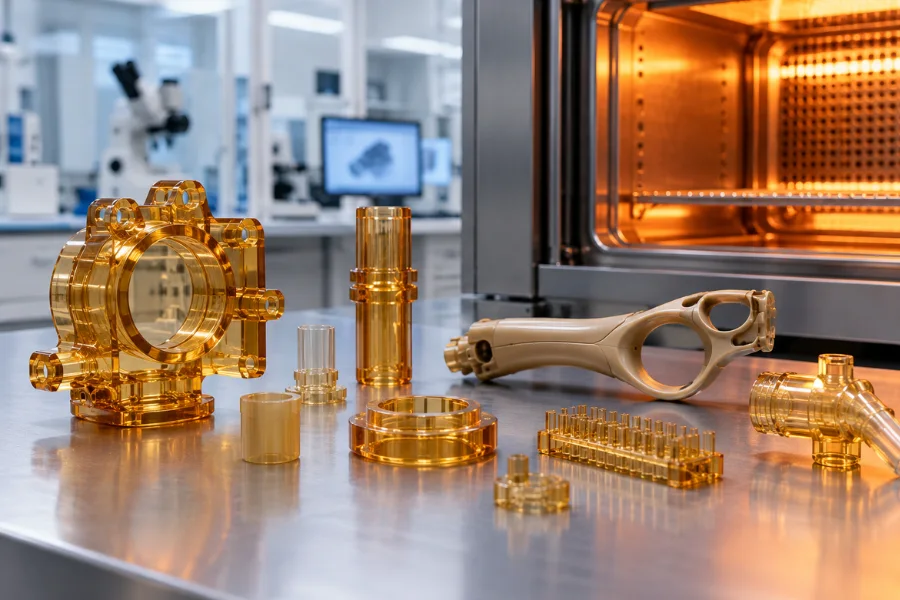
PEI is attractive for medical applications because several useful properties can occur within the same material system.
The following values are reference data for specific PEI grades and test conditions rather than universal limits for all PEI materials.
| Property or test condition | Example reference value | Why it matters |
|---|---|---|
| Glass transition temperature | Approximately 217°C for ULTEM HU1000 | Indicates high thermal capability |
| Continuous operating temperature | Approximately 170°C under applicable conditions | Helps evaluate long-term service requirements |
| Molding shrinkage | Approximately 0.5% to 0.7% | Supports dimensional control considerations |
| EtO sterilization | 100 cycles reported for specific grades | Relevant to repeated low-temperature sterilization |
| Gamma irradiation | 500 megarads under specified testing | Relevant to radiation sterilization |
| Dry heat | 160°C for specified ULTEM grade | Relevant to high-temperature sterilization |
These values should be reviewed together with the specific resin datasheet, test method, part geometry, sterilization cycle, and intended service environment.
Why PEI Is Used for Medical Devices
PEI becomes most useful when several demanding requirements occur together. A reusable medical component may need to maintain rigidity during sterilization while also resisting cleaning chemicals and maintaining dimensional stability.
Its value therefore comes from a combination of properties, rather than from temperature resistance alone.
Repeated Sterilization Resistance
A medical component can experience hundreds or thousands of cleaning and sterilization cycles over its service life. The material must therefore be evaluated for property retention rather than only its response to one exposure.
Selected PEI grades have demonstrated resistance to steam autoclaving, EtO, gamma radiation, dry heat, and other sterilization processes under specified test conditions.
Elevated-Temperature Performance
PEI can retain useful mechanical performance in elevated-temperature environments where conventional engineering plastics may become less suitable.
This makes it relevant to reusable instruments, sterilization trays, laboratory equipment, and selected medical components exposed to elevated temperatures.
The practical service limit still depends on load, exposure duration, geometry, environmental conditions, and required dimensional and mechanical performance.
Rigidity and Dimensional Stability
High rigidity can be important when a medical component must maintain its shape during use, assembly, sterilization, or repeated handling.
PEI also has relatively low molding shrinkage. Reference data gives approximately 0.5% to 0.7%, although actual molded dimensions depend on grade, geometry, reinforcement, mold design, cooling, and processing conditions.
Low shrinkage can support dimensional control, but it doesn’t guarantee tight molded-part tolerances. Residual stress, cooling variation, fiber orientation, wall thickness, and process stability remain important.
Chemical and Cleaning Resistance
Healthcare components may encounter detergents, sanitizing agents, hot water, steam, and other chemicals during cleaning and use.
PEI provides resistance to many chemicals and sanitizing agents used in healthcare environments. Actual compatibility should still be evaluated against concentration, temperature, exposure duration, and mechanical loading.
Electrical Insulation
PEI also offers strong electrical insulation characteristics.
This can make it useful for connectors, insulating components, supports, housings, and selected diagnostic equipment components where electrical properties must remain stable under elevated temperatures.
PEI Sterilization Compatibility for Medical Devices
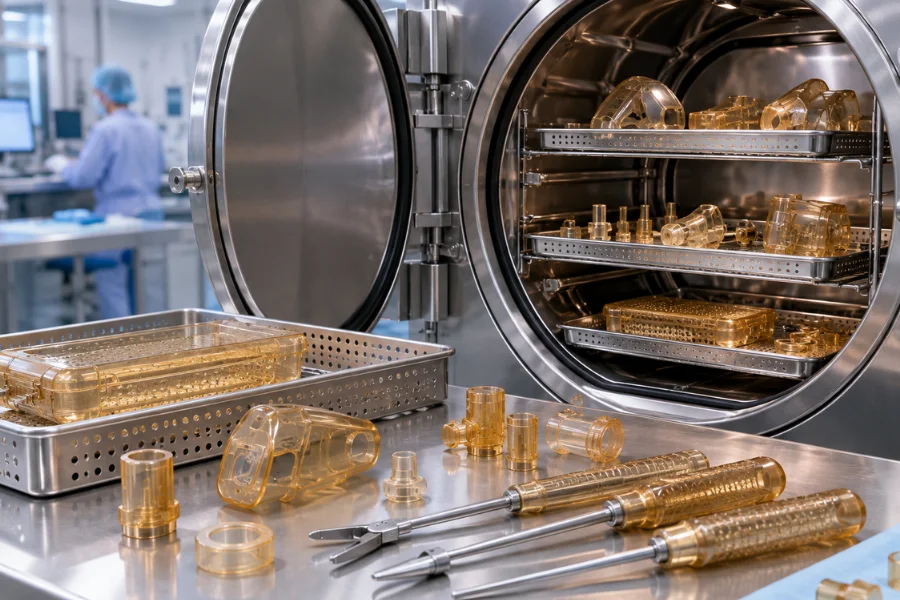
Sterilization compatibility is one of the strongest reasons to consider PEI for reusable medical components.
However, the correct evaluation isn’t based on sterilization temperature alone. The material should be evaluated against the complete cycle, expected number of cycles, mechanical requirements, appearance requirements, and finished-part performance.
Steam Autoclave
Steam autoclaving is particularly relevant to reusable surgical instruments, instrument trays, and other reusable medical components.
Reference data indicates that selected ULTEM materials can retain useful mechanical properties through extensive autoclave exposure. Testing also reports retention through thousands of cycles under specified conditions.
PEI trays have demonstrated resistance to crazing during repeated steam autoclaving, although localized crazing appeared at higher cycle counts under the reported conditions.
This creates an important distinction between functional durability and cosmetic condition. A component may remain mechanically serviceable while showing surface changes that could still matter for a medical application.
Ethylene Oxide Sterilization
EtO can be compatible with selected PEI grades.
Reference testing for ULTEM 1000 and ULTEM HP reported property retention after 100 EtO sterilization cycles. ULTEM 1000 retained its initial tensile strength and more than 75% of its initial tensile elongation under the reported test conditions.
The reported 100 cycles shouldn’t be interpreted as a universal limit. Actual suitability depends on the selected grade, sterilization process, exposure history, and required service life.
Gamma Radiation
PEI also offers useful resistance to gamma irradiation.
Reference testing reports that ULTEM 1000 and ULTEM HP retained their properties following cumulative gamma exposure up to 500 megarads under specified conditions, with tensile strength loss reported at less than 6%.
Radiation dose, dose rate, grade, geometry, and required end-use properties should be considered before applying this information to a finished medical component.
Dry Heat and Hydrogen Peroxide Sterilization
Selected PEI grades can also tolerate dry heat sterilization. ULTEM HP is reported as capable of withstanding dry heat exposure at 160°C.
Medical-grade PEI materials have also been evaluated for hydrogen peroxide-based sterilization systems and other low-temperature processes. The actual equipment and cycle should be matched to the selected material grade.
Why Sterilization Cycles Matter
A material can survive one sterilization cycle without visible change while experiencing gradual changes after repeated exposure.
A more useful evaluation sequence is:
Sterilization method → cycle conditions → required cycle count → material grade → property retention → finished-part evaluation
This approach reduces the risk of selecting a polymer based only on a published temperature rating.
Medical-Grade PEI and ULTEM Grades
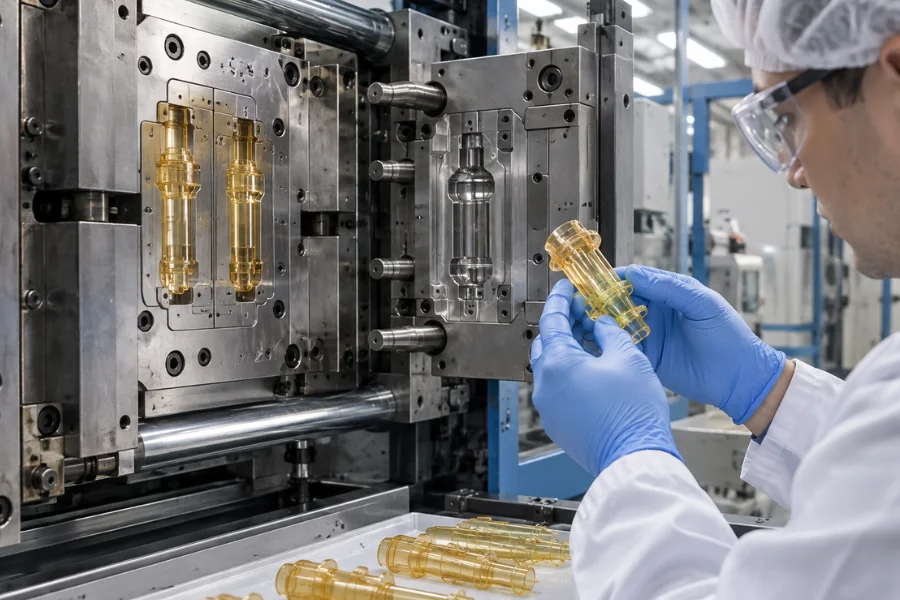
PEI should be evaluated at the specific grade level, not simply as a polymer family.
A structured medical material selection process should consider sterilization, temperature, mechanical requirements, contact conditions, processing characteristics, and available documentation.
Different grades can vary in viscosity, reinforcement, mechanical behavior, biocompatibility documentation, and intended medical applications.
ULTEM HU1000
ULTEM HU1000 is described as an unreinforced medical-grade PEI intended for medical device and pharmaceutical applications.
The material has a reported glass transition temperature of approximately 217°C and is intended for applications that require high-temperature performance and sterilization resistance.
Potential applications include reusable surgical instruments, instrument handles, and selected drug delivery components.
ULTEM HU1010
ULTEM HU1010 is described as a lower-viscosity version associated with HU1000.
Its flow characteristics can be useful for injection-molded components with thin walls or intricate precision features. However, improved flow doesn’t eliminate the need to evaluate injection pressure, gate design, thermal control, and dimensional requirements.
For complex medical components, grade selection and part geometry should therefore be considered together.
ULTEM HU1004
ULTEM HU1004 is described as a medical PEI grade intended for applications involving longer exposure to bodily fluids and tissue than grades intended for shorter contact conditions.
The material is reported to retain properties and color after repeated sterilization and to be compatible with several sterilization processes.
The relevant question isn’t simply whether the material is labeled medical grade. The contact type, contact duration, sterilization method, and available biocompatibility documentation all need to match the intended application.
Glass-Filled PEI
Glass reinforcement can increase stiffness, tensile strength, and dimensional stability.
It also changes molding behavior. Fiber orientation can produce anisotropic mechanical and dimensional properties, while reinforcement can affect flow, surface appearance, gate strategy, and shrinkage behavior.
For precision medical components, glass-filled PEI should therefore be evaluated based on both mechanical requirements and the actual part geometry.
Biocompatibility and Regulatory Considerations
Medical material selection involves more than thermal and mechanical performance.
The selected grade should have documentation appropriate to the intended application, while the finished medical device must still be evaluated through the applicable regulatory and biological assessment process.
ISO 10993
Certain medical-grade PEI materials have biocompatibility data associated with ISO 10993 requirements.
The appropriate biological evaluation depends on the way the finished device contacts the body, including the type and duration of contact.
Existing material-level data can support material selection, but it doesn’t automatically establish the biological safety of the finished device.
USP Class VI
USP Class VI information can be relevant when screening materials for medical and pharmaceutical applications.
The specific resin grade and supplier documentation should be verified rather than assuming that all PEI formulations have the same qualification.
FDA-Related Requirements
Some PEI grades are available with FDA-related compliance information for specified applications.
The regulatory status of the finished medical device depends on the complete device, its intended use, manufacturing process, and applicable regulatory pathway.
Material Documentation and Traceability
Medical production also requires attention to material documentation.
Depending on the project, procurement and quality teams may need:
- Exact resin grade
- Material specifications
- Lot or batch information
- Certificates or declarations
- Supplier quality documentation
- Material traceability records
- Change notification information
Material documentation should be reviewed during supplier qualification rather than after production begins.
PEI Injection Molding Considerations for Medical Devices
PEI’s high performance in service comes with more demanding processing requirements than many commodity and standard engineering plastics.
For medical plastic injection molding, material selection should therefore be evaluated together with tooling and process capability.
Material Drying and Moisture Control
Moisture management is important when processing engineering thermoplastics.
Improper material preparation can contribute to surface defects, molding instability, and variation in final part properties. Drying conditions should follow the requirements for the selected PEI grade and resin supplier.
Melt and Mold Temperature Control
PEI requires high processing temperatures.
Stable thermal control can influence filling behavior, cooling, dimensional stability, surface quality, and residual stress.
For precision components, thermal uniformity can matter as much as the nominal temperature setting.
Venting and Gate Design
Complex medical components can include thin walls, long flow paths, enclosed sections, and small functional features.
Poor venting can contribute to trapped air, burn marks, short shots, or inconsistent filling. Gate location can also affect weld lines, packing, flow direction, fiber orientation, and critical dimensions.
Thin-Wall and Complex Geometry
Thin-wall components can benefit from lower-viscosity PEI grades when their medical and performance requirements support their use.
However, thin-wall molding also reduces the available filling window. Flow length, melt temperature, mold temperature, gate location, and injection pressure can become more sensitive.
Dimensional Control and Residual Stress
PEI’s relatively low shrinkage can support precision applications, but dimensional stability still depends heavily on the molding process.
Important variables include:
- Wall thickness
- Cooling uniformity
- Mold temperature
- Packing conditions
- Material orientation
- Fiber reinforcement
- Residual stress
- Environmental exposure
These variables should be considered during DFM and tooling development rather than treated only as production-stage problems.
Tooling and DFM Considerations for PEI
Material performance doesn’t remove the need for appropriate tooling design.
PEI’s processing temperature and the geometry of the molded component can influence mold temperature control, venting, cooling, gate strategy, and ejection. Proper medical mold making can help translate these material characteristics into a stable production process.
Wall Thickness
Consistent wall thickness can help reduce uneven cooling and dimensional variation.
Abrupt section changes should be minimized where practical, particularly around critical dimensions and functional surfaces.
Ribs and Bosses
Ribs and bosses can provide stiffness and mounting functions, but excessive material concentration can create localized cooling differences.
Their geometry should provide the required structural function without creating unnecessarily thick sections.
Draft and Ejection
Adequate draft supports reliable ejection and reduces unnecessary stress during demolding.
The required value depends on surface finish, texture, geometry, and tooling design.
Gates and Flow Paths
Gate position should be considered together with critical dimensions, weld lines, filling behavior, and functional surfaces.
For reinforced PEI, flow direction can also influence fiber orientation and anisotropic behavior.
Mold Material and Wear
High-temperature processing places additional demands on tooling.
Reinforced PEI grades can also increase mold wear compared with unfilled formulations. Tooling decisions should therefore consider the selected resin grade, production volume, expected tool life, thermal control requirements, and maintenance strategy.
Early free mold tool design can help identify potential tooling and molding constraints before production tooling is finalized.
Manufacturing Risks to Review Before Production
PEI can provide a strong performance profile, but its advantages depend on stable processing.
| Manufacturing factor | Potential concern |
|---|---|
| Moisture control | Splay, bubbles, surface defects, and property variation |
| Thermal control | Filling variation, residual stress, and dimensional changes |
| Venting | Burn marks, trapped gas, and incomplete filling |
| Gate location | Weld lines, orientation effects, and critical-dimension variation |
| Uneven cooling | Warpage and dimensional instability |
| Thick sections | Localized cooling and residual stress |
| Glass reinforcement | Fiber orientation and anisotropic shrinkage |
| Ejection | Mechanical stress or cosmetic damage |
The purpose of this review isn’t to suggest that PEI is unusually difficult to mold. It is to recognize that a high-performance resin still requires process conditions that are consistent with the material and component geometry.
Medical Device Applications for PEI
PEI is most relevant when its combination of properties solves a specific medical manufacturing requirement.
Reusable Surgical Instruments
Reusable instruments can experience repeated cleaning, sterilization, handling, and mechanical loading.
PEI can be considered for selected handles, structural components, fixtures, and other non-implantable parts where rigidity and sterilization resistance are important.
Sterilization Trays and Fixtures
Trays and supporting fixtures must maintain their geometry during repeated high-temperature exposure.
PEI’s resistance to steam and dimensional stability can make it suitable when the selected grade and design meet the required performance criteria.
Fluid Management and Drug Delivery Components
Selected medical-grade PEI materials can be considered for fluid-management and drug-delivery applications where chemical resistance, dimensional stability, sterilization compatibility, and appropriate contact documentation are required.
The actual fluid, temperature, exposure duration, and contact conditions must be evaluated.
Diagnostic and Imaging Equipment
Diagnostic and imaging systems can contain structural supports, housings, connectors, electrical insulation components, and other precision parts.
PEI’s rigidity, electrical properties, and dimensional stability can make it useful for selected components.
Laboratory and Pharmaceutical Equipment
PEI is also relevant to laboratory and pharmaceutical equipment where repeated cleaning, sterilization, chemical exposure, or dimensional stability are important.
Potential applications include equipment components, supports, containers, and other non-implantable parts.
PEI vs Other Medical-Grade Engineering Plastics
The right comparison isn’t simply which polymer has the highest specification.
Material selection should consider whether the polymer provides enough performance margin for the actual device requirements.
| Selection factor | PEI | PEEK | PPSU | PC |
|---|---|---|---|---|
| Temperature capability | High | Higher | High | Lower |
| Repeated sterilization | Strong candidate for suitable grades | Strong candidate | Strong candidate | Grade-dependent |
| Rigidity | High | High | Moderate | Moderate |
| Chemical resistance | Good for many healthcare environments | Generally higher | Good | More application-dependent |
| Dimensional stability | High | High | Good | Good |
| Electrical insulation | Excellent | Excellent | Good | Excellent |
| Transparency | Available in selected grades | Generally limited | Available in selected grades | Excellent |
This comparison is intended for initial screening rather than final qualification. Actual performance depends on the specific grade, test conditions, sterilization cycle, operating environment, and finished-part design.
PEI vs PEEK
PEEK generally provides higher temperature capability and stronger chemical resistance.
PEI may be a better fit when the application requires rigidity, dimensional stability, sterilization resistance, electrical insulation, and elevated-temperature performance without requiring the full performance envelope of PEEK.
The relevant question is whether PEEK’s additional performance is actually required by the device.
PEI vs PPSU
PPSU is well suited to applications where impact resistance and repeated sterilization are major requirements.
PEI may become more attractive when rigidity, dimensional stability, electrical insulation, or higher-temperature performance carries more weight.
PEI vs Polycarbonate
Polycarbonate provides strong impact resistance and optical clarity but generally operates at lower temperatures than PEI.
PEI becomes more relevant when repeated high-temperature exposure, sterilization, rigidity, or dimensional stability is more important than the processing and cost advantages that can make PC attractive.
How to Decide If PEI Is Right for Your Medical Device
Material selection should start with the device requirements rather than the material name. This is why medical device product development is an important stage for defining sterilization, temperature, mechanical, dimensional, and regulatory requirements before tooling.
Step 1 — Define the Sterilization Method
Determine whether the component will undergo steam autoclave, EtO, gamma radiation, hydrogen peroxide, dry heat, or another process.
Then define the temperature, exposure time, and expected number of cycles.
Step 2 — Define Temperature and Mechanical Requirements
Establish the actual operating temperature and identify continuous loading, impact, vibration, pressure, fatigue, or other mechanical conditions.
Evaluate the material at the temperatures and loads expected during actual service.
Step 3 — Define Chemical Exposure
Identify cleaning agents, sanitizers, process fluids, body fluids, and other chemicals that may contact the component.
Compatibility should be evaluated under the expected concentration, temperature, exposure duration, and mechanical conditions.
Step 4 — Define Medical Contact Requirements
Determine whether the component is non-contacting, contacts bodily fluids, contacts tissue, or has another defined exposure profile.
Contact duration should also be established because medical grades can have different supporting biocompatibility information.
Step 5 — Select the Appropriate PEI Grade
Compare candidate grades based on:
- Sterilization requirements
- Temperature requirements
- Mechanical properties
- Dimensional stability
- Flow characteristics
- Wall thickness
- Reinforcement
- Appearance
- Biocompatibility documentation
Step 6 — Evaluate Part Design and Tooling
Review the geometry before finalizing the material grade.
Thin walls, long flow paths, tight tolerances, complex features, and reinforced formulations can all influence molding behavior and tooling requirements.
Step 7 — Review Validation and Material Documentation
Confirm that the selected grade has appropriate supplier documentation for the intended application.
Material qualification should then be considered within the broader medical device validation and verification strategy for the finished device.
A practical selection sequence is:
Device requirements → PEI grade → part design → tooling → process control → validation → production
What Procurement Teams Should Confirm Before Selecting PEI
Material selection is also a supply and quality decision.
Before approving a PEI grade for production, procurement and quality teams should confirm:
- Exact resin grade and manufacturer
- Medical application documentation
- Biocompatibility information
- Sterilization test data
- Material lot traceability
- Available certificates and declarations
- Processing requirements
- Long-term material availability
- Supplier change notification procedures
These checks help distinguish a technically suitable material from a material that can also support a controlled medical manufacturing program.
When PEI May Not Be the Best Choice
PEI isn’t universally the best medical plastic.
Another material may be more appropriate when the component operates beyond PEI’s practical temperature range, requires extreme chemical resistance, demands very high wear resistance, or has impact performance as its dominant requirement.
PEEK can be a stronger candidate when higher continuous temperature capability or more aggressive chemical resistance is required.
PPSU may be preferable when impact resistance and repeated sterilization dominate the design requirements.
A lower-cost engineering plastic may also be appropriate when the application doesn’t require PEI’s additional performance.
The objective isn’t to select the highest-performing polymer. It is to select a material that provides an appropriate performance margin without introducing unnecessary manufacturing complexity or cost.
Frequently Asked Questions About PEI for Medical Devices
What is the difference between medical-grade PEI and standard PEI?
Medical-grade PEI is associated with specific formulations and documentation intended to support defined medical applications.
The relevant properties and compliance information depend on the exact resin grade rather than the PEI polymer family alone.
Can PEI be sterilized repeatedly?
Selected PEI grades have demonstrated resistance to repeated steam, EtO, gamma, dry heat, and other sterilization processes under specified conditions.
The grade, sterilization method, cycle count, and required property retention should all be considered.
Can PEI be used for thin-wall medical injection molding?
Certain lower-viscosity PEI grades can be useful for thin-wall or intricate components.
However, thin-wall molding requires careful control of flow length, gate location, melt temperature, mold temperature, and injection pressure.
Can glass-filled PEI be used for precision medical components?
It can be considered when higher stiffness, strength, or dimensional stability is required.
Fiber orientation and anisotropic behavior should be evaluated during part and mold design.
What should be verified before selecting a medical PEI grade?
The key factors include sterilization, temperature, mechanical loading, chemical exposure, contact conditions, part geometry, processing requirements, and available material documentation.
Is PEI better than PEEK for medical devices?
Neither material is universally better.
PEEK generally provides a higher temperature and chemical-resistance range, while PEI can provide an effective balance of rigidity, dimensional stability, sterilization resistance, electrical properties, and processability for applications that don’t require PEEK’s full performance range.
Can PEI be injection molded?
Yes. PEI is an injection-moldable thermoplastic.
Its higher processing temperatures make material preparation, thermal control, venting, gate design, mold temperature, and process stability important considerations.
Selecting PEI for the Right Medical Manufacturing Requirement
PEI is most useful when several demanding requirements occur together.
A medical component may need to withstand repeated sterilization while maintaining rigidity, dimensional stability, chemical resistance, and reliable mechanical or electrical performance.
The material decision should therefore connect the specific PEI grade with sterilization, part design, tooling, process control, validation, and production requirements.
For OEMs that need these stages coordinated from development through production, medical device contract manufacturing can provide an integrated manufacturing path.
For medical device OEMs evaluating PEI components, defining these requirements early can reduce material-selection risk and create a more controlled path from material qualification through production.
Discuss your medical manufacturing project with SeaSkyMedical.