COP and COC are high-performance cyclic olefin materials used in medical devices, diagnostics, pharmaceutical packaging, and life science applications. Both offer high transparency, low moisture interaction, high purity, and low protein adsorption, but they aren’t interchangeable.
COP generally deserves closer consideration when moisture protection, low-temperature performance, toughness, and sensitive biologic applications drive the specification. COC is often a strong starting point when optical performance, rigid precision structures, grade flexibility, and cost-performance balance carry more weight.
For an injection-molded medical component, the better question isn’t simply which polymer is superior. It is which failure mode the material needs to control.
A practical selection path looks like this:
Application requirements → material properties → resin grade → part geometry → molding behavior → sterilization and secondary operations → validation → production economics
COP vs COC at a Glance
COP means cyclic olefin polymer, while COC means cyclic olefin copolymer. Both can provide glass-like transparency while avoiding the inherent breakage risk of glass.
Their practical differences become clearer when specific medical requirements are introduced.
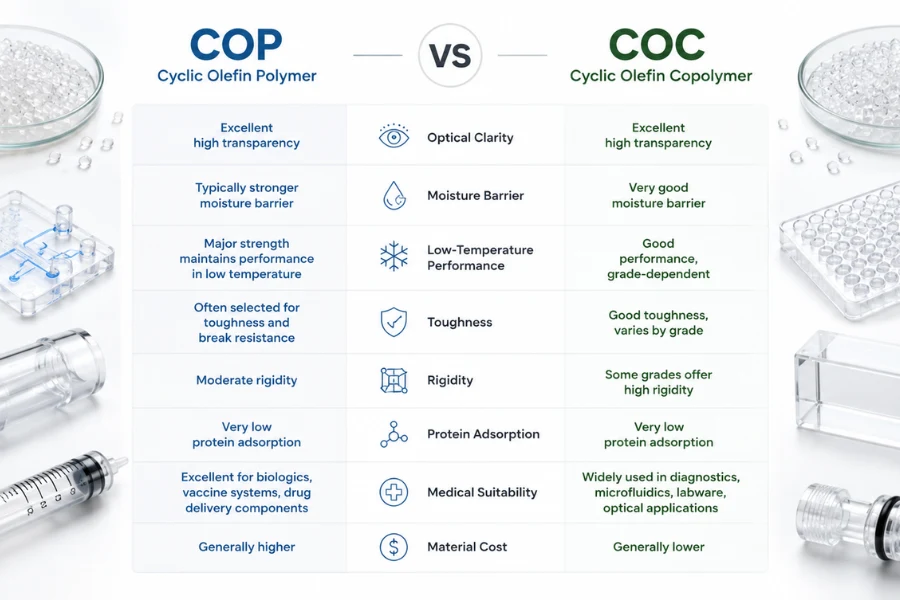
| Selection Factor | COP | COC |
|---|---|---|
| Optical performance | Excellent | Excellent |
| Moisture barrier | Typically stronger | Very good |
| Low-temperature performance | Major strength | Good, grade-dependent |
| Mechanical behavior | Often selected for toughness and break resistance | Some grades provide high rigidity |
| Protein adsorption | Very low | Very low |
| Diagnostic applications | Excellent | Major application area |
| Material cost | Generally higher | Generally lower |
| Typical selection logic | Performance-first | Performance-cost balance |
These are family-level tendencies rather than universal specifications. Final selection should move quickly from comparing COP and COC as material families to evaluating specific medical-grade resins.
What Is the Difference Between COP and COC?
The distinction starts with molecular structure.
COP – Cyclic Olefin Polymer
COP is produced from cyclic olefin monomers. Its molecular architecture contributes to structural stability, low moisture interaction, high transparency, and useful performance under demanding storage conditions.
These characteristics make medical-grade COP relevant to biologic packaging, vaccine systems, prefilled drug-delivery components, cell and gene therapy applications, and other products where moisture, cold-chain handling, or break resistance creates meaningful risk.
COC – Cyclic Olefin Copolymer
COC combines cyclic olefin chemistry with another olefin. Its amorphous structure gives the material glass-like optical characteristics without introducing crystalline regions that can scatter light.
Medical-grade COC is widely considered for microfluidic chips, diagnostic cartridges, cuvettes, optical cells, laboratory consumables, and other transparent precision components.
The practical difference isn’t simply polymer versus copolymer. Their structures influence moisture response, mechanical behavior, thermal characteristics, optical performance, and processing.
COP vs COC – The Differences That Affect Medical Material Selection
Material properties become useful only when they are connected to the actual performance or failure requirements of the device.
For that reason, medical plastic material selection should begin with the application, expected failure modes, manufacturing process, and validation requirements rather than a single datasheet property.
Optical Performance Goes Beyond Transparency
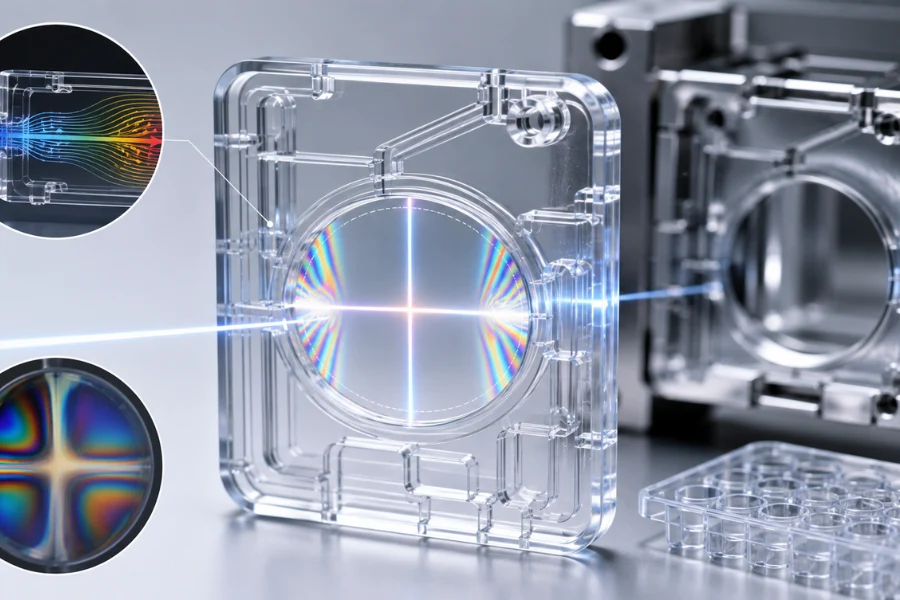
Both COP and COC can provide excellent optical clarity. COC is particularly common in diagnostic and microfluidic applications where transparent structures participate directly in inspection or measurement.
But a resin with high light transmission doesn’t automatically produce a reliable optical component.
Gate location, flow orientation, residual stress, wall thickness variation, cavity surface finish, and cooling conditions can influence the molded optical path. A component may remain visibly transparent while stress-induced birefringence interferes with optical measurement.
Fluorescence-based systems introduce another requirement. Autofluorescence, additives, surface treatments, and excitation or emission wavelengths can affect background signal even when the component looks perfectly clear.
A high-clarity resin also cannot compensate for tool marks, inadequate polishing, or surface defects transferred from the mold cavity.
For optical medical components, evaluate material + tooling + molding process rather than transparency alone.
Moisture Barrier and Dimensional Stability
COP generally provides a stronger moisture barrier, making it a logical starting point for moisture-sensitive drugs, biologics, vaccines, and other applications where water vapor can affect product stability.
COC also offers low moisture interaction compared with many conventional transparent plastics and may be sufficient when exposure conditions are less demanding.
For precision molded devices, moisture matters for another reason. Water uptake can contribute to dimensional change in microchannels, optical chambers, wells, and precision interfaces.
COP therefore deserves stronger consideration when moisture represents a primary failure risk. COC remains a practical option when moisture conditions are controlled and optical, structural, or economic requirements carry greater weight.
Toughness, Rigidity, and Break Resistance
Mechanical comparisons require more caution because performance varies by grade.
Depending on the selected grade, COP is often considered where toughness and break resistance are priorities. This can be useful during transportation, clinical handling, or demanding cold-chain conditions.
Some COC grades provide the rigidity needed for precision structures and diagnostic components. Geometry, wall transitions, molded stress, and actual loading conditions still need to be considered where cracking is a potential failure mode.
The goal isn’t to maximize stiffness or toughness independently. It is to control the mechanical failure mode relevant to the finished device.
Low-Temperature Performance
COP deserves particular consideration when a medical product must operate or remain stable under demanding frozen or ultra-low-temperature conditions.
Potential applications include vaccines, biologics, and cell and gene therapy systems.
COC can also support low-temperature applications depending on grade and operating conditions. Specific temperature limits should be confirmed from the selected resin data and validated in the finished assembly.
This matters because seals, closures, bonded interfaces, and assembly stresses may become failure points even when the base polymer remains functional.
Chemical and Biological Interaction
Both COP and COC are valued for high purity, chemical inertness, and low interaction with sensitive contents.
COP is particularly relevant where very low protein adsorption is required. Reducing unwanted surface interaction can matter for biologics where adsorption, denaturation, or precipitation may influence product stability or delivered dose.
COC also provides high purity and is widely used in medical and diagnostic systems where sample integrity matters.
Neither family should be assumed compatible with every formulation. The actual drug, reagent, solvent, concentration, exposure duration, and temperature should be part of material evaluation.
Grade Selection Can Matter More Than the Family Name
COP and COC aren’t single materials.
Individual grades can differ in:
- Glass transition temperature
- Melt flow behavior
- Stiffness and toughness
- Optical characteristics
- Processing window
- Sterilization response
- Regulatory or application documentation
This is particularly important when thermal performance, thin-wall filling, optical quality, or sterilization drives the project.
The engineering decision should therefore progress from:
COP vs COC → candidate grades → representative molded parts
before production tooling and validation are finalized.
Early material evaluation can also be coordinated with product development so resin selection, geometry, tooling feasibility, and downstream manufacturing requirements are considered before the design becomes difficult or expensive to change.
COP vs COC for Medical Injection Molding
Datasheets describe resin properties under standardized test conditions. Medical plastic injection molding determines how those properties translate into the actual medical component.
This distinction becomes critical for optical zones, microfluidic channels, thin walls, sealing interfaces, and other precision features.
Gate Design Can Become an Optical Issue

Consider a diagnostic component with an optical inspection window.
If melt flow crosses that area under unfavorable orientation and stress conditions, molecular orientation can become frozen into the component during cooling. The part may remain visibly clear while developing birefringence that affects optical measurement.
The engineering relationship becomes:
Gate location → flow orientation → residual stress → birefringence → optical performance
Changing the polymer alone may not correct the problem.
Gate position, melt temperature, mold temperature, injection conditions, packing, and cooling strategy need to be developed as part of the optical requirement. Early mold development should therefore consider not only whether the cavity can fill, but also how tooling decisions influence the functional performance of the molded component.
Thin Walls and Microfeatures Need a Processing Balance
Microfluidic components may combine narrow channels, wells, detection chambers, thin sections, and long flow paths within one molded part. These geometries can make micro injection molding requirements substantially different from those of a simple transparent container.
The selected COP or COC grade needs sufficient flow behavior to replicate these features without creating unacceptable stress or dimensional variation.
Simply increasing pressure can solve one problem while creating another. More aggressive filling or packing may improve feature replication but increase residual stress in an optical or dimension-critical region.
Function-critical tolerances should therefore be identified during DFM and mold design. Optical zones, microchannels, sealing interfaces, and general structural dimensions may require different tooling and process-control strategies rather than one blanket tolerance requirement.
Surface Behavior and Secondary Operations
Low-polarity cyclic olefin surfaces contribute to low moisture interaction, but they may not provide the wetting behavior required by every microfluidic application.
Plasma treatment, coatings, or other surface modification may be required when capillary flow, reagent interaction, or bonding depends on surface energy.
Bonding also needs to preserve the characteristics that justified the material choice. Excessive heat, pressure, solvents, or deformation can affect microchannel geometry, optical performance, or surface functionality.
Material selection should therefore include the secondary operations required after molding. This is particularly important when surface treatment, bonding, printing, or other downstream processes can change a functional property established during molding.
Sterilization Can Change the Decision
The useful question isn’t simply whether COP or COC can be sterilized. It is whether the finished component remains within specification afterward.
Depending on the application, evaluation may include:
- Optical transmission and haze
- Color change
- Dimensional stability
- Mechanical performance
- Bond integrity
- Surface functionality
- Optical background
EtO, radiation, or thermal methods may be appropriate for particular grades and applications. Dose, exposure conditions, geometry, and post-sterilization aging can influence the result.
Representative molded components provide more useful evidence than assuming sterilization performance from the polymer-family name alone.
Quick Application Screening for COP and COC
This table provides a starting point rather than a final material specification.
| Medical Application | Likely Starting Point | Main Selection Driver |
|---|---|---|
| Biologic packaging | COP | Moisture protection and low protein adsorption |
| Vaccines and cold-chain systems | COP | Low-temperature performance |
| Cell and gene therapy | COP | Sensitive product handling and storage |
| Prefilled syringe systems | COP or COC | Formulation, geometry, storage, and process |
| Microfluidic chips | COC or COP | Optical, fluidic, and dimensional requirements |
| Diagnostic cartridges | COC | Optical performance and precision |
| Cuvettes and optical cells | COC | Optical clarity |
| Medical aesthetic packaging | COP | Toughness and transport protection |
| Cost-sensitive transparent components | COC | Performance-cost balance |
Application type alone shouldn’t determine the material. Two diagnostic cartridges can require different polymers because their optical method, moisture exposure, chemistry, geometry, or mechanical risks differ.
How Do COP and COC Compare With Other Medical Materials?
Compared with glass, COP and COC can offer shatter resistance, lower weight, low protein adsorption, and greater freedom to mold complex features directly into a medical component. Glass remains established in many pharmaceutical systems, so barrier requirements, drug compatibility, regulatory strategy, and total system cost still need consideration.
Compared with plastics such as PP, PC, or PMMA, cyclic olefin materials can offer advantages in areas such as optical performance, purity, moisture interaction, and dimensional stability. Those advantages come with higher material costs, so COP or COC should be used where their properties solve a real device requirement.
Material Price Isn’t the Same as Finished-Part Cost
COC is generally positioned as the more economical option, while COP often carries a higher resin cost.
For an OEM, however, price per kilogram is only one part of the decision.
A more useful cost chain is:
Resin cost → molding cycle → scrap → process stability → secondary operations → inspection → validation → production yield
A lower-cost resin that creates higher optical rejection, a narrow processing window, or additional surface-treatment requirements may not produce the lowest finished-part cost.
The opposite is also true. Specifying a premium polymer when a less expensive grade already meets the functional requirement adds cost without improving the medical device.
The better comparison is total manufacturing cost at a validated production yield.
When Should You Choose COP?
COP is generally the stronger starting point when the primary risks involve:
- Moisture ingress
- Demanding low-temperature storage
- Breakage during transport or handling
- Sensitive biologic contact
- Low protein adsorption requirements
- Cold-chain reliability
The higher material cost becomes easier to justify when component failure or loss of a high-value drug product carries a much greater cost than the resin itself.
When Should You Choose COC?
COC is generally a strong starting point when the application emphasizes:
- Optical measurement
- Diagnostic readout
- Microfluidic structures
- Rigid precision geometry
- Grade flexibility
- Cost-performance balance
This makes COC particularly relevant to diagnostic cartridges, cuvettes, optical cells, and other transparent precision medical components.
Cost alone shouldn’t determine the selection. Moisture, mechanical loading, sterilization, optical behavior, and molding geometry still need to meet the device requirements.
A Practical COP vs COC Selection Checklist
Before specifying a material, answer these questions at the finished-device level.
- Does the component sit in an optical or fluorescence detection path?
- Will it contact a drug, biologic, reagent, or patient sample?
- How sensitive is the product or component to moisture?
- What storage and operating temperatures must the assembly survive?
- Are breakage, impact, or transport loads significant risks?
- Does the design contain thin walls, microchannels, optical zones, or tight functional interfaces?
- Will the surface require controlled wetting, coating, or bonding?
- Which sterilization method and exposure conditions will be used?
- What production volume, process stability, and validated yield are required?
If these questions don’t point clearly toward one family, comparing specific candidate grades and molded samples is more useful than continuing to compare generic COP and COC properties.
Validate the Material in the Finished Medical Component
Material selection narrows the design space. It doesn’t complete the engineering process.
A practical development path is:
Material screening → grade selection → DFM → tooling → mold trials → dimensional and optical testing → sterilization evaluation → functional testing → process validation
Once the material, tooling, and molding window are established, regulated production may require appropriate qualification and validation activities such as IQ, OQ, and PQ based on the project requirements and quality system.
Assembly introduces another layer of risk. When molded COP or COC components move into medical device assembly, interfaces, bonding methods, dimensional stack-up, and handling conditions can affect performance even when the individual molded parts meet specification.
This is where material behavior becomes manufacturing evidence.
Wall thickness affects flow. Gate design affects molecular orientation. Cavity finish affects optical surfaces. Cooling influences stress and dimensions. Surface treatment changes wetting. Bonding and sterilization introduce additional thermal, chemical, or mechanical exposure.
The final material decision should therefore be based on whether a specific grade can be molded, processed, assembled, sterilized, and validated consistently within the finished medical component requirements.
Final Decision – COP or COC?
Don’t choose COP because it is considered the higher-performance option. Don’t choose COC simply because it offers strong optical properties or a lower material cost.
Choose the material that controls the most important failure mode without adding unnecessary manufacturing cost or validation risk.
COP is generally the stronger starting point when moisture protection, demanding low-temperature performance, toughness, and sensitive biologic applications dominate the risk profile.
COC is often the stronger starting point when optical performance, diagnostic functionality, rigid precision structures, grade flexibility, and cost-performance balance carry more weight.
Then move from the polymer family to the actual grade and molded component.
SeaSkyMedical supports material evaluation, DFM, tooling, precision molding, assembly, validation, and scalable medical device contract manufacturing for OEM medical components. For COP or COC projects, evaluating material and manufacturing requirements together before production tooling can help identify avoidable process and performance risks earlier.
Discuss your medical manufacturing project with SeaSkyMedical.