Medical-grade thermoplastic polyurethane, or TPU, is used in catheters, tubing, strain reliefs, seals, connectors, and other medical components that need flexibility without sacrificing mechanical strength.
Selecting the right grade requires more than choosing a Shore hardness. TPU chemistry, modulus, body-contact conditions, sterilization, part geometry, manufacturing method, moisture sensitivity, and long-term stability all influence whether a material will perform reliably in the finished device.
The practical question is not which TPU has the best individual property. It is which formulation can meet device requirements through manufacturing, sterilization, shelf life, and clinical use.
Quick Medical TPU Selection Guide
Medical-grade TPU refers to TPU formulations supplied and documented for defined medical-device applications. It is not one standardized material with fixed properties.
A structured medical material selection process should therefore begin with the functional and environmental requirements of the finished component rather than a single material property.
| Device Requirement | TPU Direction to Evaluate | Key Risk to Verify |
|---|---|---|
| Frequent moisture exposure | Polyether TPU | Oxidative stability and property retention |
| Long-term hydrolytic and oxidative stability | Polycarbonate TPU | Application-specific chemical compatibility |
| High mechanical and abrasion performance | Polyester TPU | Hydrolytic stability |
| Optical clarity and color stability | Aliphatic TPU | Mechanical requirements and processing |
| Flexible catheter section | Lower-modulus TPU | Kink resistance and pushability |
| Structurally supportive component | Higher-modulus TPU | Flexibility under actual use conditions |
| Radiopaque component | Filler-compatible formulation | Flow, bonding and mechanical changes |
| Thin-wall molded component | Suitable flow and thermal behavior | Shear, filling and dimensional stability |
These are screening directions rather than material specifications. Final selection requires evaluation of the specific grade, component design, manufacturing process, sterilization method, and intended biological contact.
How TPU Chemistry Affects Medical Material Selection
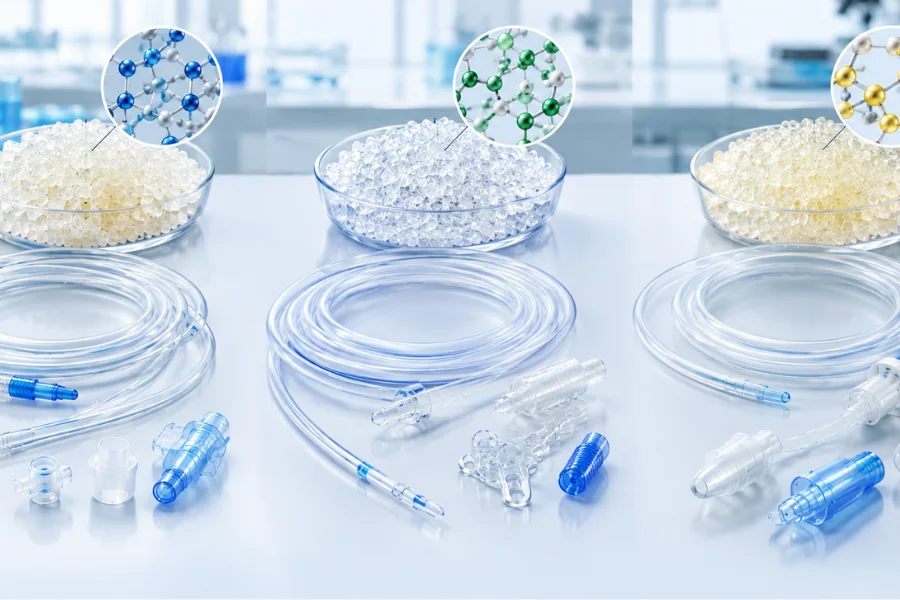
TPU is a thermoplastic elastomer with hard and soft molecular segments. Hard segments primarily contribute strength and stiffness, while soft segments strongly influence flexibility and environmental stability.
TPU terminology can be confusing because two chemistry decisions are involved.
- Soft-segment chemistry includes polyester, polyether, polycarbonate, and specialty chemistries
- Hard-segment chemistry introduces characteristics commonly described as aromatic or aliphatic
Both interact with formulation and hardness to determine final material behavior.
Polyester, Polyether, and Polycarbonate TPU
| TPU Chemistry | Main Strength | Main Limitation | Selection Focus |
|---|---|---|---|
| Polyester TPU | Mechanical, abrasion and chemical performance | Greater hydrolysis sensitivity | Mechanically demanding or shorter-duration uses |
| Polyether TPU | Hydrolytic stability and flexibility | Oxidative stability requires evaluation | Catheters, tubing and moisture exposure |
| Polycarbonate TPU | Hydrolytic and oxidative stability | Compatibility remains environment-specific | Applications requiring greater long-term biostability |
Polyester TPU generally provides strong mechanical and abrasion performance, but prolonged moisture exposure can increase hydrolytic degradation risk.
Polyether TPU offers better hydrolytic stability and is commonly evaluated for catheter and tubing applications. Longer-duration use also requires consideration of oxidative conditions and the actual biological environment.
Certain polycarbonate TPU formulations provide strong resistance to both hydrolytic and oxidative degradation, making them candidates for more demanding applications. Chemical exposure, sterilization, and clinical environment still require device-specific evaluation.
Aromatic vs. Aliphatic TPU
Aromatic TPU is often selected where mechanical strength, abrasion resistance, and durability carry greater weight. Certain formulations may yellow after UV or ionizing-radiation exposure.
Aliphatic TPU can provide better optical and color stability and may offer advantages where clarity or specific additive systems are required.
Neither chemistry is universally better. A non-transparent medical component may place far more value on strength or stiffness retention than on color stability.
Select TPU by Device Mechanics – Not Hardness Alone
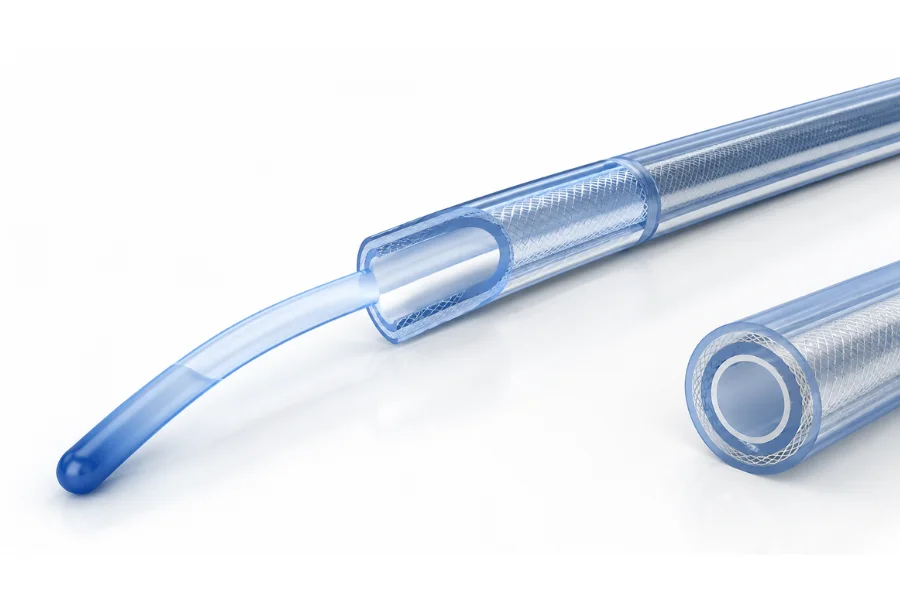
Shore hardness is useful for screening TPU grades, but it cannot predict catheter or molded-component performance by itself.
Actual behavior reflects the interaction of chemistry, modulus, hardness, wall thickness, geometry, reinforcement, temperature, and moisture exposure.
Catheter Tips and Shafts
A distal catheter section may need compliance and elastic recovery to reduce localized tissue loading. A lower-modulus TPU can support this requirement, but excessive softness can affect handling, dimensional stability, joining, and kink resistance.
Catheter shafts require a different balance. Pushability, torque response, column strength, flexibility, and fatigue resistance may lead designers toward higher modulus materials, reinforcement, multilayer constructions, or transitions between grades.
Body temperature and moisture can also change TPU stiffness. Performance should therefore be assessed under conditions representative of clinical use rather than room-temperature hardness alone.
Extruded Catheter Structures vs. Injection-Molded Components
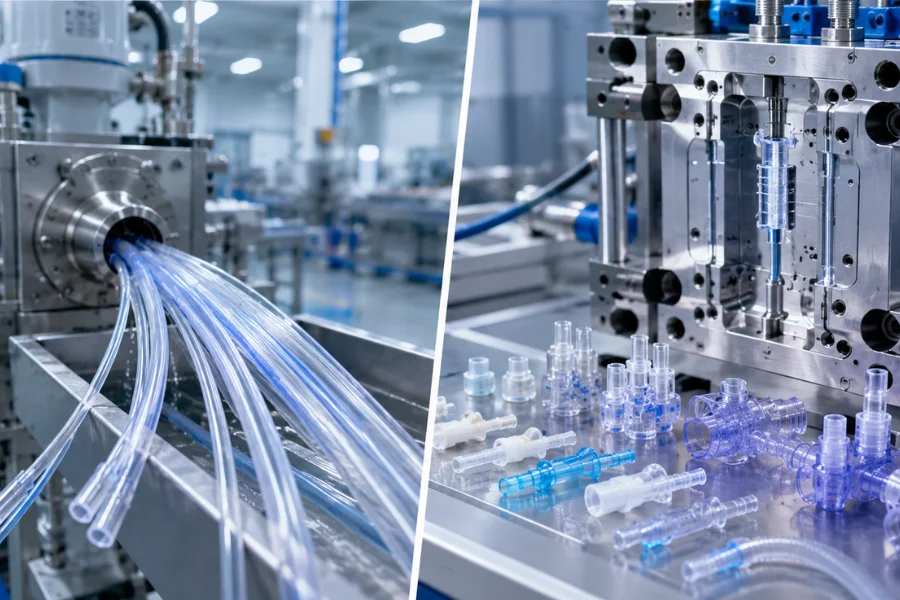
Many catheter shafts and tubing structures are manufactured by extrusion. Catheter assemblies may also contain injection-molded OEM medical components such as:
- Connectors and hubs
- Strain reliefs
- Flexible seals
- Valve elements
- Protective sleeves
- Flexible housings
- Overmolded interfaces
The same TPU family does not necessarily suit every component or manufacturing method.
An extrusion grade must maintain the melt behavior required for stable tubing dimensions, while a grade intended for TPU injection molding must fill the cavity, reproduce small features, demold reliably, and maintain dimensional stability.
Match TPU to Body Contact and Use Duration
A short-term external component and a long-term blood-contacting component present different material risks.
For shorter-duration applications, engineers may place greater emphasis on immediate mechanical performance, manufacturability, sterilization, and the biological evaluation required for the intended contact.
Longer-duration or implantable applications increase the importance of:
- Hydrolytic degradation
- Oxidative degradation
- Chemical resistance
- Fatigue
- Blood or tissue interaction
- Surface changes
- Mechanical-property retention
The exposure environment matters as much as duration. Blood-contacting devices, gastric components, and reusable devices exposed to cleaning chemicals create different degradation mechanisms.
Manufacturability Should Influence TPU Selection Early
A TPU can meet the mechanical targets listed on a technical data sheet and still perform poorly in the actual manufacturing process.
For medical plastic injection molding, moisture control, melt behavior, shear, shrinkage, cooling, and elastic recovery should be evaluated before the material and tooling specifications are locked.
Control Moisture Before Melt Processing
TPU is hygroscopic. Excess moisture during melt processing can contribute to:
- Silver streaks
- Voids
- Surface defects
- Polymer degradation
- Dimensional variation
- Inconsistent mechanical properties
Drying conditions should follow the requirements of the specific resin. Handling after drying also matters because TPU can reabsorb moisture before molding.
Control Temperature, Residence Time, and Shear
Higher melt temperature can improve flow, but excessive temperature or residence time can increase degradation risk.
Thin-wall medical components create a tighter processing window because the melt must fill restricted sections before cooling increases flow resistance.
Runner and gate design also influence shear and pressure loss. Efficient flow paths help reduce unnecessary shear heating, while gate position should avoid directing excessive melt force toward slender cores.
DFM for Injection-Molded Medical TPU Components
Material selection and part design should be reviewed together before mold construction. Early DFM and mold design can identify interactions between TPU behavior, geometry, filling, cooling, and ejection before tooling changes become costly.
Maintain Consistent Wall Thickness
Large wall-thickness transitions create different cooling and shrinkage behavior across the component.
Where the functional design allows it, more uniform walls reduce the risk of internal stress, deformation, and dimensional variation.
Evaluate Thin Walls Against Flow Length
Thin walls can support device miniaturization, but they increase flow resistance.
Material viscosity, flow length, gate position, injection profile, and required mechanical performance determine whether a thin section can be filled consistently.
A wall that works in CAD is not automatically suitable for stable production.
Protect Slender Cores and Small Lumens
Small molded lumens often require long, slender cores.
Unbalanced melt pressure or inadequate core rigidity can cause core deflection, changing lumen concentricity and wall thickness. This can become a functional problem when the feature must control flow, seal, mate, or align with another component.
These risks should be addressed during medical mold manufacturing through core support, gate positioning, cavity balance, tooling rigidity, and cooling design.
Account for Shrinkage and Elastic Recovery
TPU shrinkage should not be treated as a single catalog value when mold dimensions are defined.
Actual dimensional behavior can vary with grade, hardness, wall thickness, flow orientation, mold temperature, packing, cooling, and elastic recovery after ejection.
Flexible parts may temporarily deform during demolding and recover afterward. Final dimensional studies should therefore consider the measurement condition and time after molding rather than relying only on dimensions measured immediately at the press.
Balance Cooling for Dimensional Stability
For tight-tolerance TPU components, cooling balance affects more than cycle time.
Uneven cavity and core temperatures can change local shrinkage and post-ejection recovery. A component may appear dimensionally acceptable immediately after molding but shift after conditioning.
Deep cores and elongated geometries can make uniform heat removal more difficult. Cooling design should therefore be evaluated alongside dimensional requirements during mold development.
Design Ejection Around TPU Flexibility
Draft, surface finish, undercuts, and ejection area should minimize localized deformation and surface dragging.
For suitable tubular geometries, sleeve-style ejection can distribute force more uniformly than individual ejector pins positioned against thin walls.
Common TPU Molding Defects and Their Medical Manufacturing Risks
A defect that is mainly cosmetic in a general industrial part can become a functional risk in a medical component when it affects a lumen, sealing surface, mating feature, or patient-contact area.
| Defect | Possible Cause | Medical Manufacturing Concern |
|---|---|---|
| Silver streaks | Moisture or thermal degradation | May indicate inadequate resin conditioning or polymer damage |
| Flash | Excess pressure, poor parting control or tooling condition | Can interfere with sealing, mating, or patient-contact features |
| Weld lines | Cooling flow fronts or inadequate venting | May create local appearance or mechanical concerns |
| Core shift | Unbalanced filling or insufficient core rigidity | Can alter lumen concentricity and wall thickness |
| Dimensional variation | Temperature, pressure, cooling or shrinkage variation | Can affect assembly and functional fit |
| Short shot | Excessive flow resistance | Can leave functional features incomplete |
| Ejection damage | Excessive demolding resistance | Can distort thin walls or damage surfaces |
Corrective action should be based on material condition, mold behavior, and process data rather than changing one molding parameter in isolation.
Verify Sterilization Compatibility by TPU Grade
Sterilization can change polymer appearance, chemistry, and mechanical properties.
| Sterilization Method | Main TPU Consideration |
|---|---|
| EtO | Material behavior, residual management and process validation |
| Gamma / E-beam | Radiation-related discoloration or property changes |
| VHP | Oxidative exposure |
| Steam | Combined heat, moisture, and hydrolysis risk |
Repeated cleaning or sterilization can introduce cumulative thermal, chemical, or oxidative stress.
Compatibility should therefore be confirmed for the specific TPU formulation, finished component, sterilization cycle, aging condition, and required post-sterilization performance.
Medical-Grade TPU Does Not Eliminate Device-Level Validation
Material documentation is only one layer of medical device evaluation.
Suppliers may provide biological evaluation data generated under relevant frameworks such as ISO 10993 for specific TPU formulations and test conditions. Those results do not automatically establish biological safety for a finished medical device.
A more useful development sequence is:
Material documentation → controlled manufacturing process → finished-device evaluation
Processing introduces additional variables through heat history, additives, pigments, radiopaque fillers, contamination controls, assembly, coatings, and sterilization.
For components with relevant cleanliness or contamination-control requirements, cleanroom injection molding can become part of the manufacturing strategy.
Traceability and supplier change control also matter. A formulation or specification change can trigger additional risk assessment, testing, or revalidation after a device enters production.
Where process validation is required under the manufacturer’s quality system and regulatory strategy, an established material, mold, and processing window can support subsequent IQ, OQ, and PQ activities.
TPU vs. Silicone vs. PVC for Medical Components
| Factor | TPU | Silicone | Plasticized PVC |
|---|---|---|---|
| Flexibility | Broadly tunable | Very high | Formulation-dependent |
| Mechanical durability | Strong in suitable grades | High elasticity with different wear behavior | Application-dependent |
| Processing | Thermoplastic extrusion and molding | Elastomer-specific processing and curing | Thermoplastic processing |
| Thin-wall capability | Strong potential | Design-dependent | Common in tubing |
| Long-term stability | Chemistry-dependent | Strong option for many demanding uses | Formulation and plasticizer considerations |
| Sterilization | Grade-dependent | Often broad compatibility | Formulation-dependent |
| Cost | Moderate and grade-dependent | Often higher | Often economical |
TPU is worth evaluating when thermoplastic processability, adjustable stiffness, thin-wall capability, and repeated-flex durability are needed together. Silicone, PVC, or another medical polymer may be more appropriate when other application requirements dominate.
What to Check Before Approving a Medical TPU Grade
A technical data sheet helps screen materials, but supplier data should be reviewed by category rather than by one attractive property.
Mechanical properties
- Shore hardness
- Modulus
- Tensile strength and elongation
- Tear resistance
Processing data
- Drying requirements
- Recommended processing window
- Melt-flow behavior
- Shrinkage information
Application performance
- Chemical resistance
- Sterilization information
- Radiopacity or additive options
Medical and supply documentation
- Available biological evaluation data
- Material traceability
- Formulation consistency
- Supplier change-notification policy
- Long-term supply availability
Test methods and conditioning matter when comparing grades. Values generated using different specimen geometries, temperatures, conditioning procedures, or test standards should not automatically be treated as equivalent.
Practical Medical TPU Selection Process
A structured sequence keeps material selection tied to the finished device.
- Define body contact and duration – Identify the biological environment and required service time.
- Set mechanical targets – Define flexibility, modulus, kink resistance, fatigue, recovery, and dimensional requirements.
- Identify environmental exposure – Consider body fluids, water, drugs, cleaning chemicals, temperature, and other relevant conditions.
- Select candidate chemistry – Narrow the soft- and hard-segment chemistry according to the dominant risks.
- Evaluate hardness with geometry – Review modulus and hardness together with wall thickness, lumens, reinforcement, and use conditions.
- Confirm sterilization compatibility – Evaluate the intended sterilization process and acceptable post-sterilization changes.
- Evaluate manufacturability – Review drying, flow, shear, shrinkage, cooling, ejection, extrusion, molding, bonding, and assembly requirements.
- Verify documentation and supply readiness – Review biological evaluation support, traceability, change control, and material availability.
- Prototype and validate – Test candidate materials in representative geometry, manufacturing, sterilization, aging, and use conditions.
Prototype development can be incorporated into a broader medical device product development process before the resin, tooling, and production specifications are finalized.
The strongest material decision starts with what the finished component must do rather than with the TPU supplier’s catalog.
Medical TPU Injection Molding and DFM Support
For injection-molded medical TPU components, resin selection directly affects mold and process development.
Moisture sensitivity, flow behavior, shrinkage, post-ejection recovery, gate position, slender cores, cooling, and ejection can determine whether the finished component maintains its required dimensions and mechanical performance across production.
Reviewing these variables during DFM can identify manufacturing risks before mold construction and provide a stronger basis for process development and subsequent validation.
For projects that continue beyond molding, medical device assembly can also influence material decisions because bonding, joining, and component interfaces need to be considered during development rather than after molding is complete.
SeaSkyMedical supports OEM projects from material and DFM review through tooling, injection molding, cleanroom production, assembly, and medical device contract manufacturing.
Discuss your medical TPU molding project with SeaSkyMedical.
FAQ
What type of TPU is commonly used for medical catheters?
Polyether-based medical TPU is commonly evaluated for catheter and tubing applications because of its flexibility and hydrolytic stability. Polycarbonate and specialty formulations may be considered where greater long-term hydrolytic and oxidative stability is required.
Is medical-grade TPU biocompatible?
Specific medical-grade TPU formulations may have biological evaluation data supporting defined uses. Finished-device evaluation still needs to consider formulation, processing, additives, contact type, duration, sterilization, and applicable requirements such as ISO 10993.
What TPU hardness should be used for a catheter?
There is no universal Shore hardness. Catheter performance depends on modulus, hardness, wall thickness, lumen geometry, reinforcement, temperature, moisture, and required properties such as kink resistance and pushability.
Can medical TPU be sterilized with EtO or gamma radiation?
Some TPU grades can be used with EtO, gamma, e-beam, or other sterilization processes. Compatibility should be confirmed for the specific formulation, finished device, sterilization cycle, and aging requirements.
What is the difference between polyether and polyester TPU?
Polyester TPU generally provides strong mechanical and abrasion performance but has greater hydrolysis sensitivity. Polyether TPU offers better hydrolytic stability, making it a common candidate for moisture-exposed medical applications.