Medical grade polyvinyl chloride (PVC) is used in medical tubing, fluid management components, flexible containers, and other devices that require flexibility, transparency, or chemical resistance. Its suitability depends on the formulation, intended use, patient contact conditions, and evidence supporting the finished device.
For medical device OEMs, the main selection challenges are plasticizer migration, biological safety, sterilization compatibility, regulatory requirements, and manufacturing stability. These factors must be evaluated alongside mechanical properties and component design.
This guide explains medical PVC applications, relevant regulations, material selection criteria, and the manufacturing considerations that affect component quality.
What Is Medical Grade PVC?
Medical grade PVC is a PVC formulation selected and evaluated for a defined medical application. Depending on the required properties, it may contain plasticizers, heat stabilizers, lubricants, pigments, and other additives.
The term medical grade does not identify one universal formulation or establish suitability for every medical device. A material suitable for an external housing may not be appropriate for blood-contact tubing or a component used to administer medication.
Selection therefore requires evidence relevant to the specific formulation, device design, contact conditions, and manufacturing process. A structured medical-grade material selection process can help align these requirements before production begins.
Medical Grade PVC vs. Standard PVC
General-purpose PVC data describe material properties but do not, by themselves, establish suitability for medical use.
For a medical application, manufacturers may need formulation information, biological evaluation, chemical characterization, sterilization compatibility data, and manufacturing controls. The required evidence depends on the device’s intended use and risk profile.
Processing residues, colorants, cleaning agents, assembly materials, and sterilization can also influence the characteristics of the finished component. A supplier’s material declaration supports the assessment but does not replace evaluation of the finished device.
Rigid PVC vs. Flexible PVC
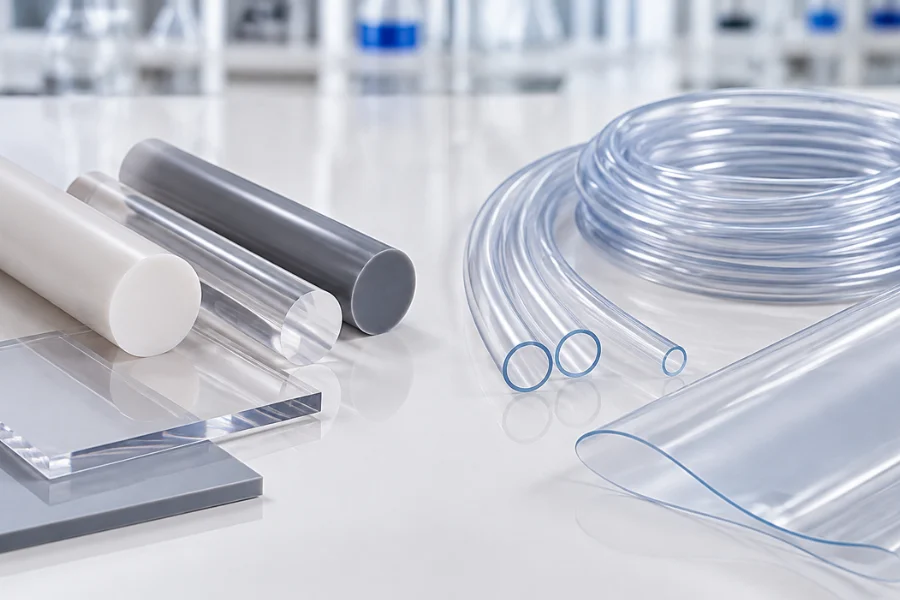
The main difference between rigid and flexible PVC is the formulation, particularly the amount and type of plasticizer used.
| Characteristic | Rigid PVC | Flexible PVC |
|---|---|---|
| Plasticizer content | None or relatively low | Higher, depending on formulation |
| Mechanical behavior | Greater stiffness and shape retention | Greater flexibility and elongation |
| Typical design needs | Structural support and dimensional stability | Bending, flexibility and resistance to kinking |
| Key medical considerations | Geometry, mechanical performance and contact conditions | Plasticizer migration, fluid compatibility and repeated flexing |
| Processing considerations | Thermal stability and mold filling | Thermal stability, formulation consistency and plasticizer behavior |
Adding plasticizer generally increases flexibility and elongation while reducing hardness and tensile strength. The actual balance depends on the resin, plasticizer system, and additive package.
Rigid and flexible PVC should not be treated as interchangeable. The formulation must match the component’s functional requirements and intended contact conditions.
How PVC Formulation Affects Performance
Each ingredient can influence material performance and the evidence required for medical use.
- Plasticizers modify flexibility and influence migration, chemical compatibility, and long-term performance.
- Heat stabilizers help control thermal degradation during processing.
- Lubricants affect melt flow and processing behavior.
- Colorants and other additives may affect chemical characterization, biological evaluation, and appearance.
Changing an additive type, concentration, or supplier can affect whether existing test data remain applicable. Material specifications should therefore identify the relevant grade and formulation, with a process for assessing changes.
Early coordination between material selection, component design, and tooling can reduce avoidable development changes. SeaSkyMedical’s medical product development services are relevant when material requirements need to be considered alongside part geometry and manufacturing feasibility.
Common Uses of Medical Grade PVC
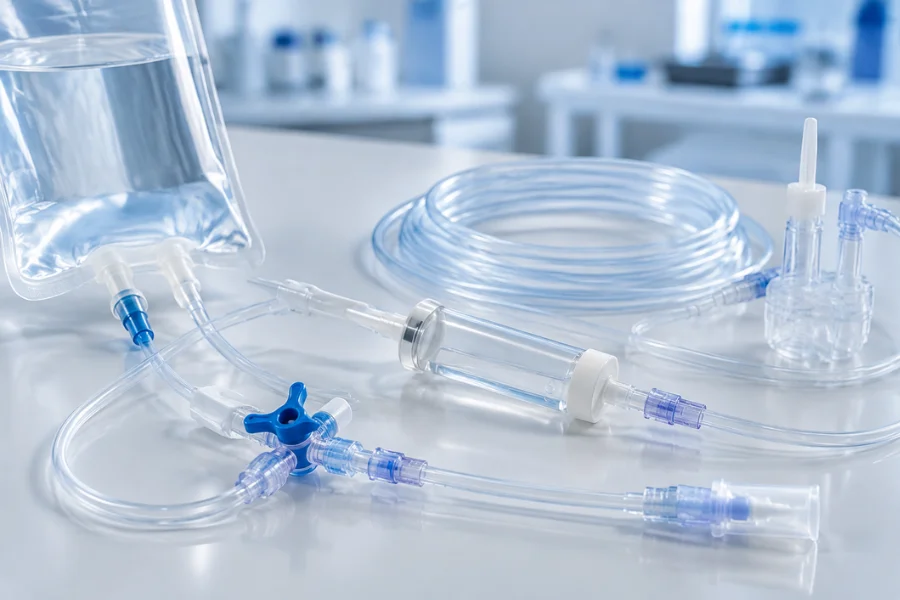
Flexible PVC is used in selected medical applications where flexibility, transparency, and fluid handling are important. The required formulation depends on the component’s contact pathway, operating conditions, and performance requirements.
IV Bags and Fluid Management Components
Flexible PVC has been used in intravenous fluid containers and related fluid management products because it can provide flexibility and transparency.
The key material questions concern the intended fluid, contact duration, temperature, extractables and leachables, and the effects of sterilization and storage.
A formulation that performs acceptably with an aqueous solution may behave differently with a lipid-containing preparation or another chemically challenging fluid. Drug compatibility and potential interactions between the container and its contents must be evaluated for the intended application.
Medical Tubing and Catheters
Flexible PVC can be considered for tubing and catheter applications requiring flexibility, transparency, and controlled dimensions.
Selection should account for the transported fluid, resistance to kinking, pressure conditions, connection design, and expected service life. Blood-contact applications also require evaluation of biological risks and potential interactions between the material and blood.
For assemblies containing tubing, connectors, valves, and seals, compatibility must be assessed across the complete system. A material that performs adequately as a standalone tube may behave differently when assembled with other polymers or exposed to different fluids.
Respiratory and Other Medical Devices
PVC may also be used in selected respiratory components, masks, and other medical products. Suitability depends on the intended contact pathway, mechanical requirements, and formulation-specific safety evidence.
A flexible mask component and a fluid-contact component may require different properties and evaluations. Suitability for one application does not establish suitability for another.
Medical PVC Plasticizers and Material Safety
Plasticizer selection is a major consideration for flexible PVC because some plasticizers can migrate from the polymer into contacting fluids or surrounding materials. The potential exposure depends on the formulation and conditions of use.
DEHP and Non-DEHP Alternatives
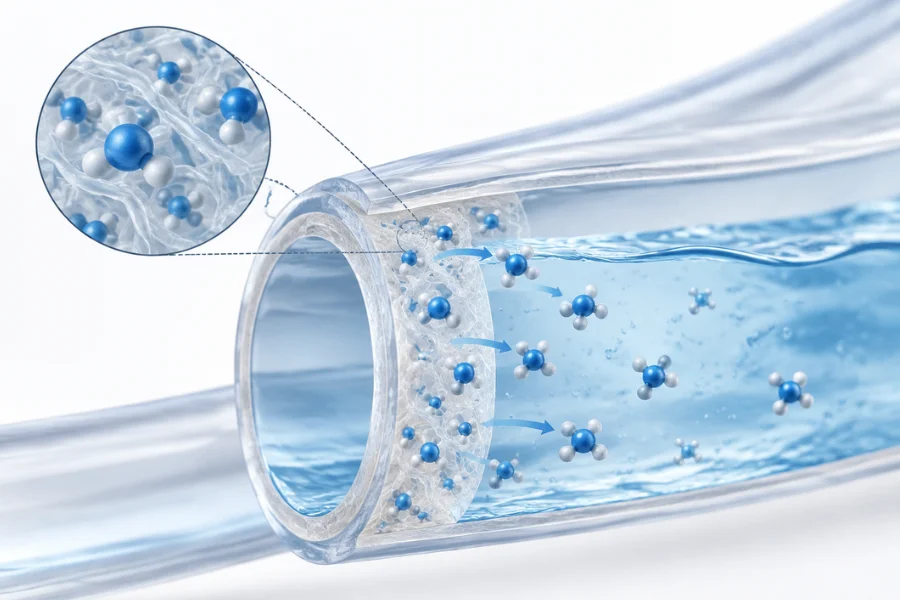
Di(2-ethylhexyl) phthalate, commonly known as DEHP, has historically been used to plasticize flexible medical PVC. Exposure concerns and applicable regulatory requirements have led manufacturers to evaluate alternative formulations.
Alternatives used in or investigated for medical PVC include DEHT, also known as DOTP, TOTM, and DINCH. These substances have different chemical structures and migration behavior, so they cannot be assumed to perform equivalently.
A study published in the International Journal of Pharmaceutics compared the migration of DEHP, DEHT, DINCH, and TOTM from PVC tubing into a 50% ethanol-water simulant at 40°C, with measurements after 24 hours, 72 hours, and 10 days. Under the conditions investigated, TOTM release was more than 20 times lower than DEHP release, while DEHT migration was approximately three times lower. DINCH showed a different migration profile.
These results are specific to the tested formulations and conditions. They do not establish universal migration ratios or prove that one plasticizer is best for every medical device. The researchers also identified the need for additional clinical and toxicological evidence.
The study Migrability of PVC plasticizers from medical devices into a simulant of infused solutions provides the experimental context for these findings.
A DEHP-free formulation is not automatically free of chemical or biological risk. Alternative plasticizers, other ingredients, potential impurities, and the finished device must be evaluated for the intended application.
Plasticizer Migration, Extractables and Leachables
Extractables and leachables help characterize substances that may be released from a medical device.
Extractables are substances released under specified laboratory extraction conditions, which may be more aggressive than normal use. Testing can help identify chemicals that could potentially become available for patient exposure.
Leachables are substances that migrate into an actual or simulated use environment under defined conditions. Their identity and concentration help inform exposure assessment and toxicological risk evaluation.
For PVC components, relevant substances may include plasticizers, stabilizers, impurities, and degradation products. Their release depends on the formulation, processing history, contact medium, temperature, and exposure duration.
ISO 10993-18 addresses chemical characterization of medical device materials, while ISO 10993-17 addresses toxicological risk assessment of medical device constituents. Together, these standards support a risk-based evaluation rather than a universal testing protocol for every PVC component.
Fluid Contact and Multi-Material Compatibility
Different contact media can produce different migration results. Aqueous solutions, lipid-containing fluids, drug formulations, and cleaning agents may interact differently with the same PVC formulation.
Temperature and contact duration also affect the amount and rate of substance release. Short-term laboratory results may not represent longer exposure or actual clinical conditions.
Compatibility must extend to the assembled device. PVC tubing may contact connectors, seals, adhesives, coatings, or other polymers. Material interactions should be evaluated when they could affect chemical exposure, mechanical performance, or the function of the complete assembly.
Medical Grade PVC Regulations and Standards
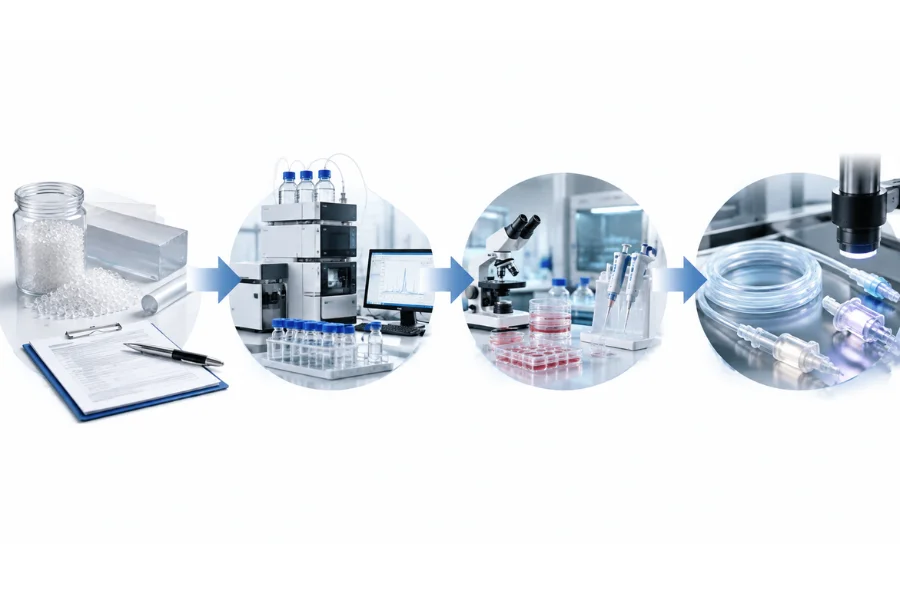
Regulatory requirements depend on the device, intended purpose, target market, and risks associated with its materials and use. No single certificate establishes universal compliance for every medical PVC application.
FDA Requirements and Device-Specific Evaluation
In the United States, the Food and Drug Administration (FDA) evaluates medical devices under the applicable regulatory framework. Biological safety is one part of the evidence used to support device safety.
The required evaluation depends on the device’s contact conditions and risk profile. A material declaration or existing test report may support the assessment, but it does not automatically establish that the finished device is suitable for every intended use.
Manufacturers should confirm that the tested material and processing conditions represent the proposed device. Changes to the formulation, manufacturing process, or sterilization method may require reassessment of the existing evidence.
ISO 10993 and Biological Evaluation
The ISO 10993 series provides a framework for evaluating the biological safety of medical devices. ISO 10993-1 establishes the overall biological evaluation approach within a risk management process, while other parts address specific evaluation methods and risks.
ISO 10993-1:2025, the sixth edition, was published in November 2025. The FDA added it to its recognized consensus standards database on May 25, 2026, with partial recognition. The FDA’s recognition record identifies provisions that are not recognized, including wording in Clause 6.5.11.3 and the approach to biological risk estimation in Clause 6.9.
The FDA also states that declarations of conformity to ISO 10993-1:2018 may be accepted in premarket submissions until July 1, 2029, under the stated recognition arrangement.
Manufacturers should check the current FDA recognition record before finalizing a biological evaluation plan. Publication of a new ISO edition does not mean every clause is automatically recognized by the FDA.
Chemical Characterization and Toxicological Risk Assessment
ISO 10993-18 provides a framework for chemical characterization, while ISO 10993-17 addresses toxicological risk assessment of relevant constituents.
The FDA’s recognition database lists ISO 10993-18:2020, including its 2022 amendment, as partially recognized as of September 7, 2026. The applicable recognition conditions should be reviewed before relying on this standard as the sole basis for a US regulatory submission.
Chemical characterization helps identify and quantify relevant substances. Toxicological assessment then considers whether the potential exposure presents an unacceptable risk. Neither step constitutes automatic approval of a material for every medical application.
EU MDR, REACH and Phthalate Requirements
The European Union Medical Device Regulation, Regulation (EU) 2017/745, addresses risks associated with certain substances in medical devices.
Annex I, Section 10.4 establishes requirements for specified substances classified as carcinogenic, mutagenic, or toxic to reproduction, as well as certain endocrine-disrupting substances. For devices covered by this provision, concentrations above 0.1% by weight trigger applicable requirements concerning justification, information, and other measures.
The provision applies to specified devices, components, and materials, including certain invasive devices, devices that administer substances to or from the body, and devices that transport or store substances intended for administration. Relevant labeling and information requirements may also apply.
This is not a blanket prohibition on all PVC formulations or every use of DEHP. Applicability depends on the substance, device category, and relevant legal provisions.
REACH restrictions and authorization requirements are separate considerations. Their applicability depends on the substance, use, applicable legal provisions, and any relevant authorization or exemption.
Manufacturers supplying the European market should verify the applicable requirements for the specific formulation and device. Procurement teams should identify relevant substances, confirm the applicable rules, and retain supporting documentation rather than relying on a generic claim such as “EU compliant.”
What Material Documentation Should Buyers Request?
The documentation package should reflect the device’s intended use and regulatory pathway. Buyers should consider requesting:
- Exact material grade and formulation identification
- Technical data sheets and relevant mechanical or chemical property data
- Available biological evaluation and chemical characterization reports
- Information about plasticizers and other relevant additives
- Sterilization compatibility data for the intended method
- Lot identification and traceability arrangements
- Change notification and applicable quality documentation
Buyers should confirm that test reports represent the actual formulation and that material identity can be maintained across production lots. If the formulation or manufacturing source changes, the manufacturer should assess whether existing qualification evidence remains applicable.
Sterilization Compatibility of Medical PVC
Sterilization can affect polymer properties, appearance, chemical stability, and additive behavior. Compatibility must be established for the specific formulation and sterilization cycle.
Ethylene Oxide Sterilization
Ethylene oxide (EtO) is used to sterilize medical devices that are not suitable for certain high-temperature methods. Evaluation should consider the cycle’s effects on the material, potential sterilant residuals, aeration, and the complete device configuration. Packaging can also influence sterilization performance and residual removal.
Gamma and Electron Beam Irradiation
Gamma and electron beam sterilization can cause polymer chain scission, crosslinking, oxidation, or other changes, depending on the formulation and exposure conditions.
For flexible PVC, these changes may affect color, flexibility, or mechanical performance. Engineers should review evidence for the specific material and relevant dose range rather than relying on generic claims about radiation resistance.
Steam and Chemical Sterilization
Steam sterilization exposes materials to elevated temperatures and moisture. A PVC formulation suitable for one sterilization method may not tolerate repeated steam cycles without unacceptable changes.
Chemical sterilants and disinfectants can cause swelling, surface changes, degradation, or interactions with additives. Evaluation should reflect the actual chemical, concentration, exposure conditions, and expected service life.
Medical PVC Injection Molding Considerations
PVC’s thermal sensitivity makes temperature control and melt residence time important during processing. Excessive heat exposure can cause degradation and release hydrogen chloride, potentially affecting material properties, part appearance, and processing stability.
The supplied reference book on plastic molding and mold design identifies thermal stability, residence time, stabilizers, lubricants, and mold design as key processing considerations. These principles provide an engineering basis for process development, but actual settings must be established for the specific formulation, equipment, mold, and component.
Thermal Stability and Material Degradation
PVC can degrade when exposed to excessive temperatures or prolonged residence in processing equipment. Degradation may cause discoloration, changes in material properties, and the release of hydrogen chloride.
The processing window depends on the formulation and equipment. Process development should consider barrel temperature distribution, actual melt temperature, residence time, screw design, and material handling.
Production interruptions require particular attention because material remaining in a hot barrel may experience longer thermal exposure than intended. Purging and restart procedures should therefore be established for the selected formulation and equipment.
Discoloration can indicate a processing problem, but visual inspection alone cannot establish that the material has retained all required properties.
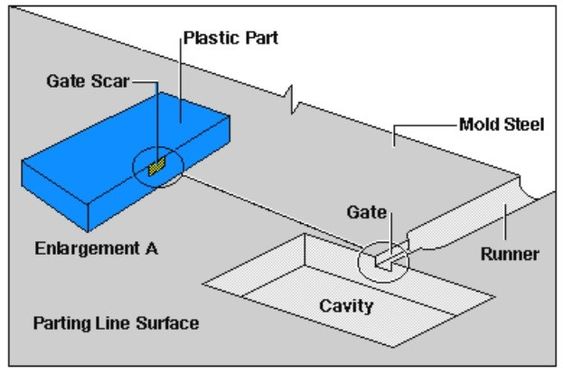
Mold Design, Gate Layout and Cooling
PVC mold design should support predictable filling while limiting unnecessary heat exposure and material stagnation.
The reference book recommends a relatively short, adequately sized gating system and effective mold cooling. These are starting principles rather than universal design rules. Final decisions depend on component geometry, formulation viscosity, wall thickness, gate location, and production requirements.
Engineers should evaluate the following factors:
- Runner and gate design: Flow paths and gate dimensions should support filling without unnecessary pressure loss or excessive residence time.
- Dead spots and stagnation: Areas that retain material can increase degradation risk during extended production.
- Cooling control: Appropriate cooling helps manage cycle time, dimensional stability, and part consistency.
- Venting and filling behavior: The mold must allow air to escape and avoid filling conditions that produce unacceptable defects.
- Process repeatability: Tooling should support stable production within the established process window.
For projects requiring custom tooling, medical injection mold design and manufacturing can be considered alongside part geometry, resin processing characteristics, dimensional requirements, and production volume.
The reference book provides general PVC processing ranges, but these should not be copied directly into a medical production specification. Resin grades, plasticizer systems, equipment designs, and component geometries can differ substantially.
Process Validation and Production Consistency
A successful molding trial does not establish that a process will remain stable during routine production. Process development should define operating conditions, acceptance criteria, and inspection methods appropriate to the component and manufacturing process.
Relevant controls may include material lot traceability, dimensional inspection, visual defect criteria, process parameter monitoring, and documented handling of deviations. Changes to the resin formulation, mold, equipment, or processing conditions should be assessed for their impact on component performance and existing validation evidence.
Depending on the project scope, medical device verification and validation can support evaluation of design requirements, manufacturing processes, and defined acceptance criteria.
For projects involving molded medical components, medical plastic injection molding can be evaluated in relation to the selected resin, component geometry, tooling requirements, dimensional tolerances, and production volume.
How to Select Medical Grade PVC for an OEM Project
A structured selection process helps engineering, procurement, and quality teams evaluate materials before committing to tooling and production.
Step 1 — Define Intended Use and Contact Conditions
Document the contact pathway, contact duration, fluid or drug exposure, mechanical loading, expected service life, and target markets. These factors determine which material properties and biological risks need to be evaluated.
Addressing these requirements early can also inform medical product development, helping engineering teams align material choices, part design, and manufacturing considerations before tooling begins.
Step 2 — Confirm the Formulation and Documentation
Request the exact grade designation and available documentation for the proposed application. Check whether the data relate to the actual formulation and whether the supplier can maintain material identity and notify customers of relevant changes.
Generic PVC data may support initial screening but may not be sufficient for final qualification.
Step 3 — Evaluate Chemical and Sterilization Compatibility
Identify the relevant fluids, cleaning agents, sterilization cycle, and storage conditions. Assess potential plasticizer migration, other leachables, material degradation, and changes in mechanical properties.
Where necessary, establish testing based on the intended use and final device configuration.
Step 4 — Verify Manufacturability and Scale-Up Readiness
Review the component design, mold-filling requirements, thermal stability, cooling, dimensional tolerances, and expected production volume.
For injection-molded components, confirm that the formulation can be processed within a suitable operating window. The manufacturing plan should address process monitoring, acceptance criteria, traceability, and change control.
Step 5 — Assess the Complete Project Risk
Material cost should be evaluated alongside qualification effort, tooling requirements, processing stability, and lifecycle risk.
A formulation that requires extensive compatibility testing, difficult process adjustments, or repeated design changes may increase project cost and delay production. The selection should balance functional performance, regulatory evidence, manufacturing feasibility, and long-term consistency.
Medical Grade PVC vs. Alternative Materials
PVC is not the only option for medical components. TPU, silicone, and polypropylene may be suitable alternatives depending on the required function.
| Material | Potential advantages | Important limitations to evaluate |
|---|---|---|
| PVC | Flexible formulations, transparency, established processing options | Plasticizer-related risks, thermal degradation, formulation-dependent compatibility |
| TPU | Elasticity, abrasion resistance, flexible component design options | Chemical compatibility, formulation-specific biological evaluation, processing requirements |
| Silicone | Flexibility and performance across selected temperature ranges | Different tooling and processing needs, mechanical design constraints, cost |
| PP | Low density, chemical resistance, potential suitability for rigid components | Lower flexibility than many plasticized PVC formulations, application-specific sterilization and mechanical limits |
This comparison is for initial screening, not a universal material ranking. Performance depends on the specific grade, formulation, component geometry, processing conditions, and intended use.
Replacing flexible PVC tubing with TPU may require changes to dimensions, connections, processing conditions, and validation evidence. For projects considering TPU injection molding, the material’s mechanical properties, chemical compatibility, and intended use should be assessed before confirming the substitution. Switching to silicone may involve a different manufacturing route. Any material change should be evaluated at both the component and device levels.
Frequently Asked Questions
Is medical grade PVC safe for medical devices?
It can be suitable for specific medical applications when the formulation and finished device have been appropriately evaluated for their intended use. Safety cannot be established from the PVC designation alone.
Does medical grade PVC need ISO 10993 testing?
The required biological evaluation depends on the device, contact conditions, risks, and available evidence. ISO 10993 provides an evaluation framework rather than an identical test list for every PVC material.
What is the difference between DEHP and DEHP-free medical PVC?
DEHP is a plasticizer historically used in flexible PVC. DEHP-free formulations use other plasticizers, which must be assessed for their own chemical, biological, and performance characteristics.
Can medical grade PVC be sterilized?
Some formulations may be compatible with particular sterilization methods, but compatibility must be demonstrated for the selected material and cycle. EtO, irradiation, steam, and chemical methods can affect material properties in different ways.
Is PVC suitable for medical injection molding?
PVC can be injection molded using appropriately selected materials, equipment, tooling, and process conditions. Its thermal sensitivity makes temperature control, residence time, and mold design particularly important.
What documents should buyers request from a medical PVC supplier?
Buyers should request the exact material grade, relevant technical data, available biological and chemical evaluation evidence, sterilization compatibility information, traceability arrangements, and change-control documentation appropriate to the project.
Medical PVC Material Selection for Manufacturing Projects
Medical PVC selection requires the formulation, intended use, chemical exposure, biological evaluation, sterilization method, and manufacturing process to be considered together. A material’s general properties cannot replace evidence that the finished component meets its requirements.
For OEM projects, early coordination between product design, material suppliers, quality teams, and manufacturing engineers helps identify compatibility and processing risks before tooling and qualification activities progress too far.
SeaSkyMedical provides medical device contract manufacturing services covering relevant stages of product development and manufacturing, depending on project requirements. Discuss your component design, material considerations, tooling needs, and production requirements with the team to determine an appropriate manufacturing approach.