Polystyrene (PS) is widely used in laboratory and diagnostic products because of its optical clarity, rigidity, and favorable injection molding characteristics. Common applications include Petri dishes, microplates, selected laboratory tubes, and diagnostic cartridge housings.
General-purpose polystyrene (GPPS) is preferred when transparency and rigidity are important, while high-impact polystyrene (HIPS) offers improved impact resistance through rubber modification. Selecting a suitable grade requires evaluating optical performance, chemical exposure, mechanical loads, sterilization conditions, and manufacturing requirements.
For OEM manufacturers, the main challenge is matching these material characteristics to the functional requirements of the finished component. Resin qualification, surface treatment, mold design, dimensional control, and production validation must be considered together.
Understanding Medical-Grade Polystyrene
What Is Polystyrene (PS)?
Polystyrene is an amorphous thermoplastic polymer produced through the polymerization of styrene monomers. Its amorphous structure supports transparency and relatively uniform optical appearance, while its rigidity makes it suitable for disposable laboratory components.
The supplied plastics engineering reference identifies the following general properties of conventional PS.
- Density of approximately 1.054 g/cm³.
- Good electrical insulation, including high-frequency insulation performance.
- Favorable melt flow and injection molding characteristics.
- Resistance to selected acids, alkalis, alcohols, and salt solutions.
- General heat deflection temperature of approximately 70–98°C.
PS also has important limitations. Its relatively low heat resistance restricts high-temperature applications, while its brittle behavior and relatively high thermal expansion require attention during product design and mold development.
Chemical resistance must be evaluated against the actual exposure conditions. PS can be attacked by aromatic hydrocarbons, ketones, esters, and other solvents, so compatibility should be verified for the specific resin grade, chemical concentration, temperature, and contact duration.
The reference values describe conventional PS rather than every medical or modified formulation. Actual properties must be confirmed using the selected resin supplier’s technical data.
GPPS vs HIPS for Medical Applications
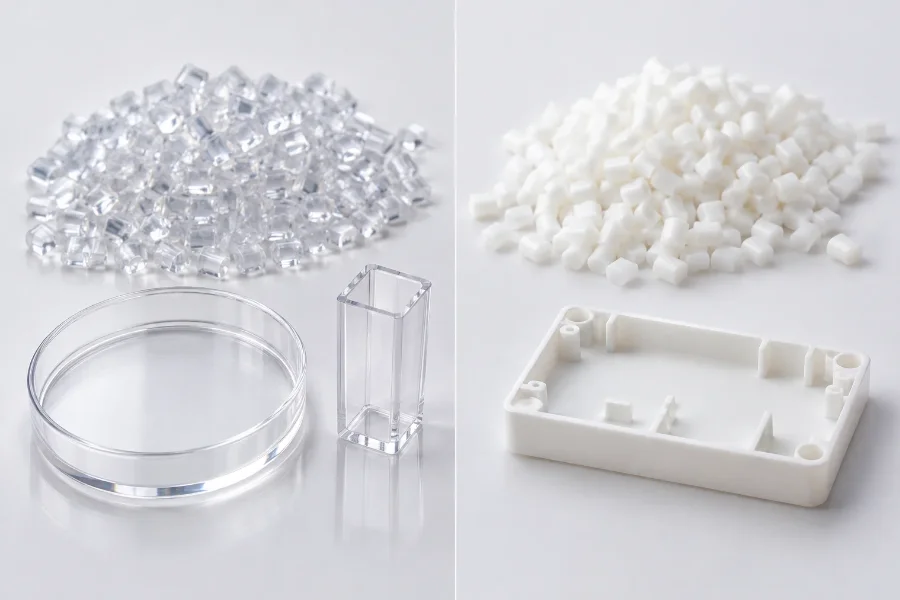
GPPS and HIPS are two important polystyrene categories used in different laboratory, diagnostic, and packaging applications.
| Property | GPPS | HIPS |
|---|---|---|
| Transparency | High | Usually opaque |
| Rigidity | Relatively high | Generally lower than GPPS |
| Impact resistance | Relatively low | Improved through rubber modification |
| Surface appearance | Clear and glossy | Generally opaque |
| Typical applications | Laboratory ware and transparent components | Protective trays and selected packaging |
| Main limitation | Brittle behavior | Reduced optical clarity |
GPPS is commonly considered for Petri dishes, microplates, and transparent sample handling components. Its rigidity and optical clarity support visual inspection and applications involving visible-light measurements.
HIPS is more appropriate for components that require greater impact resistance, such as selected protective trays and packaging structures. Rubber modification improves toughness but also changes optical properties, melt flow, and shrinkage behavior.
The term medical-grade PS requires careful interpretation. A conventional GPPS or HIPS designation does not establish medical suitability by itself. Manufacturers must evaluate the specific resin formulation, additives, supplier documentation, intended application, and applicable regulatory requirements.
Applications of Polystyrene in Laboratory and Diagnostic Products
PS is used in several disposable laboratory and diagnostic product categories. Its suitability depends on whether the application prioritizes transparency, surface characteristics, dimensional accuracy, or impact resistance.
Petri Dishes and Tissue Culture Products
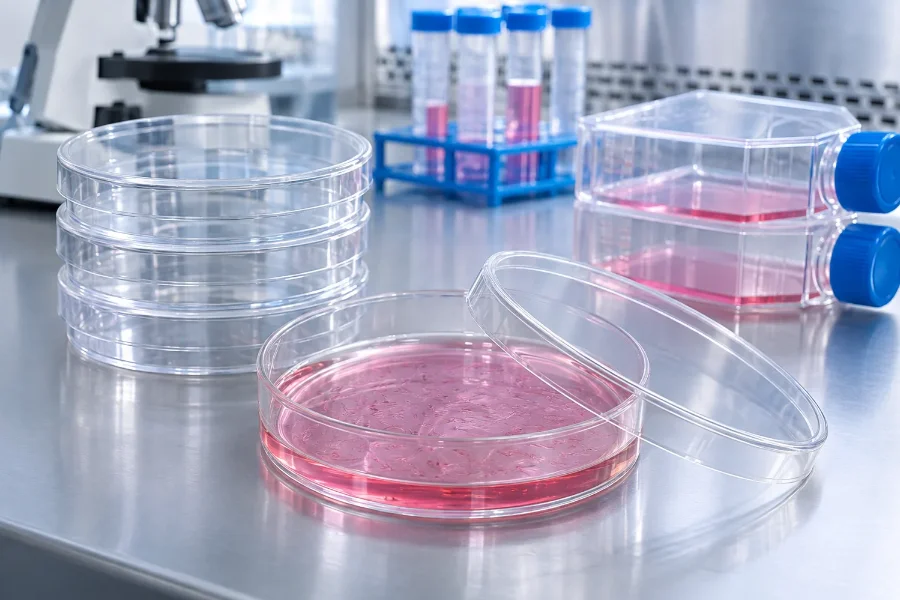
Petri dishes and tissue culture vessels are established applications of GPPS. Transparent walls allow researchers to observe samples and cell growth without opening the container.
Surface characteristics are particularly important in cell culture. Untreated PS is generally hydrophobic, which can limit cell attachment depending on the cell type and culture conditions.
Manufacturers use plasma treatment, corona treatment, or other surface modification processes to increase hydrophilicity. These treatments alter the polymer surface and can influence protein adsorption and cell attachment.
Different surface requirements serve different laboratory purposes.
- Tissue culture-treated surfaces support selected adherent cell culture applications.
- High-binding surfaces promote protein adsorption for specific assay requirements.
- Low-binding surfaces help reduce unwanted protein or biomolecule adsorption.
- Specialized coatings support selected molecular or cellular interactions.
These surface categories are not interchangeable. The treatment must match the intended biological interaction, and its effectiveness should be evaluated after manufacturing and under the product’s intended storage conditions.
For OEM projects involving disposable laboratory vessels, SeaSkyMedical provides custom medical laboratory consumables manufacturing support.
Microplates for Diagnostic and Laboratory Testing
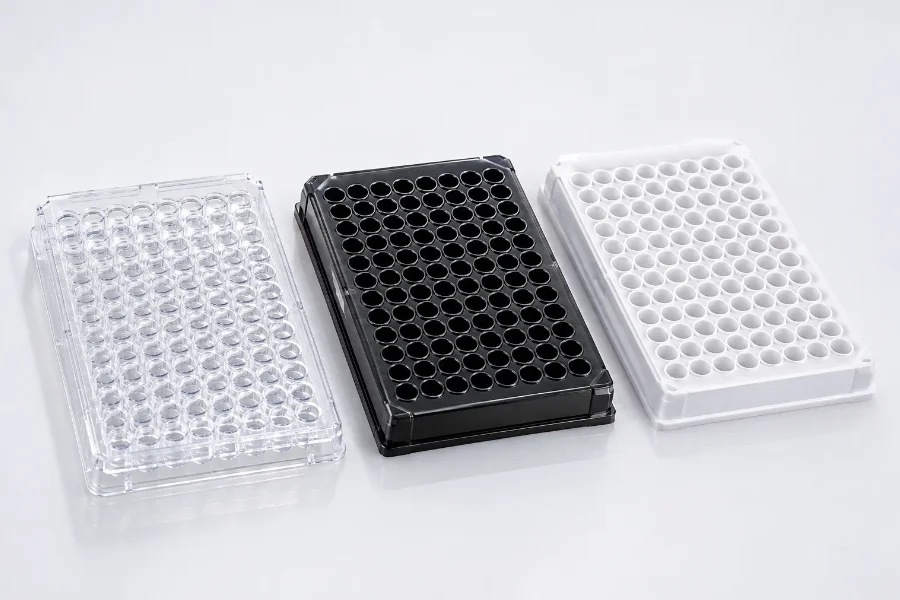
Microplates are used in biochemical assays, immunological testing, and high-throughput laboratory workflows. GPPS is widely used because it combines transparency, rigidity, and the ability to reproduce multiple wells through injection molding.
Common formats include 96-well and 384-well plates. Their performance depends on both material properties and the dimensional consistency of the molded wells.
Optical properties and plate selection
Clear PS microplates are commonly used for absorbance measurements and visual sample inspection. Black plates are frequently selected for fluorescence applications because they can reduce background signal and optical crosstalk, while white plates are commonly used for luminescence measurements because they reflect emitted light toward the detector.
These are common application choices rather than exclusive rules. Actual plate selection depends on the assay chemistry, detector configuration, well geometry, and required signal characteristics.
Well geometry and dimensional consistency
Consistent well dimensions, spacing, and bottom geometry support automated pipetting and instrument compatibility. Variations in these features can affect liquid handling, sample positioning, and measurement consistency.
Plate flatness is also important. Warpage can interfere with instrument positioning, automated handling, and sealing operations.
For multi-cavity molds, dimensional inspection should identify whether variation originates from individual cavities rather than relying only on average measurements across the complete plate.
Autofluorescence and optical anisotropy
Transparency alone does not establish optical suitability. Resin composition, surface characteristics, molecular orientation, and residual molding stress can influence autofluorescence and optical behavior.
Flow-induced molecular orientation and residual stress can contribute to optical anisotropy and birefringence in molded PS components. These effects may interfere with polarization-sensitive assays, including fluorescence polarization and selected FRET-based measurements.
For applications requiring UV transmission or particularly low optical interference, conventional PS may not provide the required performance. COC, COP, or glass may be more appropriate depending on the wavelength range and analytical requirements.
Test Tubes, Pipettes and Filtration Units
PS is used in selected laboratory tubes, serological pipettes, and disposable filtration products where rigidity and transparency support sample handling and visual inspection.
Material selection must account for the liquid-contact environment, operating pressure, and exposure duration. PS resists selected aqueous solutions but has limited resistance to many organic solvents, including aromatic hydrocarbons, ketones, and esters.
Not every laboratory pipette or filtration component uses PS. Many pipette tips, for example, use polypropylene because its flexibility and chemical resistance better match the product’s functional requirements.
Engineers should evaluate the material requirements of the product body, liquid-contact surfaces, connectors, and sealing components separately rather than assuming one polymer is suitable for every part of an assembly.
Selected Diagnostic Cuvettes and Sample Handling Components
Certain diagnostic sample handling components and cuvettes use transparent plastics for optical measurement and visual inspection.
PS can be considered when the required wavelength range, chemical compatibility, and optical performance fall within the capabilities of the selected resin grade.
However, conventional PS should not be treated as a universal material for diagnostic cuvettes. UV-based measurements and applications requiring particularly low background fluorescence may require COC, COP, or other specialized materials.
Material evaluation should include light transmission, background fluorescence, optical uniformity, sample compatibility, and dimensional requirements of the measurement system.
Injection-Molded IVD Diagnostic Cartridges
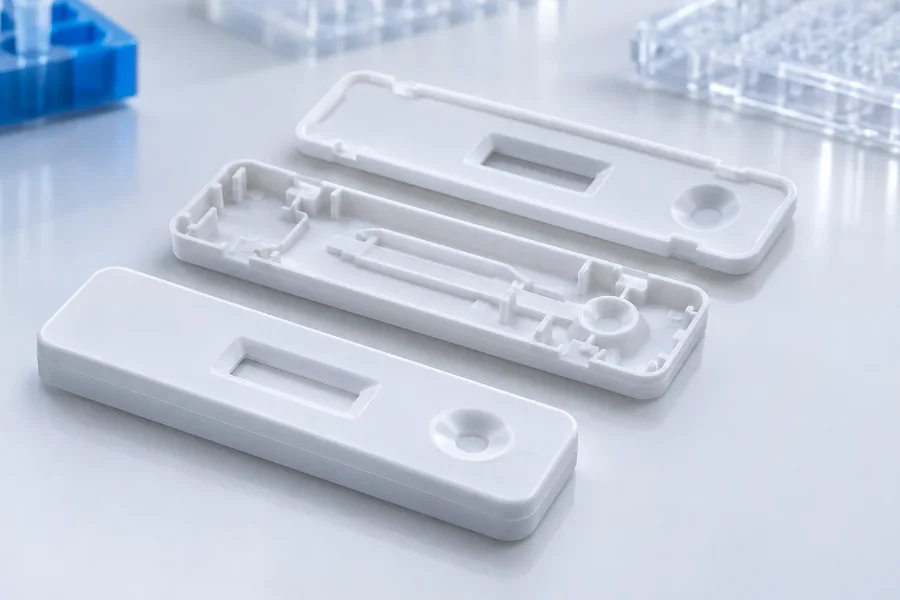
Polystyrene can be considered for selected in vitro diagnostic (IVD) cartridge components, including certain lateral flow test housings and sample handling structures.
These components may contain internal channels, assembly interfaces, alignment features, and sealing structures. Their geometry must support the intended diagnostic workflow without interfering with the performance of internal functional components.
Three manufacturing considerations are particularly important.
Cartridge geometry and assembly
Wall thickness transitions, internal ribs, snap-fit features, and mating interfaces influence component strength and assembly accuracy. Shrinkage or warpage can change assembly clearances and affect the fit between cartridge components.
Mold filling and ejection
Narrow sections and complex internal geometries require appropriate gate positioning, venting, and filling balance. Weld lines near critical assembly or functional areas may require design changes, while uneven ejection forces can damage brittle PS features.
Dimensional consistency
Critical dimensions may include internal channel geometry, alignment features, sealing surfaces, and assembly interfaces. For multi-cavity production, cavity-specific variation should be evaluated when it affects functional performance.
PS is not suitable for every diagnostic cartridge. PP, PC, COC, COP, or other polymers may be required when chemical compatibility, mechanical toughness, optical performance, or temperature requirements exceed the capabilities of the selected PS grade.
Material selection and mold design should therefore be evaluated together during early DFM review.
HIPS Medical Device Trays and Packaging
HIPS is used in selected medical packaging applications where impact resistance and structural rigidity are more important than transparency.
Thermoformed HIPS trays can protect medical devices during handling, storage, and transportation. Their geometry can be designed around the dimensions and retention requirements of the packaged device.
A protective tray and a medical device component have different material qualification requirements. Suitability for external packaging does not automatically establish suitability for direct patient contact or other regulated medical applications.
Thermoforming should also be distinguished from injection molding because the processes involve different tooling, material behavior, and design considerations.
How PS Surface Modification Affects Laboratory Performance
PS surface modification changes the properties of the polymer’s outer surface without necessarily changing the bulk material. The treatment method should be selected according to the required wetting behavior, protein interaction, and cell attachment characteristics.
Untreated Polystyrene Surfaces
Untreated PS generally has a hydrophobic surface. Depending on the application, this can limit cell attachment or influence how proteins and other biological molecules interact with the surface.
However, untreated PS should not automatically be classified as a specialized low-binding material. Low-binding performance requires application-specific evaluation and may involve additional surface treatments or coatings.
Plasma and Corona Surface Treatment
Plasma and corona treatments modify the polymer surface through oxidation and can introduce oxygen-containing functional groups.
These changes influence surface energy, wettability, and interactions with biological molecules. Their effectiveness depends on treatment conditions, surface coverage, and the stability of the modified surface.
For production applications, manufacturers should evaluate treatment uniformity and whether the required surface characteristics remain within specification after storage. A surface treatment that initially improves hydrophilicity may not maintain the same performance indefinitely.
Surface Requirements for Cell Culture and Diagnostic Assays
Different laboratory applications require different surface interactions.
| Surface Type | Primary Function |
|---|---|
| Tissue culture-treated | Support selected adherent cell culture applications |
| High-binding | Promote protein adsorption |
| Low-binding | Reduce unwanted biomolecule adsorption |
| Specialized functional coating | Support specific molecular or cellular interactions |
Surface treatment should be specified as a functional product requirement. Hydrophilicity alone does not prove that a surface will provide the desired cell attachment, protein binding, or assay performance.
Injection Molding Considerations for Medical PS Components
PS offers favorable melt flow and can reproduce detailed molded geometries. Its brittleness, thermal expansion, and sensitivity to residual stress require careful control of wall thickness, filling, cooling, and ejection.
Wall Thickness and Mold Design
Uniform wall thickness helps reduce variations in cooling and shrinkage. Sudden transitions between thick and thin sections can create localized cooling differences, increasing the risk of sink marks, dimensional distortion, and residual stress.
The supplied plastics engineering reference lists general PS wall thickness values of approximately 2.25–2.60 mm for typical parts. It also identifies 0.75 mm as a minimum reference value under its stated flow-length condition.
These figures are not universal design limits. Microplates, thin-walled laboratory vessels, and diagnostic cartridges may require different thicknesses based on resin flow behavior, part geometry, tooling capability, and filling requirements.
During DFM review, engineers should evaluate:
- Wall thickness uniformity.
- Flow length and filling requirements.
- Transitions between thick and thin sections.
- Rib and boss geometry.
- Cooling channel placement.
- Potential stress concentration areas.
- Assembly and sealing interfaces.
For complex laboratory products, tooling precision influences filling balance, cooling consistency, ejection performance, and cavity-to-cavity variation. These factors should be evaluated during medical injection mold making rather than addressed only after trial molding.
Gate Design and Flow Behavior
PS has good melt flow characteristics, and the supplied reference identifies point gates as a commonly used option. However, gate selection should depend on part geometry, appearance requirements, filling behavior, and production volume.
Gate location determines the direction of melt flow and influences where separate flow fronts meet. These meeting areas can create weld lines that affect surface appearance and, depending on their location and formation conditions, mechanical performance.
For transparent laboratory products, visible weld lines may be a cosmetic concern. In diagnostic cartridges, their location relative to assembly interfaces and functional features is particularly important.
Mold filling analysis can help identify potential flow-front meeting areas, filling imbalance, and locations where air may become trapped. Gate positioning and mold venting should be evaluated during mold development rather than addressed only through process adjustments.
Injection Molding Parameters for PS
The supplied plastics engineering reference provides the following general PS injection molding values.
| Process Parameter | Textbook Reference Value |
|---|---|
| Nozzle temperature | 160–170°C |
| Front barrel temperature | 170–190°C |
| Middle barrel temperature | 165–180°C |
| Rear barrel temperature | 140–160°C |
| Mold temperature | 20–60°C |
| Injection pressure | 60–100 MPa |
| Holding pressure | 30–40 MPa |
| Holding time | 15–40 seconds |
| Cooling time | 15–30 seconds |
| Molding cycle | 40–90 seconds |
These figures are textbook reference values, not validated production settings for every PS grade. Actual conditions depend on resin formulation, injection machine design, mold geometry, component thickness, and required product performance.
The reference recommends relatively high melt and mold temperatures, lower injection pressure, and longer injection time in its general discussion of PS molding. These recommendations should be treated as starting guidance rather than universal settings.
Excessive melt temperature can contribute to silver streaks, while insufficient filling or poor venting can increase the risk of visible weld lines. Process development should establish a suitable operating window through material-specific trials and documented evaluation.
Shrinkage and Dimensional Stability
The supplied engineering reference provides the following general PS shrinkage ranges.
| PS Type | Reference Shrinkage |
|---|---|
| General-purpose PS | 0.6–0.8% |
| Heat-resistant PS | 0.2–0.8% |
| Impact-modified PS | 0.3–0.6% |
These values provide an initial reference for mold design. Actual shrinkage depends on resin grade, part geometry, mold temperature, packing conditions, and cooling behavior.
For microplates, shrinkage variation can affect well spacing, bottom geometry, and plate flatness. For diagnostic cartridges, it can influence assembly clearances, sealing interfaces, and alignment features.
Multi-cavity tooling requires cavity-specific dimensional evaluation when functional tolerances are critical. Comparing only average dimensions across all molded parts may conceal localized variation between cavities.
Mold compensation should be based on material-specific data, mold trials, and dimensional inspection rather than relying exclusively on general reference values.
Ejection, Residual Stress and Crack Prevention
PS is relatively brittle and can crack under excessive mechanical stress during demolding or subsequent handling.
The supplied reference identifies several potential causes of cracking, including insufficient draft, uneven ejection, prolonged cooling under certain processing conditions, low mold temperature under specific conditions, and differences in thermal expansion between plastic and embedded metal components.
Mold designers should therefore consider balanced ejection, suitable draft angles, appropriate cooling conditions, and the elimination of unnecessary stress concentration points.
Metal inserts require particular attention because differences in thermal expansion between the insert and PS can contribute to cracking. Where inserts are necessary, their geometry, interface design, and assembly conditions should be evaluated during DFM.
Optical Quality and Surface Defect Control
Transparent PS components require visual and dimensional inspection because molding defects can affect both appearance and functional performance.
| Defect | Potential Causes | Manufacturing Considerations |
|---|---|---|
| Weld lines | Low melt temperature, insufficient injection pressure, poor venting | Review gate location, filling behavior, and venting |
| Cracks | Uneven ejection, insufficient draft, residual stress | Improve ejection balance and mold design |
| Silver streaks | Excessive melt temperature or material-related processing issues | Review material condition and temperature settings |
| Sink marks | Inadequate packing or uneven cooling | Review wall thickness and packing conditions |
| Warpage | Uneven cooling and residual stress | Improve cooling balance and process consistency |
Visual inspection alone may not establish optical suitability for diagnostic applications. Depending on the product, verification may also require light transmission, background signal, or optical uniformity measurements.
For microplates, inspection should include well geometry and plate flatness when these characteristics affect automated handling or measurement performance.
Sterilization and Chemical Compatibility of Medical PS
PS sterilization compatibility depends on the resin formulation, sterilization dose or exposure conditions, and the functional requirements of the finished product.
Ethylene Oxide Sterilization
Ethylene oxide (EtO) is used for selected heat-sensitive medical products that cannot tolerate conventional steam sterilization conditions.
Certain PS laboratory products are supplied EtO-sterilized, but compatibility must be confirmed for the specific resin formulation and finished component.
Evaluation should consider preconditioning, gas exposure, aeration, and residual EtO levels. Packaging integrity and product functionality should also be checked after sterilization, particularly for components with complex geometries or sealing interfaces.
Gamma Irradiation
Gamma irradiation is used for selected PS laboratory and medical products. However, radiation exposure can affect polymer properties depending on resin formulation, dose, oxygen exposure, and processing history.
Potential changes include discoloration, molecular degradation, and reduced mechanical performance. For products requiring optical clarity, post-sterilization inspection should include color, transparency, and application-specific optical requirements.
Compatibility should be established using the intended sterilization dose and the actual finished product rather than resin classification alone.
Steam Sterilization Limitations
Conventional PS has limited heat resistance and is generally unsuitable for repeated high-temperature steam autoclaving.
Its heat deflection temperature is substantially below common autoclave temperatures. Exposure to these conditions can cause softening, deformation, and loss of dimensional stability.
PP and other heat-resistant polymers are often considered when laboratory products require repeated steam sterilization.
Chemical Compatibility
PS resists selected aqueous solutions, dilute acids, alkalis, and some alcohols. However, aromatic hydrocarbons, ketones, and esters can attack the polymer.
Exposure to incompatible chemicals may cause swelling, crazing, cracking, or dissolution. Compatibility testing should reflect chemical concentration, temperature, contact duration, mechanical stress, and the selected resin formulation.
PS vs Other Medical Plastics
PS is not the only material used in laboratory and diagnostic manufacturing. PP, PC, COC, and COP offer different combinations of optical, mechanical, chemical, and thermal performance.
| Material | Main Advantages | Main Limitations | Typical Application Direction |
|---|---|---|---|
| GPPS | Transparency, rigidity, good flowability | Brittleness and limited heat resistance | Laboratory ware and microplates |
| HIPS | Improved impact resistance and toughness | Reduced optical clarity | Medical trays and packaging |
| PP | Chemical resistance and better heat resistance | Optical and stiffness properties vary by grade | Laboratory containers and sterilizable products |
| PC | High impact resistance and good transparency | Chemical compatibility and stress cracking concerns | Durable transparent components |
| COC/COP | Optical performance, low birefringence, and selected chemical resistance advantages | Higher material and processing costs | Advanced diagnostic and optical components |
PS vs PP
PS is generally preferred when transparency and rigidity are important. PP offers better resistance to many chemicals and greater heat resistance, making it useful for laboratory containers and products requiring more demanding thermal conditions.
The choice depends on whether optical clarity, chemical compatibility, mechanical flexibility, or sterilization requirements dominate the design. For projects where PP is being considered as an alternative, our guide to medical-grade polypropylene injection molding explains its material behavior and manufacturing considerations.
PS vs PC
PC provides higher impact resistance and better heat resistance than conventional GPPS. It may be more appropriate for transparent components that require greater mechanical durability.
PS remains a practical option for disposable laboratory products where rigidity, optical clarity, and high-volume molding are priorities.
PS vs COC and COP
COC and COP are important alternatives for diagnostic products requiring demanding optical performance.
Their optical characteristics, including low birefringence and favorable UV transmission in suitable grades, can support applications where conventional PS has limitations. For applications requiring tighter optical control, engineers can evaluate COC injection molding for medical devices as an alternative material and manufacturing approach.
Quality and Validation Considerations for Medical PS Manufacturing
Medical PS manufacturing requires documented material control, product inspection, and process qualification. These activities address different risks and should not be treated as interchangeable.
Material Documentation and Traceability
OEM buyers should review relevant resin documentation before approving a material for production.
Depending on the project, this may include:
- Material specifications and technical data sheets.
- Certificates of Analysis (CoA).
- Certificates of Conformity (CoC).
- Resin lot identification.
- Supplier change notification procedures.
- Relevant regulatory and biological evaluation documentation.
A supplier’s statement that a resin is medical grade or non-cytotoxic does not automatically establish compliance for the finished medical device.
Material traceability should connect resin supplier information, material grades, batch numbers, molding records, and finished components. These records help manufacturers investigate material changes, production deviations, and quality issues. Our article on medical molding material traceability explains how traceability supports medical manufacturing.
For products involving direct or indirect patient contact, biological evaluation should reflect intended use, contact characteristics, manufacturing conditions, and applicable regulatory requirements. Laboratory consumables used exclusively for in vitro testing may have different assessment requirements.
Dimensional and Visual Inspection
Inspection criteria should reflect the functional characteristics of the finished component.
For microplates, important characteristics may include:
- Well dimensions and spacing.
- Well bottom geometry.
- Plate flatness.
- Optical appearance and uniformity.
- Compatibility with automated equipment.
- Variation between cavities and production lots.
For transparent laboratory vessels, inspection may cover surface defects, cracks, contamination, and dimensional consistency.
For diagnostic cartridges, critical dimensions may include internal channels, assembly interfaces, sealing surfaces, and alignment features. Acceptance criteria and inspection methods should be established during product development.
Process Validation and Production Consistency
Installation Qualification (IQ), Operational Qualification (OQ), and Performance Qualification (PQ) provide a structured approach to qualifying manufacturing equipment and processes.
- Installation Qualification (IQ) confirms that equipment, tooling, and supporting systems are installed according to defined requirements.
- Operational Qualification (OQ) evaluates whether the process operates within established parameters and acceptable operating ranges.
- Performance Qualification (PQ) demonstrates that the manufacturing process can consistently produce acceptable parts under defined production conditions.
For PS components, process qualification should consider melt temperature, mold temperature, injection conditions, packing, cooling, and ejection. These parameters influence filling, shrinkage, residual stress, and dimensional consistency.
Production monitoring and statistical process control can help identify variation before it affects finished product quality. For multi-cavity molds, cavity-specific performance should also be monitored when required by product specifications and risk assessment.
For a more detailed explanation of these stages, see our guide to medical injection molding process validation.
Frequently Asked Questions
Medical-grade polystyrene refers to specific PS resin formulations qualified for defined medical or laboratory applications. Suitability depends on the resin formulation, intended use, manufacturing conditions, sterilization method, and applicable regulatory requirements. The designation alone does not establish finished-device compliance.
GPPS offers transparency, rigidity, and favorable injection molding characteristics. These properties support disposable products such as Petri dishes, microplates, and selected laboratory tubes. Its brittleness and relatively low heat resistance must be considered during material selection.
HIPS can be suitable for selected medical device trays and protective packaging because rubber modification improves its impact resistance. It is often used when structural protection is more important than optical clarity. Packaging suitability does not automatically establish suitability for patient-contact components.
Certain polystyrene grades and finished products can tolerate gamma irradiation at validated doses. However, radiation exposure may affect color, molecular structure, and mechanical performance. Manufacturers should evaluate the specific resin formulation and finished component after sterilization.
Yes. PS is widely used in cell culture dishes and vessels because its surface can be modified to support cell attachment. Untreated PS is generally hydrophobic, while surface oxidation can improve hydrophilicity and influence protein adsorption. The required surface characteristics depend on the cell type and intended culture application.
No. PS is suitable for selected diagnostic and laboratory products, particularly those requiring transparency and rigidity. Applications involving demanding UV transmission, optical specifications, aggressive chemicals, or higher temperatures may require alternatives such as COC, COP, or PP.
Supporting Medical PS Manufacturing Projects
Selecting a suitable PS grade requires matching material properties to the product’s optical, mechanical, chemical, and manufacturing requirements. For laboratory consumables and diagnostic components, mold design and process control also determine whether the required dimensions and surface characteristics can be maintained during production.
SeaSkyMedical supports OEM projects through material evaluation, DFM review, mold development, and medical plastic injection molding. Early engineering review helps identify material limitations, tooling risks, and process requirements before production commitments are made.