Introduction
For medical devices that rely on optical measurement, the plastic component is often more than a structural element. A transparent cartridge, microfluidic channel, or optical chamber can directly influence diagnostic accuracy, signal quality, and device reliability.
Many medical OEM teams initially evaluate transparent plastics based on visible clarity. However, optical medical components require much more than transparency. Factors such as birefringence, autofluorescence, moisture absorption, chemical resistance, sterilization compatibility, and injection molding consistency all affect the final device performance.
Cyclic Olefin Copolymer (COC) has become an important material option for advanced medical applications because it combines glass-like optical performance with the manufacturing flexibility of injection molding. Its amorphous structure, extremely low moisture absorption, and low optical interference characteristics make it suitable for diagnostic cartridges, microfluidic systems, and precision optical components.
However, selecting COC is not simply a material decision. Reliable production requires coordination between resin selection, part design, mold engineering, injection molding parameters, and validation processes.
Why COC Plastic Is Used for Medical Devices
COC Is an Amorphous Polymer Designed for Optical Stability
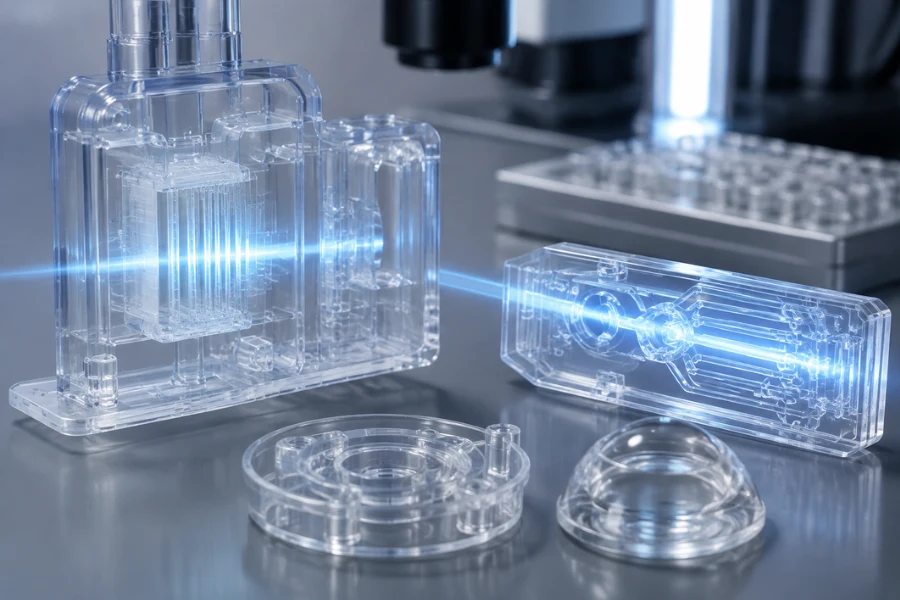
COC (Cyclic Olefin Copolymer) is an amorphous thermoplastic belonging to the cyclic olefin polymer family.
Unlike semicrystalline materials, COC does not develop crystalline structures during cooling. This reduces light scattering and allows the material to maintain excellent optical clarity and consistent light transmission.
This characteristic makes COC suitable for medical applications where the molded plastic component becomes part of an optical pathway, including:
- Diagnostic cartridges
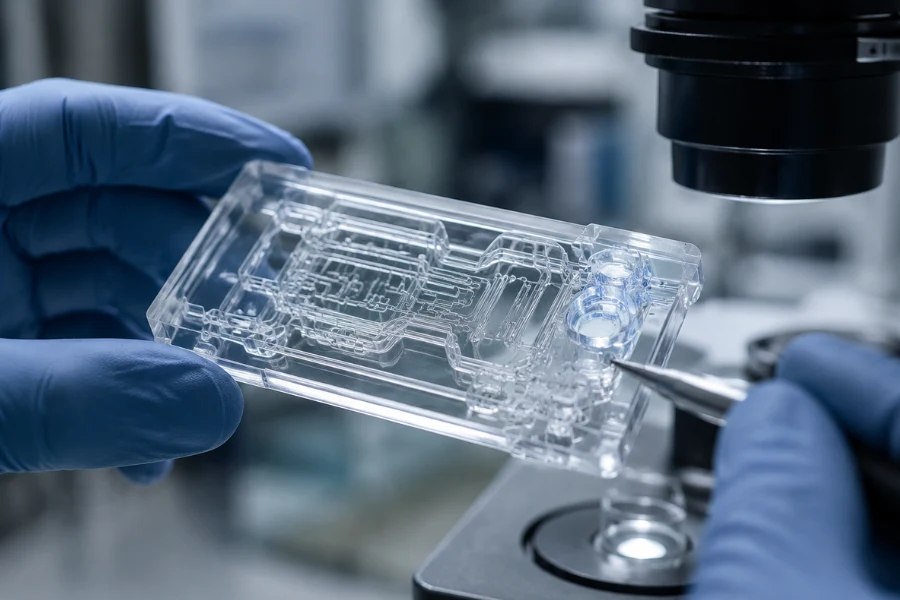
- Microfluidic devices
- Optical detection chambers
- Laboratory consumables
- Sample analysis components
The engineering advantage of COC is not simply that it looks transparent.
Many plastics can provide visual transparency, but they may still introduce unwanted variables such as optical distortion, internal stress, or dimensional changes.
For optical medical systems, the polymer must behave as a predictable material that supports measurement accuracy.
A component can appear visually acceptable while still failing functional requirements because of:
- Stress-induced birefringence
- Light scattering
- Background fluorescence
- Dimensional instability
This is why COC is often selected for applications where optical reliability is more important than transparency alone.
Low Moisture Absorption Improves Dimensional Stability
One of COC’s most valuable characteristics for medical manufacturing is its extremely low moisture absorption.
Many engineering plastics absorb environmental moisture, which can lead to dimensional changes over time. While these changes may not affect general consumer products, they can become critical in precision medical components.
For applications such as diagnostic cartridges and microfluidic devices, dimensional variation may influence:
- Microchannel geometry
- Fluid flow behavior
- Optical alignment
- Sealing performance
- Assembly repeatability
Because of its low-polarity molecular structure, COC absorbs significantly less moisture compared with many conventional transparent polymers.
This provides advantages in environments where components must maintain dimensional consistency during:
- Storage
- Transportation
- Laboratory operation
- Long-term use
However, low moisture absorption does not eliminate all dimensional risks.
Final part accuracy still depends on:
- Mold temperature control
- Cooling uniformity
- Packing conditions
- Part geometry
- Process capability
Material stability provides the foundation, but manufacturing control determines whether that stability can be achieved consistently in production.
Optical Performance of COC in Medical Applications
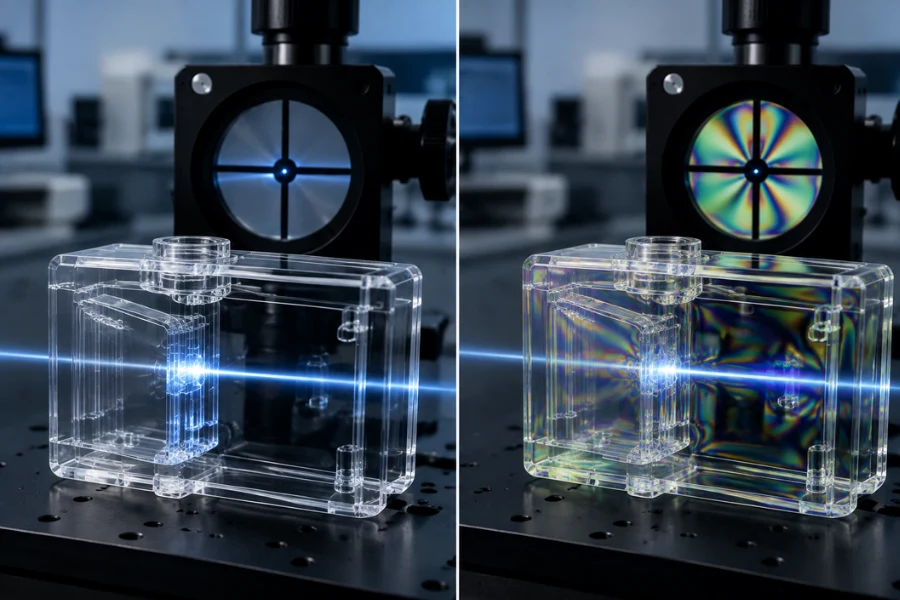
Transparency Is Only the Starting Point
COC typically provides excellent optical transmission, commonly reaching approximately 91% to 95% depending on material grade and part thickness.
Its refractive index is generally around 1.50 to 1.53, providing optical characteristics similar to certain glass applications while maintaining the production advantages of injection molding.
However, optical medical components require more than high transparency.
A diagnostic component must also control:
- Optical distortion
- Surface defects
- Light scattering
- Internal stress
- Background interference
For example, a diagnostic cartridge may pass visual inspection after molding but still produce inconsistent test results if the polymer changes the optical path during measurement.
This is why optical injection molding requires a different manufacturing approach from standard transparent plastic production.
The goal is not simply:
“Can light pass through the component?”
The real engineering question is:
“Can the component maintain predictable optical performance throughout its service life?”
Low Birefringence Supports Optical Accuracy
Birefringence is one of the most important considerations in optical injection molding.
During injection molding, polymer molecules orient along the direction of melt flow. If this molecular orientation becomes frozen during cooling, internal stress can change how light travels through the molded component.
The result may include:
- Measurement variation
- Image distortion
- Reduced detection sensitivity
COC has favorable optical characteristics because its amorphous structure helps reduce optical interference compared with many transparent polymers.
However, COC is not automatically free from birefringence.
The final optical performance depends heavily on manufacturing conditions.
Important control factors include:
| Manufacturing Factor | Impact on Optical Performance |
|---|---|
| Gate location | Influences molecular orientation and stress distribution |
| Injection speed | Affects shear stress during filling |
| Mold temperature | Controls stress relaxation and cooling behavior |
| Packing pressure | Influences shrinkage and internal stress |
| Cooling balance | Determines optical consistency |
For optical medical components, material selection and process development must be considered together.
A high-performance polymer can still produce poor optical results if the tooling and molding process introduce excessive stress.
Low Autofluorescence Supports Diagnostic Applications
In many diagnostic and analytical devices, the polymer itself becomes part of the measurement environment.
A material may appear transparent while still creating unwanted background signals that affect detection accuracy.
This is especially important for:
- Fluorescence assays
- Bio-detection platforms
- Cell analysis systems
- Molecular diagnostic devices
COC and related cyclic olefin materials are often considered because of their low optical interference characteristics.
The advantage is not only allowing light transmission, but also reducing unwanted signals that may interfere with analytical results.
For measurement-based medical systems, material selection should always consider the complete detection process rather than transparency data alone.
Medical Properties and Regulatory Considerations
Medical device materials must be evaluated not only by their optical and mechanical properties but also by their suitability for the intended application.
Medical-grade COC materials are available with documentation supporting evaluation under standards such as ISO 10993 and USP Class VI. These evaluations help manufacturers assess biological safety requirements for applications involving contact with biological fluids, tissues, or laboratory samples.
However, selecting a medical-grade resin does not automatically guarantee compliance of the final medical device.
The finished component performance depends on the complete manufacturing system, including:
- Resin grade selection
- Additives and colorants
- Injection molding conditions
- Mold cleanliness
- Surface treatments
- Assembly methods
- Sterilization exposure
For example, a COC component used in a diagnostic cartridge requires different considerations from a laboratory container because the molded component directly affects analytical performance.
Medical OEM teams should evaluate COC as part of a complete development process that includes material selection, tooling, production, and validation.
For broader medical material evaluation strategies, manufacturers often use structured medical material selection processes to compare polymer performance against device requirements.
Chemical Resistance and Sterilization Compatibility
COC provides excellent chemical resistance because of its low-polarity molecular structure.
Compared with many transparent engineering plastics, COC offers advantages in:
- Low moisture interaction
- Hydrolysis resistance
- Chemical stability
- Long-term dimensional consistency
These characteristics make COC suitable for medical components exposed to:
- Biological samples
- Laboratory reagents
- Diagnostic fluids
- Chemical solutions
However, sterilization compatibility must always be evaluated based on the specific resin grade, exposure conditions, and device requirements.
Different sterilization methods create different material challenges:
| Sterilization Method | Main Evaluation Considerations |
|---|---|
| Ethylene oxide (EtO) | Chemical exposure, residual effects, long-term stability |
| Gamma radiation | Optical changes, discoloration, molecular effects |
| Steam sterilization | High temperature and moisture resistance |
Some medical-grade COC materials may demonstrate compatibility with certain sterilization methods, but validation is still required.
Medical OEM teams should evaluate:
- Optical performance after sterilization
- Dimensional stability
- Mechanical property retention
- Long-term aging behavior
The key question is not:
“Can COC survive sterilization?”
The more important engineering question is:
“Can the COC component continue meeting functional requirements after sterilization?”
A diagnostic cartridge that maintains transparency but loses dimensional accuracy may still fail its intended purpose.
Limitations of COC Plastic in Medical Applications
Although COC provides excellent optical and dimensional performance, it is not the ideal solution for every medical device.
Understanding limitations is essential because material selection is always a balance between performance requirements, manufacturing conditions, and cost considerations.
Lower Impact Resistance Compared with Polycarbonate
COC performs extremely well in optical applications, but polycarbonate generally provides higher impact resistance and toughness.
Therefore, COC may not be the first choice for components requiring:
- High impact resistance
- Structural protection
- Repeated mechanical loading
- High abuse tolerance
For example, an optical diagnostic chamber may benefit from COC because measurement accuracy is the primary concern.
However, a transparent protective enclosure exposed to repeated impact may be better suited for polycarbonate.
The correct material depends on the dominant failure risk of the application.
Low Surface Energy Can Affect Bonding and Secondary Operations
COC’s chemical stability is one of its biggest advantages, but it can also create manufacturing challenges.
Its relatively low surface energy may make some secondary operations more difficult, including:
- Adhesive bonding
- Printing
- Coating
- Surface modification
Depending on the application, manufacturers may need additional treatments such as:
- Plasma treatment
- Surface activation
- Specialized bonding methods
This is an important engineering trade-off.
A property that improves chemical resistance can also increase assembly complexity.
For medical products requiring multiple components, secondary operations and assembly processes should be considered during early design stages.
Higher Material Cost Requires Lifecycle Evaluation
Compared with commodity transparent plastics, COC typically has a higher material cost.
For high-volume disposable medical products, engineers should evaluate more than initial resin pricing.
Important considerations include:
- Defect reduction
- Optical reliability
- Dimensional consistency
- Validation requirements
- Product lifecycle performance
A lower-cost polymer may create additional expenses if it leads to:
- Higher rejection rates
- More process adjustments
- Additional inspection requirements
- Performance variation during production
The most economical material is not always the one with the lowest purchase price. In medical manufacturing, total process reliability often has a greater impact on overall cost.
COC Injection Molding Guide for Medical Components
COC provides excellent material characteristics, but achieving consistent medical-grade production requires careful control of the injection molding process.
For optical and precision medical components, final performance depends on the interaction between:
- Resin behavior
- Mold design
- Processing parameters
- Cooling strategy
- Quality control methods
Manufacturers with experience in medical plastic injection molding understand that optical performance is created through the complete manufacturing process rather than material selection alone.
Typical COC Injection Molding Parameters
The exact processing window depends on resin grade, component geometry, and application requirements. The following values provide general engineering guidance for COC molding.
| Parameter | Typical Consideration | Manufacturing Impact |
|---|---|---|
| Melt temperature | Around 260°C depending on grade | Ensures proper plasticization while avoiding thermal degradation |
| Screw compression ratio | Approximately 2.2:1-2.5:1 | Helps reduce excessive shear stress |
| Screw L/D ratio | Higher ratio preferred for optical applications | Improves melt uniformity |
| Mold temperature | Optimized according to optical requirements | Controls residual stress and birefringence |
| Shrinkage | Approximately 0.4%-0.7% | Supports predictable dimensional control |
| Injection speed | Balanced between filling and stress control | Influences molecular orientation |
| Cooling time | Controlled for uniform solidification | Affects dimensional stability |
These values should not be treated as fixed production settings.
Medical molding requires establishing a validated process window through engineering trials, qualification, and production monitoring.
Material Preparation and Drying Requirements
One important processing advantage of COC is its extremely low moisture absorption.
Unlike hygroscopic materials such as nylon, COC typically does not require pre-drying under standard processing conditions.
This reduces risks associated with:
- Moisture-related defects
- Hydrolytic degradation
- Material preparation delays
However, medical production still requires strict material handling procedures.
Important considerations include:
- Resin storage conditions
- Lot traceability
- Contamination prevention
- Regrind management
Even when drying is not normally required, consistent material control remains important for validated medical production.
Melt Temperature Control
COC processing temperatures are commonly around 260°C depending on resin grade.
The objective is to achieve complete melting while maintaining material stability.
Insufficient temperature may result in:
- Poor filling
- Incomplete replication of fine structures
- Increased molding stress
Excessive temperature exposure may increase risks such as:
- Material degradation
- Optical discoloration
- Property variation
The optimal processing window must balance:
- Flow performance
- Optical quality
- Production repeatability
Screw Design and Plasticization Control
For optical COC components, excessive shear during plasticization should be avoided.
A lower compression ratio screw, commonly around 2.2:1 to 2.5:1, can help reduce unnecessary mechanical stress during melting.
A higher L/D ratio may also improve:
- Melt consistency
- Temperature uniformity
- Plasticization stability
This becomes particularly important for:
- Thin-wall components
- Microfluidic structures
- Optical surfaces
The purpose is not simply achieving faster melting, but creating a stable melt condition that supports repeatable optical performance.
Injection Speed and Packing Control
Injection speed directly affects the balance between filling reliability and optical quality.
Higher injection speed can provide advantages such as:
- Faster filling
- Better replication of micro features
- Reduced risk of premature freezing
However, excessive speed may increase:
- Shear stress
- Molecular orientation
- Birefringence
Lower injection speed may reduce stress but can create risks such as:
- Short shots
- Incomplete filling
- Poor replication
Packing pressure and holding time also influence:
- Shrinkage behavior
- Internal stress
- Dimensional consistency
The optimal process is not the fastest cycle.
It is the most stable process that consistently produces acceptable parts.
Mold Design Optimization for COC Medical Components
For COC optical medical components, mold design directly influences final product performance.
A mold is not only a tool for creating part geometry. It also controls how polymer flows, cools, relaxes, and maintains optical stability after ejection.
A component may meet dimensional specifications but still fail functional testing because of:
- Residual stress
- Optical distortion
- Surface defects
- Uneven cooling
- Poor flow behavior
This is why COC tooling requires a close connection between material behavior and mold engineering.
For medical applications, early DFM analysis and precision tooling development are critical. Proper mold tool design helps identify potential risks before production tooling begins.
Gate Design and Flow Control
Gate design has a direct influence on polymer orientation, filling behavior, and optical quality.
For COC optical components, the objective is to achieve:
- Balanced filling
- Controlled molecular orientation
- Reduced shear stress
- Minimal optical distortion
Fan gates are often considered for optical applications because they provide a wider filling area and can reduce localized shear concentration.
However, gate selection should always be based on the component requirements rather than using a standard approach.
Important factors include:
- Optical area location
- Flow length
- Wall thickness variation
- Weld line position
- Assembly requirements
For example, placing a gate close to an optical detection area may shorten the flow path, but it may also introduce unwanted orientation or stress in a critical region.
The best gate location is the one that provides stable polymer flow while protecting functional areas.
Venting Design for Optical Quality
Venting is one of the most important but frequently underestimated aspects of transparent medical injection molding.
During filling, displaced air must escape efficiently from the mold cavity.
Poor venting can result in:
- Burn marks
- Short shots
- Gas trapping
- Surface defects
- Incomplete replication of micro features
For optical medical components, these defects can directly affect:
- Light transmission
- Image quality
- Visual inspection
- Functional testing
Effective venting requires consideration of:
- Melt flow direction
- Filling speed
- Cavity pressure
- Final filling locations
A properly designed venting system improves process stability and reduces defect variation during long production runs.
Cooling System Design and Residual Stress Control
Cooling design has a significant impact on COC optical performance.
Because COC is an amorphous polymer, cooling behavior influences:
- Molecular relaxation
- Shrinkage
- Residual stress
- Birefringence
Uneven cooling can create differences in stress distribution across the molded component.
Potential results include:
- Optical variation
- Warpage
- Dimensional instability
A well-designed cooling system should provide:
- Uniform temperature distribution
- Stable cycle-to-cycle performance
- Controlled solidification
For optical components, the goal is not simply reducing cycle time.
The priority is producing repeatable parts with stable optical and dimensional performance.
Surface Finish and Tooling Considerations
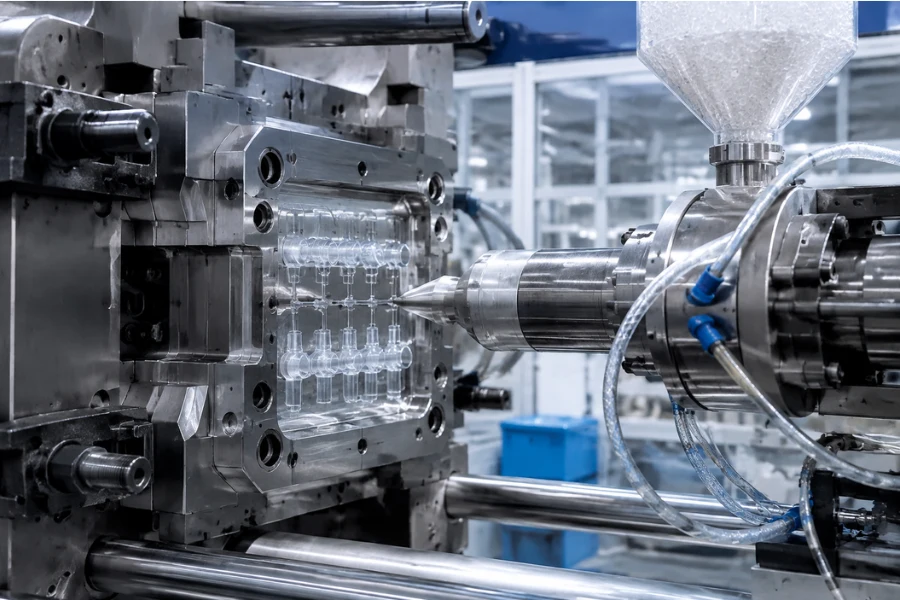
COC optical components often require high-quality mold cavity surfaces.
The cavity surface directly influences:
- Part transparency
- Surface appearance
- Optical consistency
Important tooling considerations include:
- Cavity polishing quality
- Surface protection
- Tool steel selection
- Preventive maintenance
For components used in diagnostic or analytical systems, small surface variations can affect optical performance.
Therefore, precision mold making is an important factor in achieving consistent COC part quality.
A high-performance polymer cannot compensate for poor tooling conditions.
Common COC Injection Molding Failure Scenarios
Understanding failure mechanisms provides more practical value than simply understanding material advantages.
For medical OEM teams, identifying potential failure points early helps reduce redesign cycles and production risks.
Failure Scenario 1: Optical Distortion After Successful Molding
Situation
A diagnostic cartridge passes dimensional inspection after molding.
The parts appear visually clear, but functional testing shows inconsistent optical measurements.
Possible Root Causes
The issue may not come from the resin itself.
Potential causes include:
- Excessive molecular orientation
- High injection speed
- Poor gate location
- Uneven cooling
- Insufficient stress relaxation
The component is dimensionally acceptable but optically unstable.
Engineering Solutions
Possible improvements include:
- Adjusting gate location
- Optimizing injection speed profile
- Increasing mold temperature
- Improving cooling balance
- Reducing residual stress
This example demonstrates an important principle:
For optical medical components, dimensional inspection alone is not enough. Functional optical performance must also be verified.
Failure Scenario 2: COC Components Crack After Sterilization
Situation
A molded COC component performs correctly during initial inspection but develops cracks after sterilization or environmental conditioning.
Possible Root Causes
Potential contributors include:
- Residual stress from molding
- Sharp corners in part design
- Excessive ejection force
- Sterilization-related stress
The failure may appear to be a material problem, but the actual cause may originate earlier during design or molding.
Engineering Solutions
Possible improvements include:
- Reducing stress concentration
- Improving part geometry
- Adjusting molding conditions
- Reviewing sterilization compatibility
- Performing additional validation testing
The objective is not only producing a part that survives molding, but producing a component that remains reliable throughout its intended lifecycle.
Failure Scenario 3: Microfluidic Performance Changes During Production Scaling
Situation
A microfluidic prototype performs correctly during development, but production-scale molding produces inconsistent fluid behavior.
Possible Root Causes
Potential causes include:
- Small dimensional variation in microchannels
- Tool wear
- Cooling variation between cavities
- Process drift
- Insufficient process capability monitoring
This is a common challenge when moving from prototype to mass production.
A prototype may succeed because engineers manually select acceptable samples.
Production requires a process that consistently produces acceptable parts.
Engineering Solutions
Manufacturers should evaluate:
- Mold capability
- Dimensional inspection methods
- Statistical process control
- Process monitoring
- Preventive maintenance
For precision micro-components, production stability is often determined by process control rather than material properties alone.
COC Material Selection Workflow for Medical OEM Teams
Selecting COC should begin with the device requirement rather than the material itself.
A structured evaluation process helps determine whether COC is the right solution.
Step 1: Determine Whether Optical Performance Is Critical
Key questions include:
- Is light passing through the component?
- Does the part influence measurement accuracy?
- Is fluorescence detection involved?
- Can optical distortion affect results?
If optical performance directly affects device functionality, COC becomes a strong candidate.
Step 2: Evaluate Mechanical Requirements
Consider:
- Impact resistance
- Structural loading
- Repeated handling conditions
- Assembly stress
If mechanical toughness is the primary requirement, materials such as polycarbonate may provide advantages.
Step 3: Review Chemical and Sterilization Exposure
Evaluate:
- Biological fluids
- Cleaning agents
- Reagents
- Sterilization methods
Material selection should consider long-term performance rather than initial compatibility only.
Step 4: Evaluate Manufacturing Requirements
Consider:
- Production volume
- Mold complexity
- Optical surface requirements
- Validation requirements
- Inspection capability
A suitable material must also fit the manufacturing strategy.
A structured material selection process helps medical OEM teams compare performance requirements with production realities.
Process Validation and Production Control for COC Medical Components
Selecting COC and developing precision tooling are important steps, but medical device manufacturing requires something more fundamental: a repeatable and controlled production process.
For medical OEM teams, the objective is not to produce one acceptable prototype.
The objective is to establish a manufacturing process that can consistently produce components with stable:
- Optical performance
- Dimensional accuracy
- Material integrity
- Functional reliability
This requires coordination between:
- Injection molding process development
- Mold qualification
- Quality inspection
- Process validation
- Production monitoring
For COC optical components, small variations that may appear insignificant during normal inspection can influence device performance. Therefore, validation must focus not only on physical dimensions but also on functional requirements.
IQ/OQ/PQ Validation for COC Injection Molding
Installation Qualification (IQ)
Installation Qualification confirms that the manufacturing equipment, tooling, and supporting systems are installed correctly and ready for production.
For COC medical molding, IQ activities may include verification of:
- Injection molding machine configuration
- Mold installation
- Temperature control systems
- Material handling systems
- Inspection equipment
- Production environment requirements
The purpose is to confirm that the manufacturing system has the necessary foundation to support a controlled molding process.
Operational Qualification (OQ)
Operational Qualification defines and verifies the acceptable operating window of the injection molding process.
For COC components, important process variables may include:
- Melt temperature
- Mold temperature
- Injection speed
- Injection pressure
- Packing pressure
- Cooling time
The objective is to understand how process changes influence:
- Optical clarity
- Birefringence
- Dimensional stability
- Surface quality
- Defect rates
For example, increasing mold temperature may improve optical performance by allowing greater stress relaxation, but it may also increase cycle time.
OQ helps identify the balance between product performance and manufacturing efficiency.
Performance Qualification (PQ)
Performance Qualification confirms that the validated process can consistently produce acceptable components during normal production conditions.
Evaluation may include:
- Dimensional inspection
- Optical inspection
- Functional testing
- Process repeatability
- Production capability analysis
For COC medical components, PQ should confirm not only that parts meet specifications, but that they continue meeting requirements over repeated production cycles.
Process Capability and Statistical Control
Medical manufacturing requires more than inspecting finished parts.
A stable process should demonstrate the ability to consistently remain within defined requirements.
Why Cp/Cpk Matters in COC Medical Molding
For precision COC components, process capability analysis helps manufacturers understand production variation.
Critical characteristics may include:
- Microchannel dimensions
- Optical features
- Assembly interfaces
- Component thickness
- Functional measurements
A process with excessive variation can result in:
- Higher rejection rates
- Increased inspection requirements
- Production interruptions
- Device performance inconsistency
Improving capability requires controlling the entire manufacturing system, including:
- Material consistency
- Machine stability
- Mold condition
- Process parameters
- Inspection methods
The goal is not only identifying defective parts after production.
The goal is preventing variation before defects occur.
Statistical Process Control (SPC) for Long-Term Production Stability
COC medical components often require high consistency because they may be used in diagnostic or analytical systems.
SPC helps manufacturers monitor whether the production process remains within the validated range.
Important monitoring factors may include:
- Part dimensions
- Part weight variation
- Optical inspection results
- Critical molding parameters
- Defect trends
For example, a gradual increase in dimensional variation may indicate:
- Mold wear
- Cooling system changes
- Process drift
- Machine condition changes
Early detection allows manufacturers to take corrective action before product quality is affected.
Cleanroom Manufacturing Considerations for COC Medical Devices
Many COC medical components are used in diagnostic and laboratory environments where contamination control is critical.
Depending on device requirements, production may require controlled environments such as cleanroom injection molding.
Clean manufacturing environments help control risks related to:
- Part contamination
- Foreign particles
- Handling conditions
- Production consistency
For optical medical components, contamination control is especially important because particles or surface defects may affect:
- Optical inspection
- Device assembly
- Functional performance
Cleanroom molding should be considered together with:
- Material handling
- Mold maintenance
- Packaging strategy
- Quality inspection procedures
Moving COC Components From Prototype to Mass Production
Many medical device projects experience challenges when transitioning from prototype development to production.
A prototype may demonstrate excellent performance, but production introduces additional variables.
Prototype Success Does Not Guarantee Manufacturing Stability
Prototype parts may appear successful because:
- Production quantities are limited
- Engineers manually select acceptable samples
- Process variation is not fully visible
Mass production introduces additional challenges:
- Multi-cavity tooling
- Longer production cycles
- Operator variation
- Tool wear
- Process drift
Therefore, COC components should be evaluated with production scalability in mind.
Early collaboration during medical product development can help identify risks before tooling investment begins.
Mold Maintenance and Long-Term Production Reliability
For long-term medical production, mold durability becomes a critical factor.
Important considerations include:
- Cavity wear
- Surface finish maintenance
- Cooling channel performance
- Preventive maintenance planning
This is particularly important for optical COC components because small tooling changes may influence:
- Surface quality
- Optical consistency
- Dimensional accuracy
A stable material and optimized process can still experience quality problems if tooling condition is not properly managed.
From Material Selection to Medical Device Manufacturing
COC represents a good example of why medical plastic manufacturing requires a system-level approach.
Successful production depends on the relationship between:
- Material science
- Product design
- Mold engineering
- Injection molding
- Validation
- Quality management
For OEM teams developing diagnostic devices, microfluidic systems, and precision medical components, working with a manufacturing partner experienced in the complete production process can reduce development risks.
A reliable partner should understand not only how to mold plastic, but also how material behavior influences device performance.
SeaSkyMedical supports medical device manufacturers through engineering-focused solutions, including:
- Material evaluation
- DFM analysis
- Precision tooling development
- Medical injection molding
- Production quality control
By combining medical device contract manufacturing expertise with controlled manufacturing processes, OEM teams can move advanced medical plastic concepts from development into reliable production.
Frequently Asked Questions About COC Plastic for Medical Devices
Is COC plastic suitable for medical device applications?
Yes, medical-grade COC materials are commonly considered for applications requiring high optical clarity, low moisture absorption, chemical resistance, and dimensional stability.
Typical applications include diagnostic cartridges, microfluidic devices, optical components, and laboratory consumables.
However, suitability depends on the specific resin grade, device requirements, sterilization conditions, and validation results.
What makes COC different from polycarbonate in medical applications?
COC and polycarbonate solve different engineering challenges.
COC is generally selected when the priority is:
- Optical accuracy
- Low moisture absorption
- Chemical resistance
- Dimensional stability
Polycarbonate is often preferred when the component requires:
- High impact resistance
- Structural toughness
- Mechanical durability
The better choice depends on which failure risks are most important for the medical device.
Does COC require drying before injection molding?
Because COC has extremely low moisture absorption, it typically does not require pre-drying under standard processing conditions.
However, medical production still requires proper material handling, including:
- Resin storage control
- Contamination prevention
- Lot traceability
Manufacturers should always follow resin supplier recommendations.
What are the main injection molding challenges with COC?
The main challenges are maintaining optical and dimensional consistency.
Important considerations include:
- Residual stress control
- Mold temperature optimization
- Gate design
- Cooling uniformity
- Injection parameter stability
A successful COC molding process requires balancing optical performance with production efficiency.
Can COC withstand sterilization?
COC sterilization compatibility depends on the specific grade, sterilization method, and application requirements.
Some medical COC grades may be suitable for methods such as EtO or radiation sterilization, while high-temperature steam applications require careful evaluation.
Validation should confirm:
- Optical performance
- Mechanical properties
- Dimensional stability
- Long-term reliability
Why is COC commonly used in diagnostic cartridges?
COC is commonly selected for diagnostic cartridges because it combines:
- High transparency
- Low birefringence potential
- Low moisture absorption
- Chemical resistance
- Low optical interference
These characteristics help maintain reliable performance in systems where the molded component directly influences analytical accuracy.
Conclusion
COC plastic provides a unique combination of optical performance, dimensional stability, chemical resistance, and injection molding advantages, making it an important material option for advanced medical devices.
However, selecting COC successfully requires more than choosing a high-performance polymer.
The final performance of a COC medical component depends on the interaction between:
- Material characteristics
- Part design
- Mold engineering
- Injection molding parameters
- Validation strategy
- Production control
For diagnostic devices, microfluidic systems, and optical medical components, many critical failures come from small variations that are difficult to detect but significant enough to affect device performance.
A successful medical molding strategy connects material selection with precision tooling, controlled processing, and validated manufacturing systems.
Through engineering-driven support across design, tooling, molding, and quality management, SeaSkyMedical helps medical OEM teams develop reliable plastic components that meet the requirements of modern healthcare applications.