Introduction: The Critical Role of Parameter Recording and Monitoring
In regulated industries such as medical device manufacturing, authorities including the FDA, ISO 13485, and EU MDR require manufacturers to demonstrate with objective evidence that their injection molding processes are tightly controlled and capable of producing consistently high-quality components. Reliance solely on visual inspection is insufficient for certification; instead, comprehensive records of process parameters and continuous monitoring data are essential to satisfy compliance standards. Proper tracking of injection molding process metrics supports quality management systems, enables traceability from raw material to finished part, facilitates ongoing process improvement, minimizes scrap and recall risks, and ensures that manufacturers remain audit-ready at all times.
Key Injection Molding Parameters to Record and Monitor
Temperature Metrics
Monitoring melt temperature, mold temperature, drying temperature, and barrel zone temperatures is essential to maintain material flow, prevent defects, and ensure biocompatibility for medical-grade plastics such as TPE, ABS, PET, and TPU.
Pressure Metrics
Injection pressure, holding pressure, back pressure, and clamp force influence part density, dimensional accuracy, and overall integrity, requiring precise recording and control.
Time and Speed Metrics
Injection time, holding time, cooling time, mold open/close time, and injection velocity profiles are tracked to maintain cycle consistency and ensure repeatable manufacturing outcomes.
Position and Stroke Metrics
Metering stroke, ejection stroke, and cushion volume must be monitored to confirm consistent material displacement and part formation across all cavities.
Environmental and Material Metrics
For hygroscopic materials, monitoring post-drying moisture content, resin batch number, and resin drying duration is critical to ensure consistent material performance and sterilization compliance.
Auxiliary Equipment Metrics
Temperatures of mold temperature controllers, hot runner systems, and dehumidifying dryers are recorded to maintain uniform process conditions.
Note: Only parameters directly affecting Critical Quality Attributes (CQA) and Critical Process Parameters (CPP) need frequent monitoring, while less critical parameters can be tracked per batch. Certification generally requires at least one complete set of process metrics per production batch.
Methods and Systems for Recording and Monitoring
Manual Recording
Operators may use batch record sheets to transcribe injection molding machine parameters and inspection logs. While straightforward, manual methods are prone to human error, delays, and poor traceability for transient fluctuations.
Automated Data Acquisition
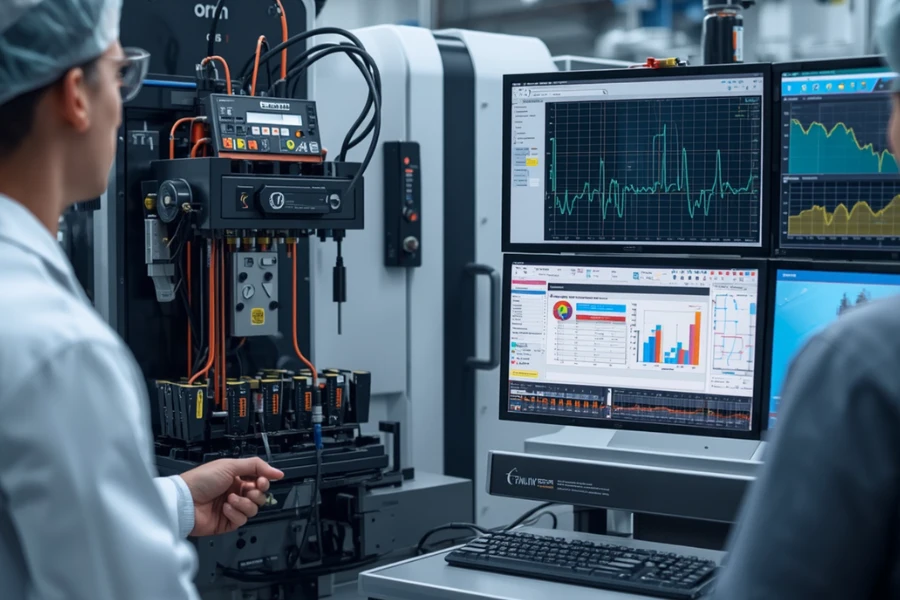
Modern injection molding facilities increasingly rely on automated systems that connect machines via OPC, Euromap 63/77, or similar protocols. MES and SCADA platforms capture process metrics in real-time, linking them with mold identifiers, material batches, and product serial numbers. Centralized databases store both setpoints and actual values for each cycle, enabling trend analysis, historical traceability, and automated generation of compliance reports. Real-time alerts can notify operators or halt production if parameters exceed validated windows, preventing the creation of nonconforming parts.
Soft Marketing Integration: SeaSkyMedical provides solutions that seamlessly integrate automated process monitoring with MES and SCADA platforms, ensuring compliance and audit readiness while minimizing manual intervention.
Statistical Process Control (SPC) and Process Capability Analysis
SPC is applied to monitor essential process metrics, such as melt temperature peaks and injection pressures, through control charts including Xbar-R, Xbar-S, and I-MR. During PQ, process capability indices (Cpk/Ppk) are calculated to demonstrate process stability, typically requiring ≥1.33 for general medical components and ≥1.67 for critical safety features. Trend analysis of long-term data identifies gradual issues, such as mold wear, hot runner clogging, or heating element degradation, allowing proactive maintenance before product quality is affected.
Parameter Recording Requirements During Validation (IQ/OQ/PQ)
Installation Qualification (IQ)
Installation records include environmental parameters such as voltage, air pressure, cooling water flow, and temperature. Sensor calibration certificates are verified to ensure that subsequent data collection is reliable and traceable.
Operational Qualification (OQ)
OQ tests the extremes of the validated process window, documenting part quality under high and low conditions for critical process metrics. Reports define acceptable upper and lower limits for each monitored variable.
Performance Qualification (PQ)
PQ demonstrates consistent production performance under normal operating conditions across multiple batches or shifts. Each batch’s complete process data is compared against OQ-defined windows, and PQ reports consolidate batch data, inspection results, and Cpk values to confirm process stability and regulatory compliance.
Traceability Systems: Linking Parameters to Product Batches
Traceability associates each batch’s process metrics with material lot numbers, mold identifiers, operator records, production dates, and final product serial numbers. Robust traceability supports rapid identification of affected items during quality investigations or recalls. For high-risk or implantable components, serialization and barcode/RFID tracking capture complete parameter histories for each product.
Documentation and Compliance Evidence Packages
To satisfy regulatory requirements, manufacturers maintain:
- Batch Production Records: parameter setpoints, actual values, SPC charts, inspection logs.
- Process Validation Reports: IQ/OQ/PQ protocols with defined process windows and extreme condition testing data.
- Mold History Records: documenting maintenance, modifications, and validation impact.
- First Article Inspection (FAI) Reports: measurements under validated process conditions.
- PPAP Documentation: control plans, MSA reports, and process capability studies.
- Control Plans: methods for monitoring, reaction plans, and frequency.
- Change Control Records: documenting parameter, material, or mold changes with associated revalidation.
Measurement System Verification (MSA / Gage R&R)
All sensors, including temperature and pressure sensors, require regular calibration and certificates. Measuring instruments used for quality verification, such as calipers or CMMs, undergo Gage R&R studies, typically with %GRR ≤10% for high-precision applications. MSA must be completed before conducting capability studies and is included in PQ reports or PPAP submissions.
Best Practices
- Integrate key parameters and acceptable ranges into mold design and process development from the outset.
- Deploy automated data acquisition to eliminate human error and enable real-time monitoring.
- Consolidate parameter records, SPC, material traceability, sensor calibration, and change control in a digital quality management platform.
- Conduct periodic audits to verify parameter completeness and accuracy for every batch.
- Train operators to understand the significance of parameters and recognize abnormal trends.
- Perform simulated audits to ensure compliance with ISO 13485 or IATF 16949 at any time.
Soft Marketing Integration: SeaSkyMedical’s integrated digital quality systems allow operators to monitor critical injection molding process metrics, maintain SPC charts, and link material traceability effortlessly, enabling audit-ready production for highly regulated industries.
FAQ
Q1: Which parameters should be recorded per mold versus per batch?
A1: Critical parameters affecting CQA, like melt temperature peaks and injection pressure, should be recorded per mold or cavity. Less variable metrics, such as drying temperature or cooling water, may be logged per batch or shift. Control plans must define risk-based monitoring strategies.
Q2: How can legacy machines satisfy FDA or ISO parameter recording requirements?
A2: Manual recording combined with periodic sampling is acceptable; operators log machine parameters at defined intervals, and critical dimension inspection frequency provides indirect evidence. Retrofitting sensors is recommended for long-term compliance.
Q3: How long should PQ parameter records be maintained?
A3: Typically, records cover at least three consecutive production batches or one full shift cycle. Medical applications may require three batches of at least 300 units, depending on complexity and risk, as specified in the validation protocol.
Q4: If a parameter temporarily exceeds the validated window but parts pass inspection, is it compliant?
A4: Deviations outside the validated process window constitute process variation. Investigations and documentation are required, even if parts meet specifications. Frequent deviations necessitate revalidation or adjustment of process limits.
Q5: Should Cpk be calculated from machine parameters or finished part dimensions?
A5: Cpk is generally calculated for critical product attributes. Using process metrics is optional to monitor input stability, provided measurement systems are validated.
Q6: How to monitor each cavity in a multi-cavity mold?
A6: Per-cavity sensors for pressure and temperature are the most reliable. Sampling combined with mold flow analysis can infer consistency if full instrumentation is unavailable. Independent monitoring is strongly recommended for high-regulation applications.
Q7: Are there additional EU MDR requirements for parameter recording?
A7: EU MDR emphasizes lifecycle monitoring and post-market surveillance. Parameter records must be retained for adverse event investigations, with extended retention for high-risk or implantable devices.
Q8: Does Gage R&R apply to machine sensors?
A8: Gage R&R applies mainly to manual measuring tools. Sensors require calibration according to ISO 17025 or equivalent, forming part of overall measurement system reliability verification.