What Is a Standard Syringe
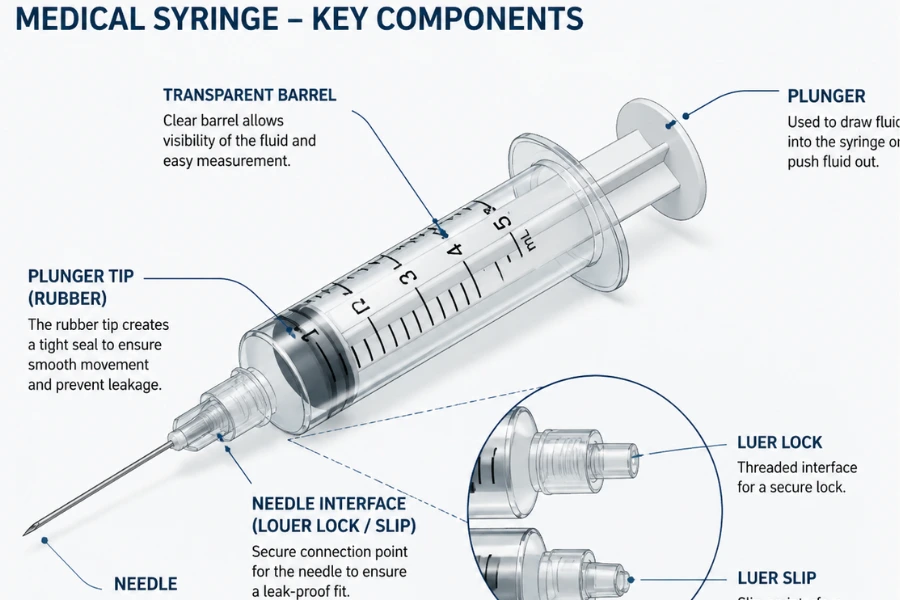
A medical injection device is a precision tool functioning as a simple reciprocating pump, composed of a plunger that fits snugly within a cylindrical barrel, allowing controlled intake and expulsion of liquids or gases through a front-facing outlet that may connect to a needle, tubing, or oral delivery system. The barrel is commonly made of transparent polypropylene or glass, with graduated markings to indicate fluid volume, while the plunger incorporates either a three-part design with a rubber tip or a precision-molded two-part configuration to create an effective seal. The nozzle or tip facilitates secure connections to needles, tubing, or oral administration. Fluid volume is typically expressed in milliliters (mL) or cubic centimeters (cc), with equivalence ensuring universal applicability across clinical, laboratory, and industrial settings. At SeaSkyMedical, our ISO-certified production ensures each injection instrument meets rigorous quality standards through medical plastic injection molding and medical device contract manufacturing, providing reliable performance for medical and research applications.
Main Types of Syringes
By Usage
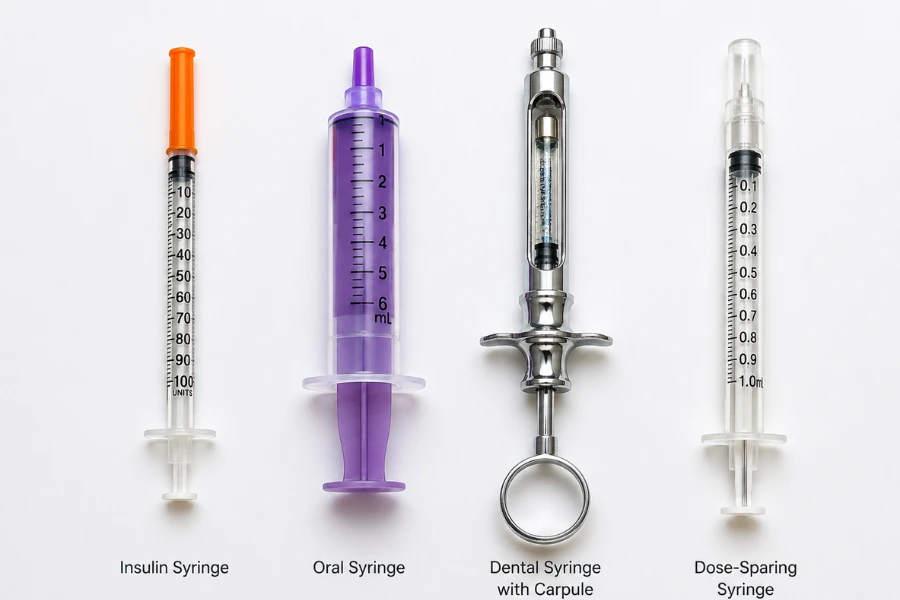
Injection instruments are categorized according to their intended purpose, each designed for specific clinical or procedural applications. Standard medical injection devices, featuring Luer connections compatible with detachable needles, are generally used for subcutaneous, intramuscular, or intravenous administration. Insulin devices employ unit-based markings (U-100), short fine-gauge needles, and low dead-space designs to support repeated self-administration by diabetic patients. Oral injection instruments, often colored purple to distinguish them from injectable devices, allow accurate administration of liquid medicines to children, elderly patients, or animals without needles. Dental injection devices, typically constructed of metal, use sealed carpule cartridges to deliver anesthetics efficiently during dental procedures. Dose-sparing devices are engineered to minimize residual liquid within the needle hub, a feature particularly valuable when handling high-demand or scarce medications. Tuberculin devices, commonly with 1 mL capacity and fine gradations, are optimized for intradermal testing procedures.
By Structural Design
Two-part instruments achieve a precise seal between the plunger and barrel without additional rubber components, a design traditionally favored in Europe to avoid contamination from lubricants. Three-part devices integrate a rubber-tipped plunger, enhancing seal integrity, but necessitate careful lubrication, standard in disposable instruments. SeaSkyMedical produces both configurations with expertise in mold making and free mold tool design, ensuring the correct choice based on clinical application, chemical compatibility, and sterilization requirements.
Syringe Volume Specifications and Selection
Selecting the appropriate injection instrument volume is crucial to achieve accurate dosing and efficient fluid delivery. Small-capacity devices, such as 0.3–1 mL insulin instruments, provide high measurement precision for low-dose medications, while larger instruments, ranging from 2 to 20 mL, are suited for subcutaneous, intramuscular, and intravenous administrations, with consideration given to needle gauge and length. Capacities above 30 mL accommodate enteral feeding, aspiration, and wound irrigation, often paired with scalp vein sets to ensure proper flow and minimal pressure effort. Notably, insulin devices align unit-based markings with precise volumes, where 30 units correspond to 0.3 mL, 50 units to 0.5 mL, and 100 units to 1 mL. SeaSkyMedical’s ISO-certified, custom injection molding capabilities, including micro injection molding and medical insert molding, enable production across this full spectrum while maintaining tight tolerances and consistent quality for clinical and laboratory applications.
Needle and Interface Designs
The design of a syringe tip or needle interface determines connection security and functional application. Luer lock tips, equipped with threaded connectors, provide a robust and leak-free interface, suitable for high-pressure injections and tubing connections. Slip tips, characterized by smooth tapered ends, allow rapid attachment and detachment in routine procedures. Catheter tips extend the slip tip design to form a tight seal within tubing systems, supporting wound irrigation and catheter-based applications. Eccentric tips, offset from the instrument axis, enable nearly parallel injection relative to superficial veins or arteries, reducing the risk of tissue trauma during surface injections. These designs leverage advanced material selection capabilities, including TPE and PP, to ensure secure and reliable connections.
Reading Measurements Correctly
Accurate dosing relies on precise alignment of the plunger with the barrel’s graduated markings. The recommended practice is to align the flat edge of the rubber plunger with the corresponding mark, rather than the curved dome, to avoid dosing errors. Liquid levels should be read with the eye level parallel to the markings to prevent parallax misreading. Different capacities exhibit varying graduations: for instance, 1 mL instruments feature long-line graduations at 0.1 mL intervals with short lines at 0.02 mL, whereas 3 mL instruments mark each 0.5 mL for long lines and 0.1 mL for short lines. For 5–12 mL instruments, long lines denote 1 mL increments with 0.2 mL short-line divisions, ensuring precise administration across applications.
Safe Usage and Precautions
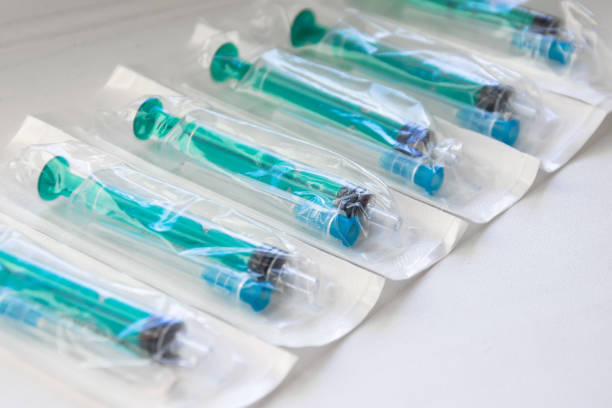
To mitigate infection risk and ensure patient safety, injection instruments should be single-use, and needle reuse is strictly discouraged, even for the same patient. Air embolism prevention requires expelling air bubbles prior to injection, achieved by holding the device upright and tapping the barrel gently. Oral and injectable instruments are not interchangeable; purple oral devices lack threaded tips and must not be used with needles. Proper storage is essential, keeping instruments inaccessible to children and securely covering medication containers. For expensive or critical medications, low dead-space or dose-sparing instruments are recommended to minimize residual fluid. SeaSkyMedical also provides guidance on safe handling and selection through secondary operations including packaging and assembly for finished devices.
Common Non-Medical Applications
Beyond clinical use, injection instruments serve laboratory, culinary, and craft purposes. In laboratories, they facilitate solvent or reagent transfer and dosing where moderate precision suffices, while glass devices may be preferred for chemical resistance and exact measurements. Culinary applications include injecting marinades into meats or fillings into pastries. In craft or maintenance settings, instruments deliver adhesives or lubricants to confined spaces, and in ink management, they refill fountain pens or printer cartridges. SeaSkyMedical’s custom plastic molding solutions, combined with CNC plastic machining, support specialized laboratory and industrial requirements, integrating precise molding with secondary operations for reliable outcomes.
Frequently Asked Questions
1 mL vs 3 mL devices, which is more accurate?
Smaller-capacity instruments provide finer measurement resolution, suitable for doses below 1 mL, whereas larger devices may introduce measurable error with small volumes.
Difference between mL and cc?
No functional difference exists; 1 mL equals 1 cc, used interchangeably depending on convention.
Insulin units to mL conversion?
For U-100 insulin, 30 units = 0.3 mL, 50 units = 0.5 mL, 100 units = 1 mL; select devices according to prescribed units.
Luer lock vs slip tip?
Luer lock offers secure connections, ideal for high-pressure or tubing; slip tips allow rapid attachment for routine injections.
Plunger alignment for children’s oral dosing?
Align the flat edge of the rubber plunger with the graduated line, not the rounded dome, to ensure accurate dosing.
Can disposable devices be sterilized and reused?
Plastic instruments are not suitable for reuse; only glass instruments can undergo autoclave sterilization.
Why replaceable needles?
Removable needles, such as Luer lock, support varied clinical applications; fixed needles reduce dead space and detachment risks.
Is 10 mL suitable for vaccines?
No, typical vaccine doses are 0.5–1 mL; larger volumes compromise dosing accuracy.
Air bubbles during aspiration?
Hold upright, tap to bring bubbles to top, expel gently until a small droplet appears at the tip.
Why are oral devices purple?
Purple indicates oral use, preventing accidental needle attachment and ingestion errors.