Introduction – Why Lead Times Are Critical in Medical Manufacturing
Understanding lead times for medical injection molded parts is fundamental for manufacturers, product developers, and procurement teams seeking to optimize production schedules while ensuring compliance with stringent quality and regulatory standards. The ability to anticipate timelines for different mold types, from prototype tooling to full-scale production molds, allows engineering teams to coordinate testing, validation, and regulatory approval processes effectively, mitigating risks associated with delays and ensuring that patient safety and device reliability remain uncompromised, particularly when leveraging comprehensive Medical Device Contract Manufacturing solutions.
Understanding Different Types of Injection Molds
Prototype Molds (2–6 Weeks)
Prototype molds are designed primarily for low-volume production intended for testing, design verification, and early-stage functional assessment. Typically fabricated from materials such as aluminum or additive manufacturing resins, these molds allow rapid turnaround, reduced costs, and sufficient durability for initial evaluations. According to Plastics Molding and Die Design (3rd Edition, p.38), controlling factors such as polymer water content and mold temperature can maintain dimensional tolerances within ±0.02 mm even at this early stage, ensuring the parts are suitable for initial regulatory assessments such as ISO 13485 documentation or preliminary FDA submissions. Utilizing prototype molds efficiently enables engineering and product teams to validate form, fit, and function before committing to more robust, long-term tooling investments, with support from advanced 3D Prototype Printing services.
Bridge Molds (4–10 Weeks)
Bridge molds, also known as soft tooling, provide a mid-tier solution for low-volume production, clinical trials, or early market introduction. Constructed from higher-grade aluminum or P20 steel, they balance speed and durability, typically producing several thousand parts while allowing for design modifications based on user feedback or regulatory input. These molds are especially relevant in medical device manufacturing where early compliance verification, market testing, and small-batch production are required before scaling to full production. By leveraging bridge molds, companies can achieve meaningful data for FDA 510(k) clearance submissions or ISO 13485 process validation without incurring the full lead time or cost of hardened production molds, and partners like SeaSkyMedical provide expert guidance on optimizing these timelines.
Production Molds (8–20+ Weeks)
Production molds are designed for high-volume, long-term manufacturing, often constructed from hardened tool steels such as H13, S7, or stainless steel variants suitable for medical applications. These molds undergo detailed machining, heat treatment, and finishing, with rigorous testing and validation to ensure reliability over hundreds of thousands or millions of cycles. Lead times are influenced by mold complexity, number of cavities, side actions, lifters, and surface finish requirements. Furthermore, production molds for regulated medical components must comply with IQ/OQ/PQ validation protocols, reinforcing compliance with ISO 13485 and FDA 21 CFR Part 820 standards. Precise mold design, temperature control, and careful material selection—as noted in Plastics Molding and Die Design (p.38)—are essential to minimize warpage and maintain tolerances critical to patient safety and regulatory approval, supported by comprehensive Medical Plastic Injection Molding capabilities.
Factors Influencing Mold Lead Times
Design Complexity
Complex part features such as undercuts, intricate curvatures, threaded elements, or integrated cooling channels require additional machining, assembly, and validation time. Early collaboration with tooling partners to conduct Design for Manufacturability (DFM) analysis can identify opportunities to simplify geometry and reduce lead times while maintaining regulatory compliance, and Mold Making expertise ensures technical feasibility.
Supplier Workload and Capacity
Lead times are also influenced by manufacturer capacity, concurrent projects, and material availability, including specialized components like hot runner systems. Communicating requirements early in the project lifecycle allows manufacturers to allocate resources effectively and avoid cascading delays. CNC support, such as CNC Plastic Machining, further improves precision and mitigates schedule risks.
Regulatory Approvals and Validation
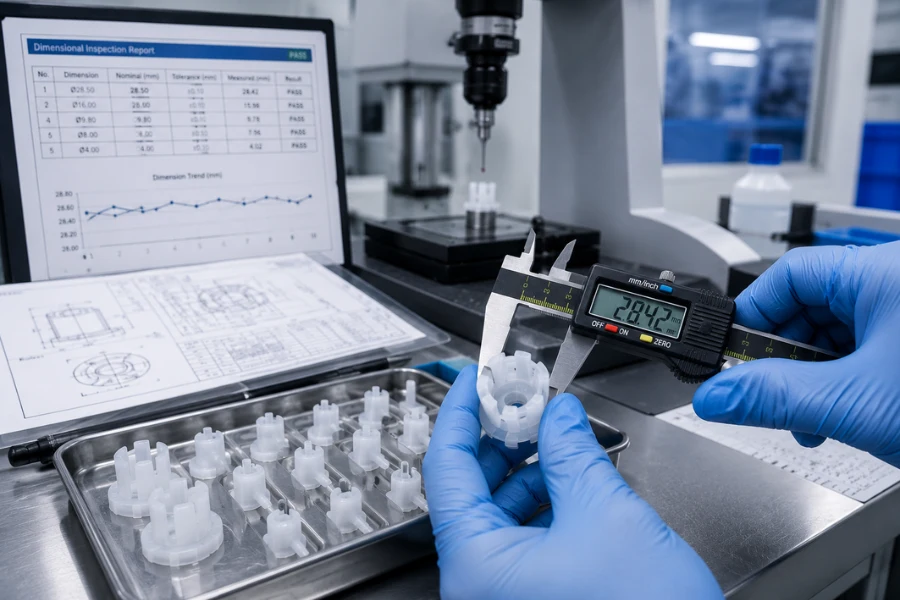
Medical device molds often necessitate comprehensive material certification, biocompatibility testing, dimensional validation, and process qualification before production can commence. These steps, critical for FDA submissions and ISO 13485 compliance, can extend lead times by several weeks or months, emphasizing the need for proactive scheduling and integration of validation steps into project planning, including Medical Device Assembly and Medical Device Packaging for end-to-end regulatory alignment.
Quick-Turn Tooling vs Full Production Molds
Quick-turn tooling, including prototype and bridge molds, accelerates part availability for early testing, regulatory submissions, or small-scale production, while sacrificing long-term durability relative to hardened production molds. When time-to-market is critical, such tooling strategies enable faster iteration and market feedback, allowing adjustments without delaying full-scale production. For organizations requiring rapid, compliant solutions, SeaSkyMedical provides end-to-end tooling expertise that balances speed, precision, and regulatory adherence.
Optimizing Lead Times Without Sacrificing Quality
Design for Manufacturability (DFM) Strategies
Applying DFM principles early in the design phase simplifies geometries, minimizes complex features, standardizes wall thickness, and optimizes gating and cooling channels. This approach reduces cycle times, lowers tooling costs, and supports consistent part quality, ensuring compliance with ISO and FDA standards, with support from Free Mold Tool Design.
Multi-Cavity Molds and Volume Considerations
For high-volume production, multi-cavity molds can significantly enhance efficiency and reduce per-part costs. However, balancing cavity filling and maintaining uniform quality are critical to achieving regulatory-compliant outcomes, and careful analysis ensures the optimal trade-off between speed and precision. Advanced Micro Injection Molding can further optimize small precision features.
Collaborating with the Right Tooling Partner
Selecting an experienced tooling partner is essential for on-time delivery, accurate cost estimation, and high-quality results. Companies like SeaSkyMedical provide comprehensive support from prototyping through full-scale production, helping teams navigate complex validation requirements while maintaining adherence to medical regulations.

Conclusion – Planning for Timely, Compliant Production
By understanding the typical lead times for prototype, bridge, and production molds, and by integrating DFM strategies, material selection insights, and expert tooling partnerships, manufacturers can achieve a balance of speed, quality, and regulatory compliance. Early planning, combined with collaboration with experienced partners, ensures medical injection molded parts are delivered on schedule, meet stringent performance criteria, and support safe, reliable patient outcomes. For organizations seeking end-to-end solutions, SeaSkyMedical offers comprehensive services that cover material selection, precision molding, and regulatory compliance.