Introduction
Selecting a plastic material for medical components is a manufacturing decision that affects product performance, production stability, and long-term reliability.
For medical OEM teams, choosing the right polymer requires more than comparing individual material properties. Engineers must evaluate how a material performs throughout the complete product lifecycle, including molding behavior, dimensional stability, chemical exposure, sterilization requirements, validation needs, and production scalability.
Medical grade HDPE (high-density polyethylene) is considered for many healthcare-related applications because it provides a practical balance of chemical resistance, moisture resistance, processability, and cost efficiency.
Its low moisture absorption and reliable processing characteristics make it suitable for applications where consistent manufacturing performance is important.
However, HDPE is not a universal medical material solution. While it performs well in chemical stability and manufacturability, it may not be the optimal choice for applications requiring extreme temperature resistance, high stiffness, or advanced mechanical performance.
The correct material decision depends on matching HDPE’s advantages with the functional requirements of the specific medical component.
What Is Medical Grade HDPE?
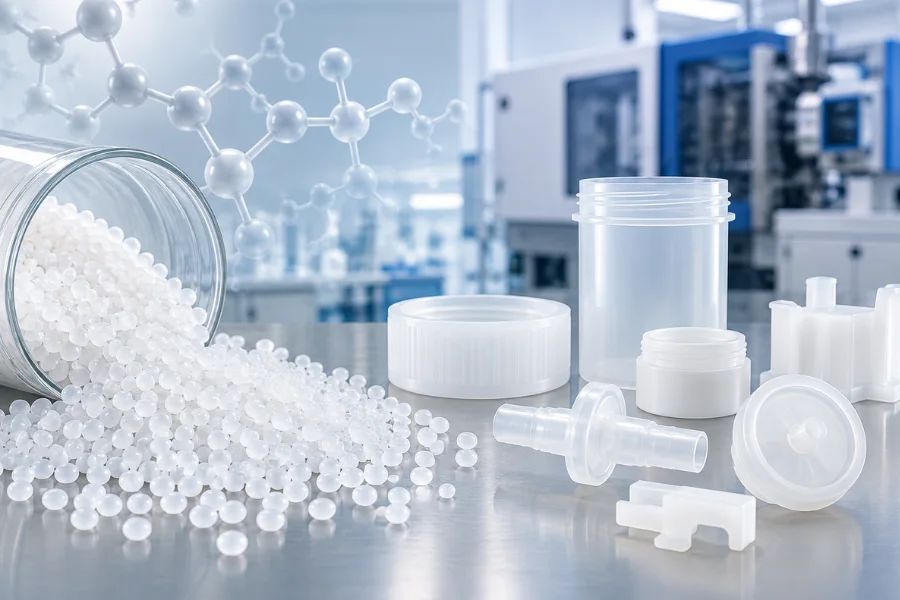
HDPE is a thermoplastic polymer within the polyethylene (PE) family.
Compared with low-density polyethylene (LDPE), HDPE has a more linear molecular structure with fewer branches. This structure allows polymer chains to pack more closely together, resulting in higher density, improved stiffness, and strong chemical resistance.
Typical HDPE characteristics include:
- Density of approximately 0.91–0.96 g/cm³
- Good chemical resistance
- Low moisture absorption
- Good melt flow behavior
- High impact resistance
HDPE belongs to a group of versatile thermoplastic materials that can be processed through methods such as injection molding, blow molding, and extrusion.
For medical applications, however, “medical grade HDPE” refers to more than the polymer category itself.
A suitable medical HDPE material selection typically considers:
- Resin consistency
- Additive control
- Material documentation
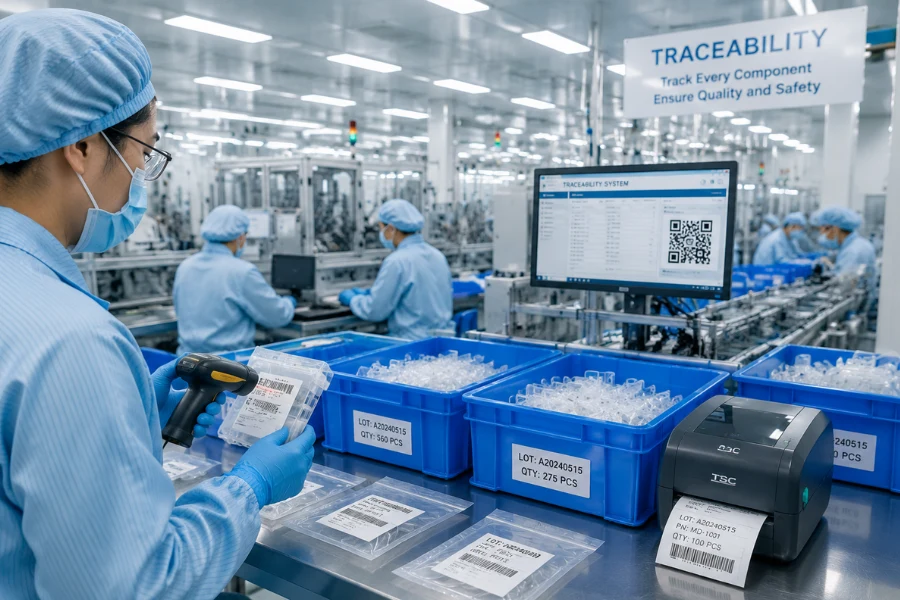
- Batch traceability
- Application-specific performance requirements
- Manufacturing quality expectations
Not every HDPE resin is automatically suitable for medical products.
The selected material must match the intended application, manufacturing process, and required product performance.
A structured medical plastic material selection process helps engineers evaluate resin characteristics, manufacturing requirements, and potential product risks before production.
What Makes HDPE Suitable for Medical Applications?
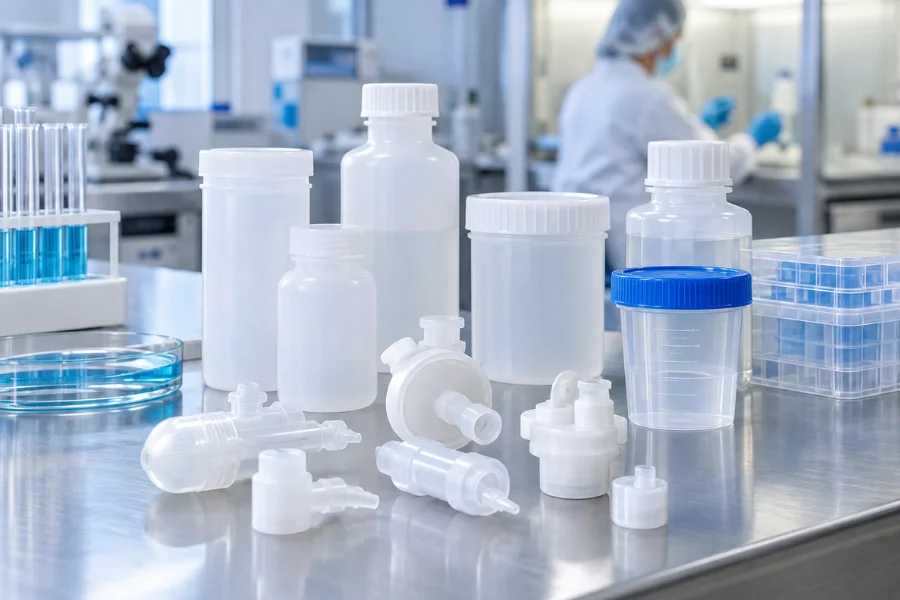
Medical manufacturers select materials based on the balance between performance, manufacturability, and risk management.
HDPE is considered for certain medical applications because several of its inherent characteristics support reliable production.
Chemical Resistance and Material Stability
Chemical resistance is one of HDPE’s strongest advantages.
The material performs well against many chemicals, including:
- Acids
- Bases
- Alcohols
- Aqueous solutions
This stability makes HDPE useful for components exposed to cleaning agents, laboratory chemicals, pharmaceutical environments, and fluid-related applications.
For medical products, chemical resistance helps reduce the risk of:
- Material degradation
- Swelling
- Loss of mechanical performance
- Premature component failure
However, chemical resistance should always be evaluated based on actual application conditions.
Important factors include:
- Chemical composition
- Concentration level
- Operating temperature
- Exposure duration
A material that performs well in one environment may require additional evaluation under different chemical conditions.
Moisture Resistance and Low Water Absorption
HDPE has very low moisture absorption compared with many engineering plastics.
Unlike hygroscopic materials such as nylon or certain polycarbonate grades, HDPE generally does not require extensive drying before injection molding when properly stored.
This provides several manufacturing advantages:
- Reduced material preparation requirements
- Lower risk of moisture-related defects
- More stable processing conditions
Excess moisture during injection molding may contribute to defects such as:
- Gas bubbles
- Silver streaks
- Surface appearance issues
For medical components where visual consistency and production repeatability are important, HDPE’s moisture resistance can simplify process control.
However, low moisture absorption does not eliminate the need for proper material management.
Medical manufacturing still requires:
- Controlled resin storage
- Material identification
- Batch traceability
- Contamination prevention
Flowability and Injection Molding Performance
HDPE generally provides good melt flow characteristics during injection molding.
This allows molten material to fill mold cavities efficiently and supports production of components with practical geometries.
Good flowability can help manufacturers achieve:
- More efficient cavity filling
- Stable molding cycles
- Reduced filling difficulty
However, good flow behavior also requires appropriate tooling and process control.
If mold design or processing conditions are not optimized, HDPE flow characteristics may contribute to:
- Flash formation
- Filling imbalance
- Dimensional variation
For medical injection molding projects, material flow behavior must be evaluated together with:
- Gate design
- Venting strategy
- Cooling system layout
- Part geometry
- Wall thickness distribution
Material performance and mold design cannot be separated.
Medical Applications of HDPE
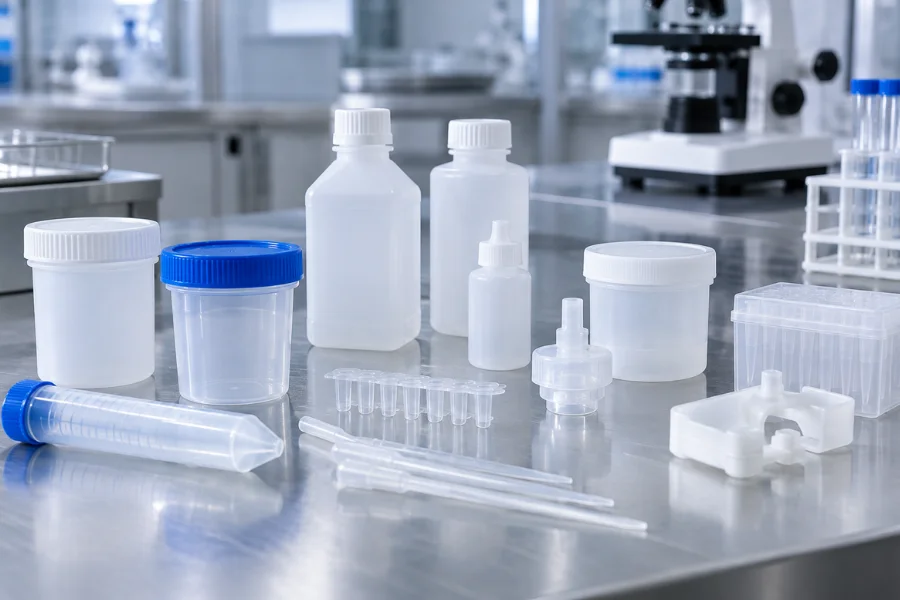
HDPE is not usually selected because it provides the highest mechanical performance among medical polymers.
Instead, it is often chosen because it provides a balanced combination of:
- Chemical stability
- Moisture resistance
- Manufacturing efficiency
- Cost control
Pharmaceutical and Diagnostic Packaging Components
HDPE is widely considered for healthcare-related packaging applications where moisture resistance and chemical stability are important.
Potential applications include:
- Pharmaceutical containers
- Specimen containers
- Diagnostic packaging components
- Laboratory storage products
For these applications, HDPE helps protect contents during storage and transportation while maintaining reliable production performance.
Material selection should still consider:
- Product compatibility
- Barrier requirements
- Intended storage conditions
- Required documentation
Laboratory and Diagnostic Components
Laboratory and diagnostic environments often expose plastic components to chemicals, cleaning procedures, and repeated handling.
HDPE may be suitable when the application requires:
- Chemical resistance
- Low moisture absorption
- Efficient high-volume production
Examples may include:
- Laboratory containers
- Sample-related components
- Supporting diagnostic components
The final choice depends on the function of the component.
A disposable laboratory product and a precision medical device component may require completely different material evaluations.
Injection Molded Medical Components
HDPE can also be considered for injection molded medical components where chemical resistance and manufacturing efficiency are priorities.
Potential applications include:
- Protective housings
- Functional plastic components
- Supporting medical parts
- Equipment-related components
For these products, successful production depends on more than selecting the resin.
The interaction between:
- Material behavior
- Mold design
- Process parameters
- Quality control
determines whether the final component can achieve consistent production performance.
For medical OEM projects requiring scalable production, medical plastic injection molding capabilities play an important role in translating material selection into reliable components.
HDPE Sterilization Compatibility Considerations
Sterilization requirements are an important factor when selecting plastics for medical applications.
A material that performs well during normal use may experience dimensional changes, mechanical property loss, discoloration, or deformation when exposed to certain sterilization conditions.
For this reason, HDPE selection should consider the relationship between:
- Sterilization method
- Exposure temperature
- Radiation conditions
- Component geometry
- Required service performance
Ethylene Oxide (EtO) Sterilization
Ethylene oxide sterilization is commonly used for medical products because it operates at relatively low temperatures compared with steam sterilization.
For HDPE components, EtO sterilization may be considered when the application requires:
- Lower temperature processing conditions
- Chemical stability
- Dimensional consistency
However, sterilization suitability depends on the specific HDPE grade, product design, packaging system, and intended use.
Material performance should be evaluated through appropriate testing rather than assumed only from resin type.
Steam Autoclave Sterilization
Steam sterilization involves elevated temperatures and moisture exposure.
Because HDPE has lower temperature resistance compared with high-performance medical polymers, repeated autoclave cycles may require careful evaluation.
Important considerations include:
- Dimensional stability after exposure
- Mechanical property retention
- Part deformation risk
- Long-term performance
For medical components requiring repeated high-temperature sterilization, engineers may consider alternative materials with higher thermal performance.
Gamma Radiation and Other Sterilization Methods
Radiation-based sterilization methods can influence polymer properties depending on:
- Resin formulation
- Additives
- Radiation dose
- Product geometry
For HDPE medical applications, compatibility evaluation should consider the complete product design rather than the material alone.
Depending on intended use and device requirements, medical OEM teams may also need to consider application-specific material evaluation, including biocompatibility considerations such as medical device validation and verification activities during product development.
HDPE Injection Molding Considerations for Medical Components
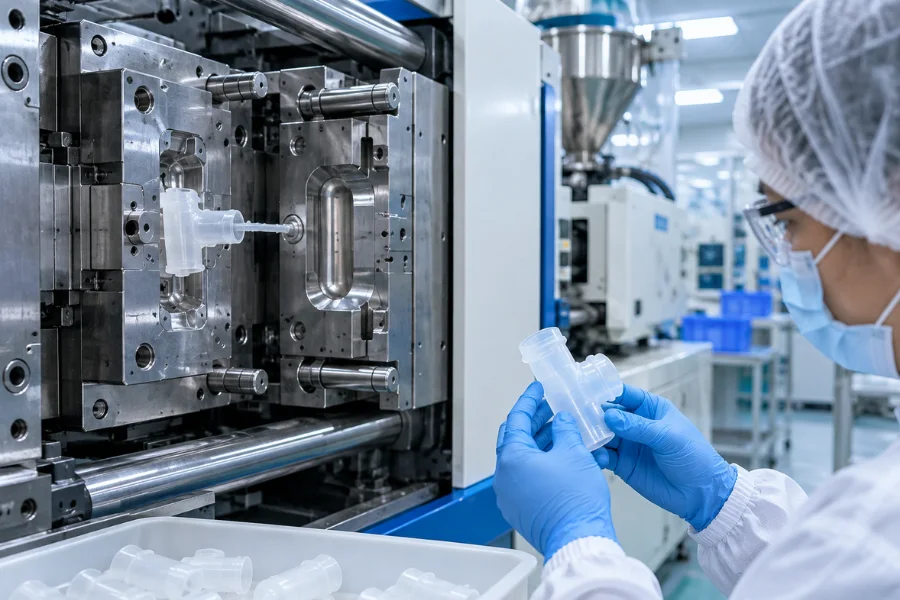
Material selection is only the first step in producing reliable medical HDPE components.
Because HDPE is a semi-crystalline polymer, its cooling behavior and shrinkage characteristics have a direct impact on final part dimensions and production consistency.
Successful HDPE molding requires coordination between:
- Material characteristics
- Mold design
- Process parameters
- Quality control methods
Managing Shrinkage and Warpage Risk
HDPE has relatively high molding shrinkage compared with some amorphous plastics.
Typical HDPE molding shrinkage is approximately 1.5%, and shrinkage differences between flow direction and transverse direction can affect dimensional stability.
During injection molding, polymer chains become oriented along the flow direction. As the material cools and crystallizes, uneven contraction may create dimensional variation.
Potential risks include:
- Warpage
- Assembly problems
- Dimensional inconsistency
- Functional performance variation
For medical components requiring reliable fit and performance, shrinkage should be managed through:
- Uniform wall thickness
- Balanced cooling design
- Proper gate location
- Controlled packing conditions
- Optimized molding parameters
The objective is not to eliminate shrinkage completely, but to control predictable material behavior through engineering design.
Mold Temperature and Cooling System Design
HDPE processing conditions influence crystallization behavior and final part dimensions.
Typical HDPE injection molding conditions include:
| Processing Parameter | Typical Range |
|---|---|
| Melt temperature | 220–260°C |
| Mold temperature | 50–95°C |
| Injection pressure | 700–1050 bar |
Actual parameters depend on:
- Material grade
- Part thickness
- Mold design
- Required tolerances
- Production requirements
Mold temperature has a significant influence on shrinkage behavior.
Uneven cooling can create different crystallization rates across the component, increasing the risk of deformation.
For medical injection molded parts, proper tooling development is essential. Early consideration of medical injection mold making helps manufacturers evaluate cooling strategies, shrinkage behavior, and production feasibility before full-scale tooling investment.
Material Drying and Moisture Control
HDPE provides a processing advantage because it has low moisture absorption compared with hygroscopic engineering plastics.
When properly stored, HDPE generally does not require the same intensive drying procedures used for materials such as nylon or polycarbonate.
This can help:
- Simplify material preparation
- Reduce moisture-related molding defects
- Improve production efficiency
However, low moisture sensitivity does not eliminate the need for controlled material handling.
Medical manufacturing still requires:
- Resin identification
- Batch traceability
- Controlled storage
- Contamination prevention
Material control remains important because consistent resin management contributes directly to repeatable production quality.
Design Considerations for HDPE Medical Injection Molded Parts
Design for manufacturability (DFM) plays an important role in successful HDPE medical component production.
Because HDPE has noticeable shrinkage behavior and crystallization characteristics, part design decisions directly influence molding stability.
Wall Thickness Consistency
Uniform wall thickness is one of the most important considerations when designing HDPE components.
Sudden thickness changes can create:
- Uneven cooling
- Internal stress
- Sink marks
- Dimensional variation
Maintaining consistent wall sections improves cooling balance and helps achieve more predictable molding results.
Draft Angles and Ejection Design
HDPE generally provides good release characteristics, but appropriate draft angles are still necessary for stable production.
Proper ejection design helps reduce:
- Part deformation
- Surface damage
- Production interruptions
For complex medical components, early mold design support can help identify potential manufacturing risks before tooling development.
Ribs, Bosses, and Structural Features
Structural features such as ribs and mounting bosses should be designed with HDPE’s cooling behavior in mind.
Excessive thickness around these areas may increase cooling differences and contribute to:
- Sink marks
- Warpage
- Dimensional instability
Engineers should balance:
- Required mechanical strength
- Material usage
- Cooling behavior
- Mold filling performance
Tolerance and Dimensional Requirements
HDPE can support many medical applications, but extremely tight tolerances require careful evaluation.
Achieving consistent dimensions depends on:
- Resin characteristics
- Mold precision
- Process stability
- Cooling consistency
- Inspection methods
Tolerance requirements should be driven by functional needs rather than unnecessarily tight specifications.
A well-designed HDPE component considers both material capability and manufacturing practicality.
HDPE Material Selection Framework for Medical Applications
Choosing HDPE for a medical component requires evaluating the complete product lifecycle.
The best material choice is not always the polymer with the highest performance. It is the material that provides the right balance between:
- Functional requirements
- Manufacturing reliability
- Regulatory expectations
- Production economics
Evaluate Application Requirements
The first step is understanding the component’s actual operating environment.
Key questions include:
- Will the component contact chemicals?
- Does it require sterilization?
- Is dimensional accuracy critical?
- Is the product single-use or reusable?
- What mechanical loads will it experience?
For example, HDPE may be a strong candidate for a diagnostic container requiring chemical resistance and moisture protection.
However, the same material may not be ideal for a structural medical component requiring high stiffness or repeated high-temperature sterilization.
Evaluate Manufacturing Requirements
The selected HDPE grade must work with the intended production process.
Important considerations include:
- Part geometry
- Injection molding requirements
- Tooling strategy
- Production volume
- Quality requirements
Medical OEM teams often evaluate manufacturing capability together with resin selection because material behavior directly affects tooling and process development.
Medical Grade HDPE Selection Matrix
A material selection matrix helps medical OEM teams compare HDPE’s strengths and limitations before moving into product development and manufacturing.
The following considerations can help determine whether HDPE matches a specific medical application.
| Requirement | HDPE Suitability | Engineering Consideration |
|---|---|---|
| Chemical resistance | Excellent | Suitable for many fluid and chemical exposure environments |
| Moisture resistance | Excellent | Low water absorption reduces moisture-related processing risks |
| Injection molding performance | Good | Requires proper tooling and process control |
| High-volume production | Good | Supports efficient manufacturing for suitable components |
| High-temperature sterilization | Limited | Requires evaluation based on sterilization method and cycle conditions |
| Optical clarity | Limited | Transparent applications may require alternative polymers |
| Tight dimensional tolerances | Moderate | Requires optimized tooling, cooling, and process control |
| High structural stiffness | Moderate | Engineering plastics may be more suitable for demanding mechanical loads |
This comparison highlights an important principle:
HDPE is not selected because it provides the highest performance in every category. It is selected when its specific advantages align with the functional requirements of the medical component.
Example: When a Medical OEM May Choose HDPE
Consider a medical company developing a diagnostic consumable that requires:
- Chemical resistance
- Moisture protection
- Consistent high-volume production
- Cost-effective manufacturing
HDPE may be a suitable choice because it provides:
- Stable chemical performance
- Low moisture absorption
- Efficient injection molding characteristics
- Practical production economics
However, if the same component requires:
- Optical transparency
- Repeated high-temperature sterilization
- Extremely high stiffness
another polymer may provide a better solution.
This is why medical material selection should focus on application requirements rather than choosing a polymer based only on popularity or cost.
HDPE Compared With Other Medical Plastics
Medical OEM teams often evaluate HDPE alongside other commonly used medical polymers.
The correct choice depends on the balance between performance requirements, manufacturing conditions, and product lifecycle expectations.
| Material | Main Advantages | Main Limitations | Common Medical Considerations |
|---|---|---|---|
| HDPE | Chemical resistance, moisture resistance, good processability | Lower temperature resistance and stiffness compared with some engineering polymers | Containers, laboratory products, molded medical components |
| PP | Higher temperature capability and good sterilization performance | Different shrinkage and impact characteristics | Medical disposables, laboratory applications |
| PC | High impact strength and optical clarity | More sensitive to certain chemicals | Transparent medical components and housings |
| PEEK | Excellent mechanical strength and thermal performance | High material and processing cost | Advanced medical applications requiring extreme performance |
HDPE vs Polypropylene (PP)
HDPE and polypropylene are often compared because both provide good chemical resistance and are widely used in medical-related applications.
HDPE advantages:
- Better moisture resistance
- Good impact performance
- Strong chemical stability
PP advantages:
- Higher temperature resistance
- Better suitability for certain sterilization environments
The choice between HDPE and PP depends on the product requirements rather than a simple material ranking.
For projects where polypropylene is more suitable, SeaSkyMedical also provides PP injection molding solutions for medical applications requiring different performance characteristics.
HDPE vs Engineering Plastics
Compared with engineering plastics such as polycarbonate or PEEK, HDPE generally provides lower mechanical and thermal performance.
However, many medical components do not require extreme material performance.
Using a higher-performance polymer when unnecessary may increase:
- Material cost
- Processing complexity
- Tooling considerations
The most effective material selection balances required performance with practical manufacturing needs.
Regulatory and Quality Considerations for Medical HDPE Components
Medical material selection involves more than polymer performance.
Depending on the intended use, medical OEM teams may need to evaluate:
- Material documentation
- Traceability requirements
- Biocompatibility considerations
- Manufacturing controls
- Validation activities
For products involving patient contact, material evaluation may include consideration of applicable standards such as ISO 10993 based on device classification and intended use.
Material compliance is determined by the complete medical application, not simply by selecting an HDPE resin.
Manufacturing processes also require appropriate quality controls. For medical products requiring controlled production environments, cleanroom injection molding may be considered to support contamination control and consistent production conditions.
Manufacturing Medical HDPE Components With SeaSkyMedical
Selecting the correct material is only the beginning of successful medical component development.
A reliable HDPE medical component requires coordination between:
- Material selection
- Product design
- Mold development
- Injection molding process control
- Quality management
SeaSkyMedical supports medical OEM teams through engineering-focused manufacturing solutions, including:
- Medical plastic injection molding
- Mold development
- DFM support
- Prototype development
- Production scaling
For projects requiring integrated manufacturing support, medical device contract manufacturing can help connect product development, tooling, manufacturing, and quality requirements into one coordinated process.
During early-stage development, SeaSkyMedical can also support product engineering decisions through OEM medical components manufacturing solutions, helping teams evaluate material behavior, manufacturability, and production requirements before commercialization.
FAQ
Is HDPE suitable for medical devices?
HDPE can be suitable for medical applications where chemical resistance, moisture resistance, and efficient manufacturing are important requirements.
The suitability of HDPE depends on the specific component design, intended use, performance requirements, and applicable quality considerations.
What makes HDPE a medical grade plastic?
Medical grade HDPE is not defined only by the polymer type.
Selection typically involves evaluating:
- Resin consistency
- Material documentation
- Traceability
- Application requirements
- Manufacturing controls
The appropriate grade depends on the intended medical application.
Does HDPE require drying before injection molding?
HDPE generally does not require extensive drying because it has low moisture absorption.
However, medical manufacturing still requires proper material storage, identification, and handling procedures to maintain production consistency.
Can HDPE withstand sterilization?
HDPE sterilization compatibility depends on:
- Sterilization method
- Material grade
- Product design
- Exposure conditions
Lower-temperature sterilization methods may be more suitable for certain HDPE applications, while repeated high-temperature sterilization requires additional evaluation.
What medical products are commonly made from HDPE?
HDPE may be used for:
- Medical containers
- Laboratory components
- Diagnostic-related products
- Certain injection molded medical parts
The final application depends on mechanical requirements, chemical exposure, sterilization conditions, and manufacturing considerations.
How should engineers choose between HDPE and other medical plastics?
Engineers should evaluate:
- Chemical resistance
- Temperature requirements
- Mechanical performance
- Sterilization conditions
- Manufacturing process
- Production volume
- Documentation requirements
The best material is the one that provides the right balance between product performance and manufacturing reliability.