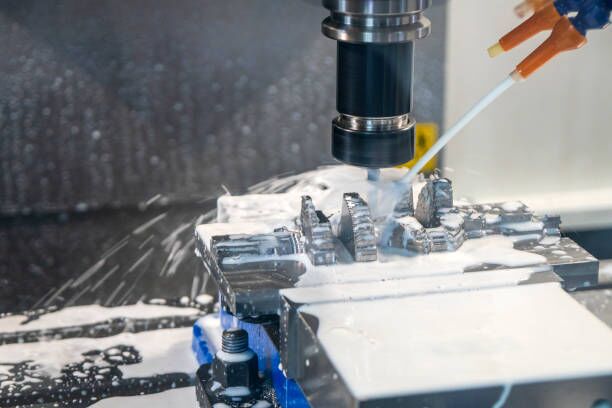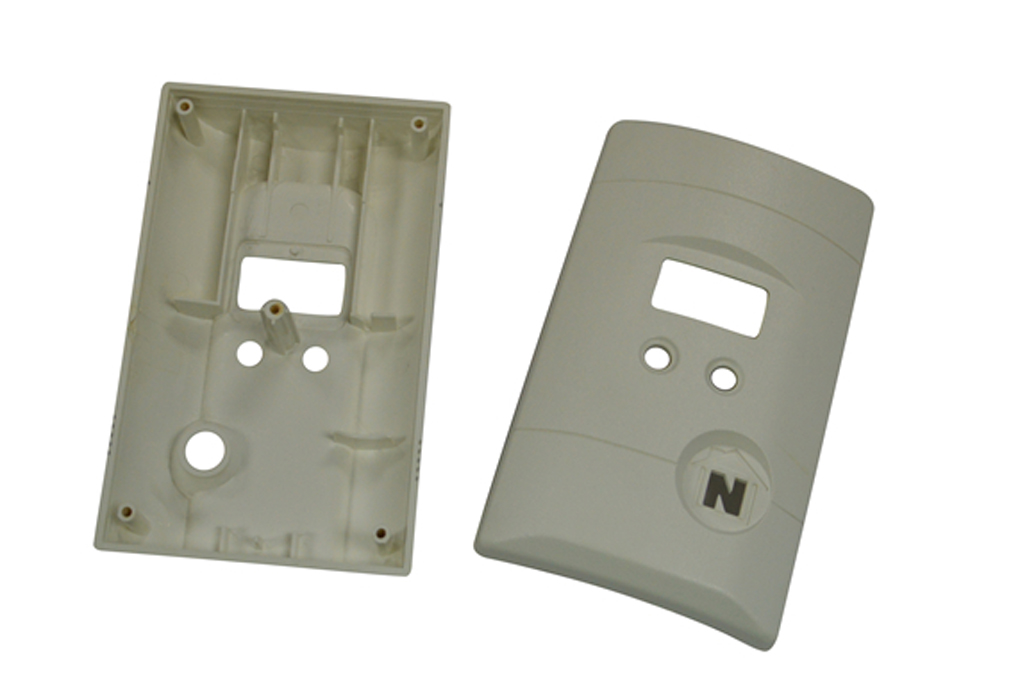
ABS can be a practical choice for a diagnostic equipment housing and a poor choice for a reusable component exposed to repeated high-temperature steam sterilization.
The difference is not simply whether the resin carries a “medical grade” designation. Engineers must match the specific ABS grade to the device’s mechanical, thermal, chemical, sterilization, dimensional, and patient-contact requirements.
For suitable applications, medical grade ABS offers a useful balance of impact resistance, dimensional stability, surface quality, moldability, and manufacturing economics. This guide explains where ABS fits, where its limitations matter, and what engineers should control before moving from material selection to production molding.
What Is Medical Grade ABS?
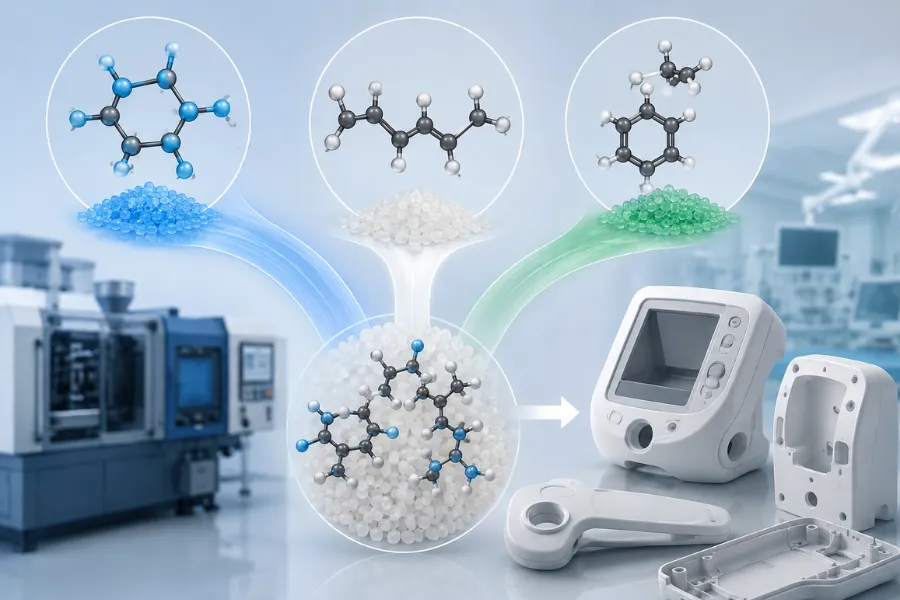
ABS stands for acrylonitrile butadiene styrene. It is an amorphous thermoplastic made from three primary components.
- Acrylonitrile contributes strength, thermal stability, and chemical stability.
- Butadiene contributes toughness and impact resistance.
- Styrene contributes rigidity, processability, and surface quality.
Manufacturers can adjust the formulation to produce ABS grades with different performance characteristics, including high-impact and heat-resistant variants.
Typical ABS has a density of approximately 1.02–1.05 g/cm³ and combines relatively high impact strength with good dimensional stability and injection moldability. These characteristics also explain why ABS plastic molding is used for a range of structural and enclosure components.
What Does Medical Grade Actually Mean for ABS?
“Medical grade” should not be interpreted as a universal certification that makes every ABS resin suitable for every medical device.
It is more useful to separate three considerations.
Material designation
A resin manufacturer may develop or market a specific ABS grade for healthcare or medical applications.
Supporting material documentation
Depending on the grade, the manufacturer may provide technical specifications, traceability information, formulation controls, biological evaluation data, regulatory support, or sterilization-related information.
Finished-device requirements
The device manufacturer still needs to determine whether the selected material is appropriate for the actual component, manufacturing process, patient-contact conditions, sterilization method, and target market.
This distinction is important because supporting material data does not automatically establish the compliance or biological safety of a finished medical device.
Colorants, additives, processing conditions, secondary operations, manufacturing residues, and actual use conditions may also affect the final evaluation.
What Should You Request From an ABS Resin Supplier?
The required documentation depends on the medical device, but the material review may include:
- Technical data sheet
- Resin grade and lot identification
- Relevant biological evaluation documentation where applicable
- Sterilization compatibility information where available
- Additive and colorant information where relevant
- Formulation or change-notification information
- Other regulatory support documentation required by the project
The objective is not to collect every available certificate. It is to determine whether the documentation supports the actual requirements of the device.
Key Properties of Medical Grade ABS
The value of ABS comes from the balance between its properties rather than one exceptional characteristic.
| Property | Engineering Significance |
|---|---|
| Impact resistance | Helps protect housings and structural parts from handling and accidental impacts |
| Rigidity | Supports structural integrity and assembly features |
| Dimensional stability | Helps maintain mating dimensions and component fit |
| Surface quality | Supports smooth, polished, or textured visible surfaces |
| Moldability | Allows relatively complex injection molded geometries |
| Electrical insulation | Useful around electronic assemblies |
| Chemical stability | Provides resistance to water, inorganic salts, oils, and some chemicals |
| Colorability | Supports appearance and product identification requirements |
ABS also retains useful impact performance at relatively low temperatures.
Actual mechanical, thermal, shrinkage, and processing characteristics vary by formulation. Engineering decisions should therefore use data for the specific resin under evaluation rather than assuming one generic ABS value applies to every medical grade.
When ABS is only one of several possible polymers, a broader medical plastic material selection review can help compare material properties against the actual device requirements before tooling begins.
Advantages of Medical Grade ABS
Good Impact Resistance for Medical Equipment
Impact resistance is one of the main reasons ABS is considered for medical equipment housings.
A handheld diagnostic device may need to withstand routine handling or accidental impacts while protecting electronic assemblies inside the enclosure. The butadiene phase contributes toughness that helps ABS absorb impact energy rather than fracture immediately.
Final performance still depends on geometry. Sharp corners, poorly designed bosses, thin sections, weld lines, and residual molding stress can reduce the impact performance of an otherwise suitable resin.
Dimensional Stability for Assemblies
ABS generally has relatively low molding shrinkage.
Typical molding shrinkage for impact-resistant or heat-resistant ABS is approximately 0.3%–0.8%. Some 30% glass-fiber-reinforced ABS materials may have shrinkage around 0.3%–0.6%.
This can benefit components containing mating surfaces, screw bosses, snap fits, alignment features, and internal mounting structures.
Low shrinkage does not mean ABS can automatically maintain any requested tolerance. Part size, geometry, wall thickness, gate location, mold construction, cooling balance, and process stability all influence dimensional capability.
Good Surface Quality
ABS can reproduce smooth, polished, or textured mold surfaces and produce components with good cosmetic quality.
This makes it useful for visible medical equipment enclosures that need both functional molded features and a controlled exterior appearance.
ABS also accepts pigmentation well. Final appearance still depends on material drying, mold finish, gate location, venting, and molding conditions.
Design Flexibility
ABS has medium flow characteristics and can accommodate relatively complex injection molded geometries.
Designers can integrate ribs, bosses, clips, snap fits, internal supports, mounting features, and interface openings into a single component.
This can reduce separate parts and assembly operations, but the design still needs to respect molding constraints such as wall transitions, draft, flow length, gate position, and cooling.
Practical Manufacturing Economics
ABS generally costs less than high-performance engineering polymers such as PPSU or PEEK.
It can therefore provide a practical balance of performance and manufacturing cost when a medical component does not require extreme thermal, chemical, or sterilization resistance.
The lowest material price is not necessarily the lowest project cost. A resin that fails cleaning, sterilization, dimensional, or functional testing can create much greater costs after tooling has begun.
Limitations of Medical Grade ABS
Limited High-Temperature Performance
ABS is not a high-temperature medical polymer.
General ABS may have a continuous service temperature around 70°C, while heat deflection temperature can be around 93°C, depending on formulation and test conditions.
This becomes an important limitation for devices exposed to elevated temperatures. Repeated high-temperature steam sterilization is one situation where a higher-temperature polymer may need to be considered.
Sterilization Compatibility Depends on the Resin and Process
The useful engineering question is not simply whether ABS can be sterilized.
It is whether the selected ABS formulation can tolerate the intended sterilization process and number of exposures while maintaining the required device performance.
Depending on the application, sterilization may involve processes such as:
- Ethylene oxide
- Gamma radiation
- Electron beam
- Steam sterilization
Possible effects can include changes in color, dimensions, surface condition, toughness, or other mechanical properties.
The source material used for this guide does not establish universal sterilization limits for medical grade ABS. Compatibility should therefore be evaluated using information for the selected resin and, where required, testing under representative device conditions.
Chemical Resistance Has Boundaries
ABS provides useful resistance to water, inorganic salts, oils, and certain acids, but it is not universally resistant to disinfectants, solvents, or laboratory chemicals.
Some chemical environments can contribute to environmental stress cracking, particularly when residual molding stress is present.
Compatibility testing should consider the actual chemical, concentration, exposure time, temperature, repeated exposure, and mechanical stress expected during use.
Limited UV and Weathering Resistance
ABS has relatively poor resistance to prolonged ultraviolet exposure.
Long-term UV exposure can contribute to discoloration, degradation, and embrittlement unless the formulation contains suitable stabilization or the component is otherwise protected.
Medical equipment expected to operate outdoors therefore requires additional material evaluation.
Not Suitable for Every Patient-Contact Application
Medical grade ABS should not automatically be treated as suitable for every patient-contact component.
The biological evaluation requirements of a device can depend on the type and duration of contact, formulation, additives, manufacturing process, and finished component.
Supplier data can support material evaluation, but it does not by itself establish the biological safety of every finished device.
Common Medical Applications of ABS
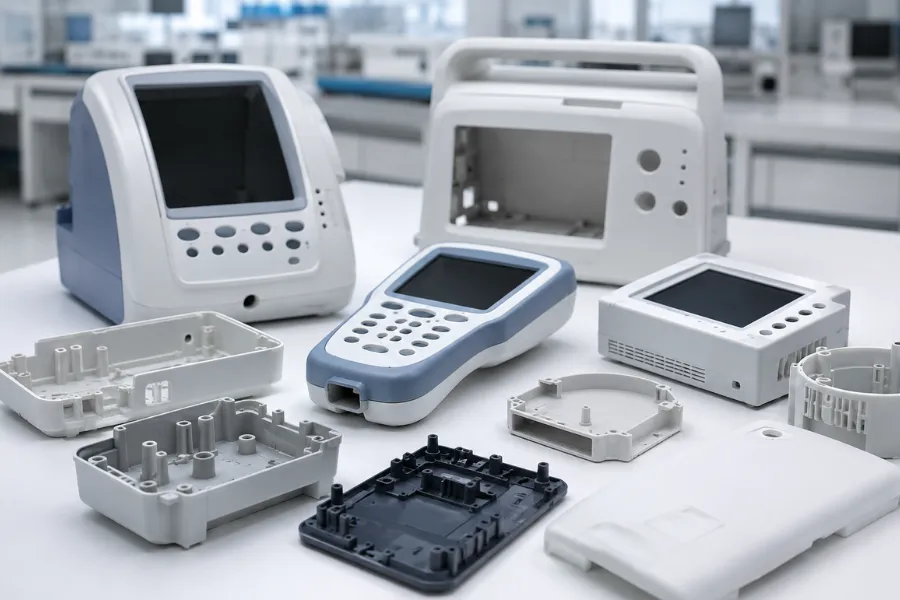
ABS is most relevant when an application benefits from toughness, rigidity, surface quality, and injection molding flexibility.
| Potential Application | Why ABS May Fit |
|---|---|
| Diagnostic equipment housing | Impact resistance, internal mounting features, dimensional stability |
| Handheld medical device enclosure | Toughness, moldability, good surface quality |
| Monitoring equipment housing | Rigidity, electrical insulation, repeatable assembly |
| Laboratory equipment cover | Dimensional stability and cosmetic appearance |
| Internal structural component | Molded ribs, bosses, supports, and mounting features |
For example, a diagnostic analyzer enclosure may require impact resistance to protect electronics, consistent mating surfaces for assembly, internal bosses for fastening, and a controlled exterior finish. ABS can combine these requirements within one molded component.
For an OEM medical component, however, the application still needs to be checked against operating temperature, cleaning chemicals, sterilization, patient contact, assembly requirements, and expected service life.
Medical Grade ABS Injection Molding Process
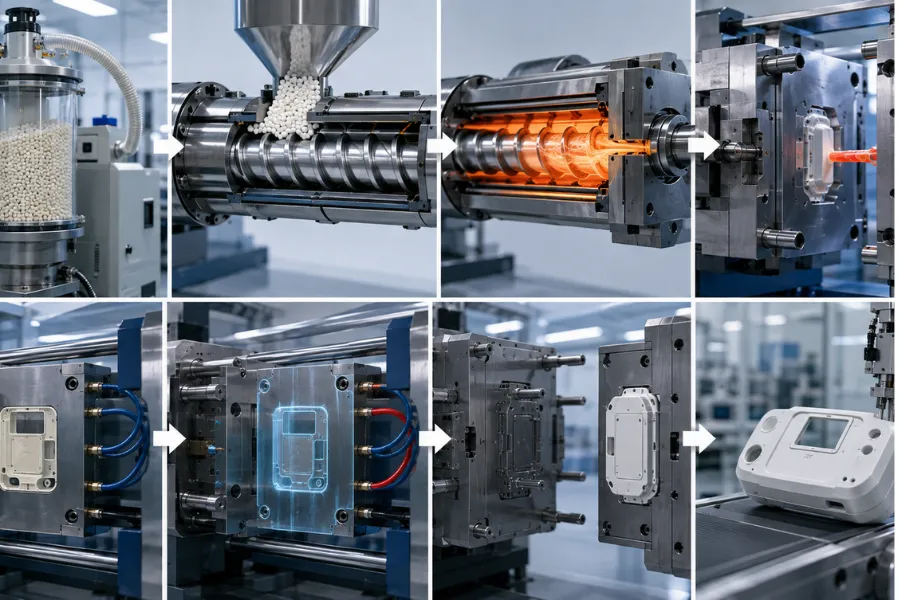
Published parameters should be treated as general ABS reference ranges, not as a fixed medical ABS production recipe.
Process development should establish a stable molding window for the selected resin, part geometry, mold, and injection molding machine. This is particularly important in medical plastic injection molding, where dimensional, visual, and functional requirements need to remain repeatable across production.
| Process Factor | General ABS Reference | If Inadequate | If Excessive |
|---|---|---|---|
| Material drying | Follow grade-specific recommendations | Splay, bubbles, surface defects | Follow resin-specific limits |
| Barrel temperature | About 190–250°C | Poor flow, short shots, high pressure | Degradation, discoloration |
| Mold temperature | About 50–80°C | Flow or surface problems | Longer cooling time |
| Injection pressure | Grade, geometry, and machine dependent | Short shots, weak packing | Flash, residual stress, overpacking |
| Packing | Part-dependent | Sink marks, dimensional loss | Stress, flash, difficult ejection |
| Cooling | Geometry-dependent | Deformation, warpage | Unnecessary cycle time |
These values provide process context. The resin supplier’s recommendations and actual molding trials should take priority when defining production settings.
Dry ABS Before Molding
ABS absorbs moisture and normally requires appropriate drying before injection molding.
Excessive moisture can contribute to silver streaks, splay, bubbles, poor surface quality, and material degradation.
Material handling also matters after drying. Excessive exposure to humid shop air can allow the resin to absorb moisture again before molding.
Control Melt Temperature Rather Than Simply Raising It
ABS is an amorphous thermoplastic with a relatively broad processing range.
A general barrel temperature reference is approximately 190–250°C.
Insufficient temperature can increase melt viscosity and contribute to incomplete filling, excessive pressure requirements, or weak weld regions. Excessive thermal exposure can cause degradation and discoloration.
The goal is to achieve reliable filling without exposing the resin to unnecessary temperature or residence time.
Use Mold Temperature to Balance Quality and Cycle Time
General ABS mold-temperature references include:
| Requirement | General Reference |
|---|---|
| High dimensional accuracy | 50–60°C |
| High surface gloss | 60–80°C |
| Large or complex components | 60–80°C |
Higher mold temperatures can support surface reproduction and flow but may increase cooling time.
Actual settings should reflect the resin grade, geometry, surface requirements, dimensional behavior, and target production cycle.
Balance Injection Pressure and Speed
ABS often requires sufficient injection pressure and velocity to maintain a stable flow front through the cavity.
Too little pressure or speed can contribute to short shots and weak weld regions. Excessive settings can increase flash, trapped gas, residual stress, or overpacking.
Rather than targeting one universal pressure value, process development should establish a filling and packing profile appropriate for the actual mold and resin.
Maintain Uniform Cooling
Low shrinkage does not eliminate the possibility of ABS warpage.
Uneven cooling around thick sections, ribs, bosses, and deep cavity features can produce differential shrinkage and dimensional variation.
Cooling design and cycle time should allow the component to develop sufficient rigidity for ejection while avoiding unnecessary cycle time.
Design Guidelines for Medical Grade ABS Parts
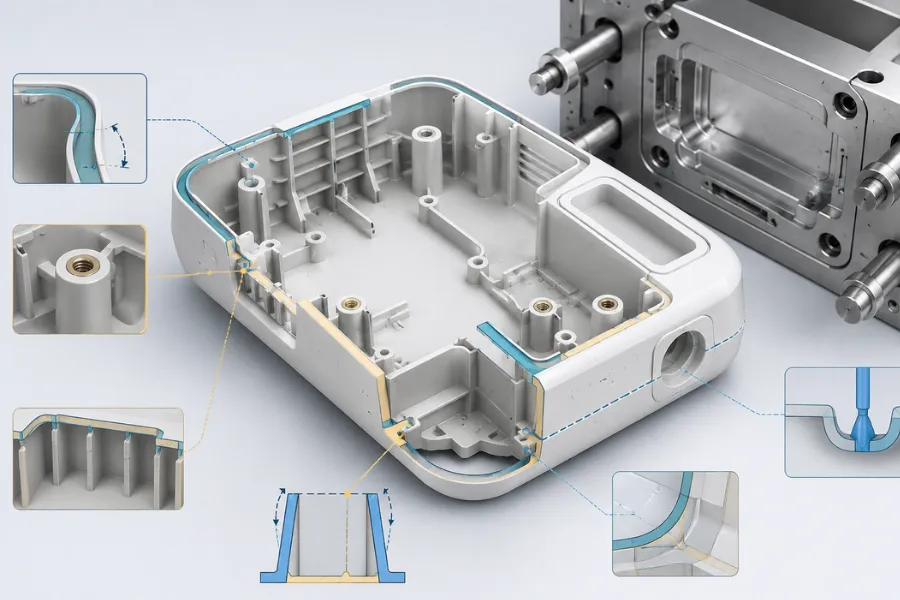
Good ABS components begin with part and tool design rather than machine settings alone. Early DFM and mold design can identify wall thickness, draft, gate, cooling, ejection, and tolerance risks before production tooling is finalized.
Keep Wall Thickness as Uniform as Practical
Abrupt transitions between thick and thin sections cool at different rates.
This can lead to sink marks, internal voids, warpage, residual stress, and longer cooling cycles.
Where additional stiffness is required, properly designed ribs may provide a better solution than simply increasing the overall wall thickness.
Focus Tolerances on Critical-to-Function Dimensions
ABS has useful dimensional stability, but material selection alone does not determine production tolerance.
Tolerance capability also depends on:
- Part size and geometry
- Wall thickness
- Shrinkage
- Gate location
- Cooling balance
- Mold construction
- Measurement method
- Process stability
During DFM, the development team should identify critical-to-function dimensions and determine how they will be molded, measured, and controlled.
Tight tolerances should be concentrated where they affect device function or assembly rather than applied unnecessarily to every dimension. Production trials can then be used to evaluate process capability for the dimensions that matter most.
Provide Adequate Draft
Traditional ABS mold-design references provide cavity draft ranges around 35′–1°30′ and core draft around 30′–40′.
These values are useful as references rather than universal design rules.
Actual draft should account for draw depth, geometry, surface texture, finish, and ejection conditions. Textured or deep surfaces may require additional draft.
Design Ribs and Bosses Around Material Distribution
Ribs and bosses commonly support circuit boards, fasteners, internal assemblies, and structural loads.
Excessive material around these features can create localized shrinkage and visible sink marks on the opposite surface.
Their geometry should provide the required stiffness or fastening function without creating unnecessarily thick sections.
Use Radii at Stress Concentrations
Sharp internal corners can concentrate mechanical stress and interfere with smooth melt flow.
Rounded transitions improve stress distribution and can support better cavity filling around bosses, ribs, and other structural features.
Consider Gate Location During DFM
Gate position influences how molten ABS fills and packs the cavity.
It can affect:
- Flow length
- Weld-line location
- Packing balance
- Air trapping
- Warpage
- Cosmetic surfaces
ABS can accommodate side, point, submarine, and other gate configurations. The final strategy should reflect geometry, appearance requirements, critical dimensions, and mold architecture.
These decisions should be incorporated into medical injection mold design and manufacturing rather than treated as adjustments after the mold has already been built.
Provide Effective Venting
Trapped air can contribute to burn marks, incomplete filling, and weak weld regions.
Traditional ABS mold-design guidance indicates parting-line vent depths around 0.03 mm.
The final vent design should account for the actual resin and tooling conditions because insufficient venting restricts filling while excessive vent depth can promote flash.
Common ABS Injection Molding Defects and Solutions
ABS molding defects usually reflect interactions between material condition, component design, tooling, and process settings.
| Defect | Common Causes | Corrective Direction |
|---|---|---|
| Splay or silver streaks | Moisture, excessive thermal exposure | Improve drying and review melt conditions |
| Sink marks | Thick sections, insufficient packing | Improve geometry and packing |
| Warpage | Uneven cooling, differential shrinkage | Balance cooling and review part design |
| Short shots | Poor flow, insufficient filling, inadequate venting | Review temperature, gates, filling, and vents |
| Burn marks | Trapped gas, excessive filling speed | Improve venting and injection profile |
| Weld lines | Flow fronts meeting around features | Review gate location and process conditions |
| Flash | Excessive pressure, mold gaps, excessive melt temperature | Review tooling, clamping, and process settings |
Changing one machine setting to eliminate a defect can introduce another.
For medical components, the objective is a repeatable process window that maintains critical dimensions, functional performance, and visual requirements under normal production variation.
Medical Grade ABS vs. Other Medical Plastics
ABS and polycarbonate are often compared for medical equipment housings when impact resistance, appearance, temperature capability, and cost must be balanced.
Other medical polymers become relevant as thermal, chemical, sterilization, or mechanical requirements change.
| Material | Why Choose It Over ABS | Why ABS May Still Be Preferred |
|---|---|---|
| PC | Transparency or higher impact and temperature requirements | ABS can offer good toughness and surface quality when transparency or additional thermal capability is unnecessary |
| PC/ABS | Higher heat capability than standard ABS with a different toughness and processing balance | Standard ABS may be sufficient when the added performance is not required |
| PP | Lower density and better resistance to certain chemical environments | ABS provides greater rigidity and cosmetic quality for many equipment housings |
| PPSU | Better suited to applications requiring repeated high-temperature steam sterilization | ABS may reduce material cost when repeated autoclaving is not required |
| PEEK | Much higher thermal and mechanical performance | ABS is substantially more economical when extreme performance is unnecessary |
The most technically capable polymer is not automatically the best choice.
Material selection should provide the properties the device actually needs without introducing unnecessary material or processing cost.
How to Choose a Medical Grade ABS Resin
Define the Device Requirements First
Before selecting an ABS grade, define what the component must withstand.
Review:
- Mechanical loads and drop requirements
- Operating temperature
- Cleaning and chemical exposure
- Patient-contact conditions
- Critical dimensional requirements
- Surface and appearance requirements
- Expected service life
- Sterilization method and frequency
These requirements determine whether ABS should remain in the candidate material set.
Review the Candidate Resin and Its Documentation
Once a potential grade has been identified, compare its technical performance and available documentation with the device requirements.
Do not assume that information from one medical-use ABS formulation automatically applies to another grade.
Material documentation should support the selection decision, while finished-device requirements determine what additional evaluation or validation may be necessary.
Evaluate Sterilization Before Production Tooling
If sterilization is required, evaluate compatibility before committing to production tooling.
The objective at this stage is to identify whether sterilization could affect dimensions, appearance, mechanical properties, surface condition, or device function.
Finding an incompatibility during material selection is much easier to manage than discovering it after mold construction or validation has begun.
Validate the Material in the Actual Component
Datasheets are useful for screening candidate polymers but cannot represent every interaction between resin, geometry, mold, molding conditions, sterilization, and end use.
A practical medical device product development sequence is:
Material selection → DFM → mold design → molding trials → dimensional inspection → functional testing → validation
Prototype parts may also be useful before committing to production tooling. Depending on the geometry and purpose of the prototype, 3D prototype printing or CNC plastic machining can support early dimensional, assembly, or functional evaluation.
As the project progresses, medical device verification and validation should confirm that the design and manufacturing approach meet the defined device requirements.
Why Manufacturing Control Matters for Medical ABS Parts
A suitable medical ABS resin cannot compensate for an unstable manufacturing process.
Consistent molded components depend on control across:
- Resin identification and traceability
- Storage and drying
- DFM and mold engineering
- Molding parameters
- Tool maintenance
- Dimensional and visual inspection
- Process monitoring
- Production documentation
These factors interact. Increasing injection pressure to eliminate a short shot, for example, may create flash or residual stress elsewhere in the component.
Where the molded ABS part becomes part of a larger device or subassembly, controlled medical device assembly also needs to account for mating dimensions, fastening features, cosmetic requirements, and functional interfaces.
For programs moving beyond individual molded components, medical device contract manufacturing can connect material selection, tooling, molding, assembly, inspection, and production documentation within a broader manufacturing workflow.
Medical molding therefore requires the material, part design, tooling, process, inspection, and validation strategy to work as one manufacturing system.
Is Medical Grade ABS Right for Your Project?
This screening matrix can help determine whether ABS deserves further evaluation.
| Project Requirement | ABS Fit |
|---|---|
| Impact-resistant medical equipment housing | Good candidate |
| Complex injection molded enclosure | Good candidate |
| High-quality cosmetic surface | Good candidate |
| Internal bosses, ribs, and mounting features | Good candidate |
| Moderate operating temperatures | Generally suitable |
| Repeated high-temperature steam sterilization | Often a poor candidate |
| Long-term outdoor UV exposure | Requires careful evaluation |
| Aggressive chemical exposure | Requires compatibility testing |
| Tight critical tolerances | Requires DFM and process capability evaluation |
| Patient-contact application | Requires grade and device-specific evaluation |
| Extreme thermal or mechanical performance | Consider higher-performance polymers |
The matrix is a screening tool rather than a substitute for resin qualification. Its purpose is to identify obvious material mismatches before significant tooling and validation resources are committed.
Frequently Asked Questions About Medical Grade ABS
Is ABS Safe for Medical Devices?
ABS can be suitable for medical device housings and selected structural components. Suitability depends on the resin grade, intended use, patient contact, chemical exposure, sterilization, and finished-device requirements.
Is Medical Grade ABS Biocompatible?
Some medical-use ABS grades may provide supporting biological evaluation data. This does not establish universal biocompatibility for every ABS resin or finished device, and requirements depend on the intended patient contact and device evaluation.
Can Medical Grade ABS Be Sterilized?
Some ABS grades may tolerate specific EtO or radiation sterilization conditions. Compatibility depends on the resin and sterilization process, while repeated high-temperature steam sterilization can be a significant limitation.
What Temperature Is Used to Injection Mold ABS?
General ABS barrel-temperature references are approximately 190–250°C, with mold temperatures commonly around 50–80°C. The selected resin supplier’s processing recommendations and molding trials should define the actual production window.
Does ABS Need to Be Dried Before Injection Molding?
Yes. Appropriate drying helps prevent moisture-related defects such as splay, bubbles, and poor surface quality. Drying conditions should follow the selected resin’s processing recommendations.
What Is the Difference Between Medical Grade ABS and Regular ABS?
Both belong to the ABS polymer family. A medical-use grade may provide additional formulation controls, traceability, technical documentation, or supporting test data relevant to medical applications, depending on the resin manufacturer.
Conclusion
Medical grade ABS is most useful when its actual properties match the requirements of the medical component. Impact resistance, dimensional stability, moldability, and surface quality can make it an effective choice for equipment housings and structural parts, while high-temperature sterilization, aggressive chemicals, or more demanding performance requirements may point toward another polymer.
The material decision should therefore connect device requirements → resin selection → DFM → tooling → process control → validation.
If you are evaluating ABS for a medical component, SeaSkyMedical can review the material, part geometry, tooling requirements, and injection molding risks before production tooling begins.