Introduction
Choosing the right material is one of the earliest and most critical decisions in medical device development. The selected polymer affects not only product performance but also sterilization compatibility, regulatory evaluation, manufacturing stability, and long-term reliability.
Medical-grade polycarbonate (PC) has become one of the most widely used engineering plastics for medical applications because it provides a valuable combination of:
- High optical transparency
- Excellent impact resistance
- Dimensional stability
- Temperature resistance
- Injection molding capability
Unlike many transparent plastics that are selected mainly for appearance, medical-grade PC is often chosen when a component must provide visibility while maintaining structural performance under demanding healthcare environments.
However, selecting polycarbonate for medical devices requires more than reviewing basic material properties. Engineers must consider whether the selected grade can support the complete product lifecycle, including:
- Biological safety requirements
- Sterilization exposure
- Injection molding performance
- Dimensional consistency
- Process validation
- Long-term production stability
A common mistake during medical product development is selecting a material only because it has excellent mechanical properties. A PC grade that performs well during initial testing may still create challenges during sterilization validation, regulatory review, or commercial production if material compatibility and manufacturing risks are not evaluated early.
This guide explains how engineers evaluate medical-grade polycarbonate, including material characteristics, application suitability, sterilization considerations, injection molding requirements, failure risks, and production scaling considerations.
What Is Medical Grade Polycarbonate (PC)?
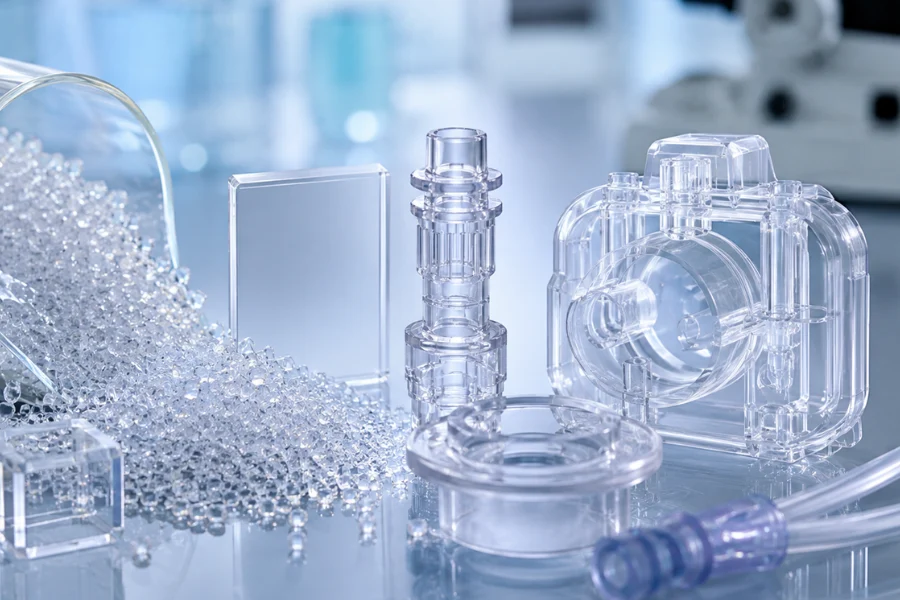
Polycarbonate is an amorphous thermoplastic engineering polymer known for its combination of transparency, toughness, heat resistance, and dimensional stability.
The material structure allows PC to maintain mechanical performance across a wide temperature range, making it suitable for applications where both visibility and durability are required.
Medical-grade polycarbonate refers to specially developed PC formulations intended for healthcare applications. Compared with standard industrial polycarbonate, medical grades typically provide additional control over:
- Material composition
- Additive selection
- Batch traceability
- Biological evaluation support
- Regulatory documentation
The difference between standard PC and medical-grade PC is therefore not only the polymer itself, but also the level of qualification and control behind the material.
For medical device manufacturers, material selection should consider:
- Patient contact classification
- Sterilization method
- Mechanical requirements
- Optical requirements
- Injection molding feasibility
- Long-term supply stability
A transparent industrial PC component and a blood-contacting medical connector may both use polycarbonate, but their qualification requirements are completely different.
During early-stage development, working with an experienced engineering team through professional product development support can help manufacturers evaluate material selection, manufacturability, and production risks before investing in tooling.
Basic Properties of Medical Grade Polycarbonate
Medical-grade PC maintains the core characteristics that make polycarbonate valuable in engineering applications.
| Property | Typical Value |
|---|---|
| Density | Approximately 1.20 g/cm³ |
| Transparency | Nearly 90% for transparent grades |
| Mold shrinkage | 0.5%–0.8% |
| Long-term operating temperature | Up to 120°C |
| Brittle temperature | Below -100°C |
| Water absorption | Relatively low |
These properties explain why polycarbonate is frequently selected for medical plastic components requiring a balance between visibility, durability, and manufacturing performance.
Optical Transparency for Medical Applications
Transparency is one of the most recognized advantages of polycarbonate.
Transparent medical components often require visibility because healthcare professionals need to observe:
- Fluid movement
- Internal device conditions
- Component operation
- Potential abnormalities
Typical applications include:
- IV connectors
- Fluid reservoirs
- Diagnostic components
- Blood processing assemblies
However, transparency alone is rarely enough for medical applications.
For example, PMMA may provide excellent optical clarity, but polycarbonate generally offers better impact resistance. When a transparent component must also withstand handling stress, assembly forces, or transportation conditions, PC often provides a better balance.
The engineering value of medical PC comes from combining:
Transparency + Mechanical Reliability + Manufacturing Repeatability
Impact Resistance and Structural Performance
Medical devices experience different mechanical stresses throughout their lifecycle.
Components may be exposed to:
- Assembly forces
- Transportation impact
- Cleaning procedures
- Clinical handling
Polycarbonate provides excellent impact resistance compared with many transparent thermoplastics, allowing engineers to develop lightweight components with reliable structural performance.
This makes PC suitable for:
- Protective medical housings
- Surgical instrument covers
- Fluid management components
- Diagnostic equipment parts
However, high impact strength does not mean unlimited durability. Residual stress, chemical exposure, and incorrect processing conditions can still cause cracking.
For this reason, reliable medical PC components depend on both appropriate material selection and controlled manufacturing processes.
Dimensional Stability for Precision Medical Components
Many medical plastic components require accurate dimensions because they must interact with other parts.
Examples include:
- Luer connectors
- Valves
- Fluid control components
- Precision assemblies
Small dimensional variations can affect:
- Sealing performance
- Leakage prevention
- Assembly consistency
- Functional reliability
Polycarbonate provides relatively stable dimensions because of its low moisture absorption and predictable molding shrinkage.
However, dimensional stability is not determined by resin selection alone.
Factors including:
- Mold design
- Cooling balance
- Injection parameters
- Residual stress management
also influence final part performance.
For medical PC injection molding projects, material selection and process development must be evaluated together.
Medical Grade PC vs Standard Polycarbonate

One of the most important considerations in medical plastic material selection is understanding that not all PC materials are equivalent.
Standard polycarbonate may provide excellent mechanical properties, but medical applications require additional controls related to safety, documentation, and long-term reliability.
| Factor | Standard PC | Medical Grade PC |
|---|---|---|
| Biocompatibility information | Limited | Medical evaluation support available |
| Material traceability | General industrial control | Controlled batch tracking |
| Sterilization data | Application dependent | Available for qualified grades |
| Regulatory documentation | Limited | Designed for medical requirements |
| Change management | Supplier dependent | More controlled |
For regulated medical devices, material qualification is part of product risk management.
The objective is not simply finding a plastic with suitable properties. The objective is selecting a material that can support the complete path from product development to validated commercial production.
Biocompatibility Requirements for Medical Grade Polycarbonate
For medical device applications, material selection must go beyond mechanical performance. A polymer used in healthcare products must also demonstrate appropriate biological safety based on its intended interaction with the human body.
This is one of the most important differences between standard polycarbonate and medical-grade polycarbonate.
Medical-grade PC materials are typically supported by biological evaluation data and documentation that help manufacturers determine whether the material is suitable for a specific medical application.
Common evaluation frameworks include:
- ISO 10993 series
- USP Class VI
- GB/T 16886
The required evaluation depends on the device category, contact type, and intended use.
For example, a polycarbonate housing used for diagnostic equipment has different requirements compared with a blood-contacting connector used in an infusion system.
Medical device engineers should evaluate:
- Contact duration
- Contact location
- Exposure conditions
- Sterilization process
- Final device configuration
The selected resin is only one part of the biological safety evaluation. The final molded component may also be influenced by:
- Processing temperature
- Mold surface condition
- Residual stress
- Cleaning procedures
- Sterilization exposure
Therefore, medical-grade PC selection should always be evaluated together with the complete manufacturing process.
For blood-contacting components, engineers typically pay closer attention to:
- Biological safety data
- Extractables and leachables considerations
- Sterilization stability
- Long-term mechanical performance
A qualified medical-grade resin provides an important foundation, but final device compliance depends on the entire product design and manufacturing process.
Sterilization Compatibility: A Critical Factor in Medical PC Selection
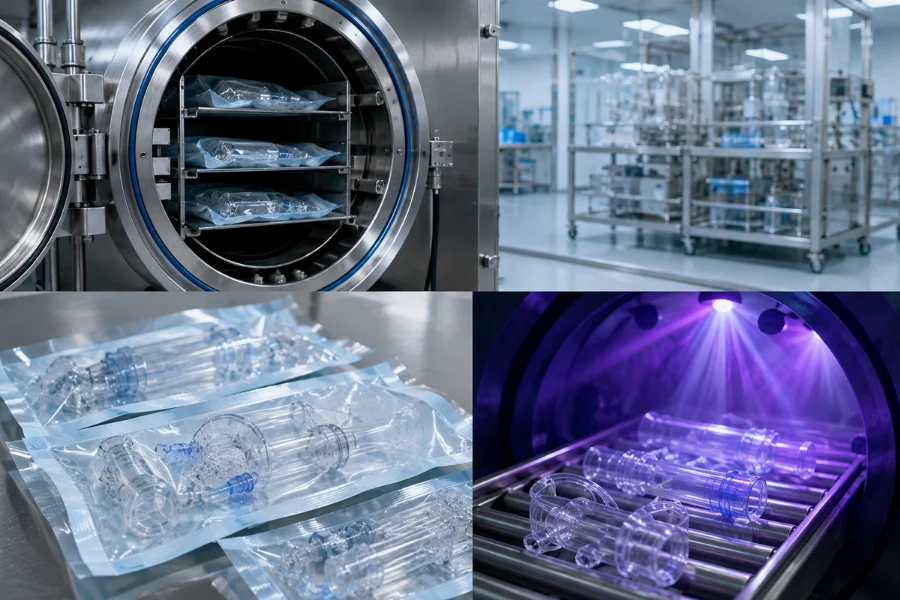
Sterilization compatibility is one of the most important factors when selecting polycarbonate for medical devices.
A material that passes initial mechanical testing may still fail during sterilization validation if the selected PC grade is not compatible with the intended sterilization method.
Potential changes after sterilization exposure include:
- Yellowing
- Loss of impact strength
- Reduced transparency
- Molecular degradation
- Dimensional changes
- Increased brittleness
For this reason, medical OEM teams should define sterilization requirements early in the material selection process.
Medical PC Selection by Sterilization Method
| Sterilization Method | Medical PC Consideration |
|---|---|
| Ethylene Oxide (EtO) | Compatible with many medical PC grades |
| Gamma radiation | Requires radiation-stabilized PC grades |
| Steam sterilization (121°C) | Requires hydrolysis-resistant grades |
| Electron beam | Requires performance validation |
EtO Sterilization
Ethylene oxide sterilization is widely used for medical devices that cannot tolerate high temperatures.
Many medical-grade PC materials are compatible with EtO sterilization because the process operates under relatively mild temperature conditions.
Common applications include:
- Disposable medical components
- Fluid handling devices
- Diagnostic assemblies
However, compatibility should still be verified based on:
- Resin grade
- Sterilization cycle
- Device geometry
- Long-term performance requirements
Gamma Radiation Sterilization
Gamma radiation is commonly used for disposable medical devices because products can be sterilized after manufacturing and packaging.
However, radiation exposure can create challenges for unsuitable polycarbonate grades.
Potential issues include:
- Yellow discoloration
- Reduced mechanical properties
- Loss of optical performance
For gamma-sterilized medical components, engineers should consider radiation-stabilized PC grades that provide improved:
- Color retention
- Mechanical property retention
- Long-term stability
A material that performs well before sterilization may not necessarily maintain the same performance after radiation exposure.
Steam Sterilization
Steam sterilization creates a more demanding environment because it combines:
- High temperature
- Moisture exposure
- Repeated thermal cycling
Some medical-grade PC materials can support steam sterilization, but engineers must carefully verify:
- Hydrolysis resistance
- Mechanical property retention
- Dimensional stability
- Stress cracking resistance
For reusable medical devices, sterilization cycle testing should be considered during material qualification rather than after tooling development.
When Medical Grade Polycarbonate Is the Right Choice
Medical-grade PC is often selected when engineers need a combination of transparency, toughness, and manufacturing efficiency.
It is particularly suitable for:
Transparent Medical Components Requiring Structural Strength
Polycarbonate is a strong candidate when a transparent component must also withstand mechanical loading.
Typical examples include:
- Fluid connectors
- Diagnostic equipment windows
- Transparent protective housings
Compared with PMMA, PC generally provides better impact resistance, making it more suitable for components exposed to handling stress.
Precision Injection Molded Medical Components
Medical PC is suitable for components requiring:
- Repeatable dimensions
- Complex geometries
- Stable production performance
Examples include:
- Luer connectors
- Valves
- Fluid management components
However, achieving reliable performance requires appropriate:
- Mold design
- Process control
- Dimensional inspection
For manufacturers producing complex medical plastic parts, professional medical plastic injection molding capabilities help ensure that material advantages are translated into consistent production results.
Medical Devices Requiring Visual Monitoring
Some medical applications require users to observe internal conditions during operation.
PC provides advantages where transparency directly supports device functionality.
Examples include:
- Blood processing systems
- Fluid reservoirs
- Diagnostic components
When Medical Grade Polycarbonate May Not Be the Best Choice
Although PC provides an excellent balance of properties, it is not a universal medical material.
There are situations where alternative materials may provide better performance.
Extreme Chemical Exposure Applications
Polycarbonate has good resistance to many substances, including:
- Water
- Dilute acids
- Salts
- Oils
However, it has limitations when exposed to:
- Strong alkalis
- Amines
- Esters
- Aromatic hydrocarbons
Chemical exposure combined with residual molding stress may cause environmental stress cracking.
For applications involving aggressive chemicals, engineers should evaluate alternative materials before final approval.
Extremely High Temperature Applications
Medical PC can withstand many healthcare environments, but some applications require higher thermal performance.
Examples include:
- Repeated high-temperature sterilization
- Extreme thermal cycling
- High-temperature chemical exposure
Materials such as:
- PEEK
- PPSU
may be considered when higher temperature capability is required.
Implant-Related Applications
Medical PC is widely used in external and device-related applications, but implant applications require significantly more evaluation.
Engineers must consider:
- Long-term biological response
- Mechanical fatigue
- Regulatory requirements
Materials specifically developed for implant applications may be more appropriate.
Common Medical PC Material Selection Mistakes
Choosing the wrong polycarbonate grade can increase development costs, create validation problems, and delay commercialization.
The following mistakes are commonly seen during medical device development.
Mistake 1: Selecting Standard PC Because Performance Appears Similar
A standard PC resin may provide similar:
- Transparency
- Strength
- Processing characteristics
during early evaluation.
However, it may lack:
- Medical documentation
- Biological evaluation support
- Sterilization data
- Traceability requirements
The issue often appears later during regulatory review or production validation.
Mistake 2: Ignoring Sterilization Requirements During Early Design
Some development teams select materials first and evaluate sterilization later.
This approach can create problems such as:
- Gamma-induced yellowing
- Steam-related degradation
- Mechanical property loss
Sterilization requirements should be defined before final resin selection.
Mistake 3: Selecting the Highest Performance Grade Without Considering Manufacturing
A higher-performance material is not always the best production choice.
An overly specialized resin may introduce:
- Higher material cost
- More difficult processing
- Longer validation requirements
The best medical PC grade is the one that balances:
- Device requirements
- Manufacturing capability
- Regulatory needs
- Production economics
Mistake 4: Evaluating Material Without Considering the Molding Process
Even a qualified medical PC resin can fail if the molding process creates excessive stress.
Common causes include:
- Poor gate location
- Uneven cooling
- Incorrect processing temperature
- Excessive residual stress
Material selection and injection molding development must be performed together.
| Recommended Material Direction | |
|---|---|
| Transparent fluid component | Optical-grade medical PC |
| Impact-resistant housing | Toughened PC grade |
| Thin-wall medical component | High-flow PC grade |
| Precision connector | Dimensionally stable PC grade |
| Radiation-sterilized device | Stabilized medical PC |
The correct choice depends on the complete product requirement.
A medical connector may require dimensional precision more than maximum impact strength, while a protective housing may prioritize durability.
Step 4: Confirm Regulatory Documentation
Before moving into production, OEM teams should verify that the selected resin provides appropriate documentation.
Important considerations include:
- ISO 10993 evaluation support
- USP Class VI compliance where applicable
- Material traceability
- Supplier documentation
- Change notification procedures
For regulated devices, documentation availability is part of supply chain risk management.
Step 5: Validate Manufacturing Performance
A resin that looks suitable on paper must still demonstrate reliable manufacturing performance.
Validation should consider:
- Injection molding consistency
- Dimensional repeatability
- Surface quality
- Sterilization performance
- Batch-to-batch stability
The final component performance depends on both the material and the manufacturing process.
Medical Grade PC Injection Molding Considerations
Medical PC injection molding requires careful process control because polycarbonate has characteristics that create specific manufacturing challenges.
Compared with commodity plastics, PC generally has:
- Higher melt viscosity
- Higher processing temperature requirements
- Greater sensitivity to moisture
- Higher residual stress risk
For medical applications, these factors directly influence:
- Optical quality
- Mechanical reliability
- Dimensional accuracy
- Sterilization performance
A manufacturing partner with experience in medical plastic injection molding can help integrate material selection, tooling design, and process control into a reliable production workflow.
Material Drying Requirements Before Injection Molding
Although polycarbonate has relatively low moisture absorption, moisture becomes critical during high-temperature processing.
Improper drying may lead to:
- Silver streaks
- Bubbles
- Reduced mechanical strength
- Surface defects
Typical drying conditions:
| Parameter | Recommended Value |
|---|---|
| Drying temperature | 120°C |
| Drying time | 3–8 hours |
For transparent medical components, drying control is especially important because surface defects can affect both appearance and functional acceptance.
Injection Molding Processing Window for Medical PC
Polycarbonate requires relatively high processing temperatures because of its high melt viscosity.
Typical processing parameters include:
| Parameter | Recommended Range |
|---|---|
| Rear barrel temperature | 260–280°C |
| Middle barrel temperature | 270–290°C |
| Front barrel temperature | 280–320°C |
| Melt temperature | 260–320°C |
| Mold temperature | 80–120°C |
| Flow direction shrinkage | 0.60%–0.70% |
The goal is not simply achieving sufficient flow.
The process must maintain a stable window that prevents:
- Material degradation
- Excessive residual stress
- Optical defects
- Dimensional variation
Advanced DFM Considerations for Medical PC Components
For medical injection molding projects, design decisions made before tooling have a major impact on final part performance.
Early engineering review, including professional free mold tool design support, can help identify manufacturability risks before tooling investment.
Wall Thickness Control
Uneven wall thickness can create:
- Uneven cooling
- Sink marks
- Internal stress
- Warpage
This is especially important for transparent PC components because internal stress can affect both appearance and long-term durability.
Maintaining consistent wall thickness improves:
- Filling behavior
- Cooling balance
- Dimensional stability
Gate Design and Flow Analysis
Gate location influences:
- Flow direction
- Weld line position
- Stress distribution
For medical PC parts, poor gate placement can create weak areas that may fail after:
- Sterilization
- Chemical exposure
- Mechanical loading
DFM analysis should evaluate:
- Filling behavior
- Air trap risk
- Weld line location
- Residual stress concentration
Mold Surface Finish and Optical Quality
Transparent medical PC components require careful tooling control.
Mold surface conditions influence:
- Optical appearance
- Surface defects
- Part transparency
Important considerations include:
- Mold polishing quality
- Contamination control
- Venting design
- Surface maintenance
For optical medical components, tooling quality directly affects final product acceptance.
Medical PC Failure Analysis: Why Medical Components Fail After Production
Selecting a medical-grade polycarbonate resin is only the first step toward successful product development. In real manufacturing environments, failures often occur because material selection, product design, tooling, and process conditions are not evaluated together.
A medical PC component may pass initial inspection but still experience problems during:
- Sterilization validation
- Assembly
- Functional testing
- Long-term storage
- Clinical use
Understanding common failure mechanisms helps OEM teams identify risks before commercial production.
Common Medical PC Failure Modes and Solutions
| Failure Mode | Possible Root Causes | Engineering Solutions |
|---|---|---|
| Cracking after sterilization | Incorrect material grade, residual stress, chemical exposure | Select suitable PC grade, optimize molding process, reduce stress concentration |
| Yellowing after radiation | Standard PC used for gamma sterilization, insufficient stabilization | Select radiation-stabilized medical PC grades |
| Leakage in connectors | Dimensional variation, poor shrinkage control, inconsistent molding | Improve tooling accuracy and process capability |
| Loss of transparency | Material degradation, contamination, poor process control | Improve material handling and molding stability |
| Warpage or deformation | Uneven cooling, excessive residual stress | Optimize cooling design and injection parameters |
Failure Scenario 1: Cracking After Sterilization
One of the most common risks in medical PC applications is cracking after sterilization.
A component may appear acceptable after injection molding but develop cracks after exposure to sterilization cycles.
Potential causes include:
Incorrect Material Selection
A standard PC grade or unsuitable medical PC grade may not provide sufficient stability for:
- Gamma radiation
- Repeated steam sterilization
- Chemical exposure
Excessive Residual Stress
Residual stress can be introduced during injection molding through:
- High injection pressure
- Poor gate location
- Uneven cooling
- Improper mold temperature
When sterilization or chemical exposure occurs, these internal stresses can accelerate cracking.
Engineering Solutions
Potential solutions include:
- Selecting a more suitable medical PC grade
- Optimizing gate location
- Increasing mold temperature
- Improving cooling balance
- Reducing stress concentration in part geometry
For complex medical components, professional mold making capabilities can help ensure tooling design supports material performance and long-term reliability.
Failure Scenario 2: Yellowing After Gamma Sterilization
For transparent medical components, color stability is an important performance requirement.
Yellowing after radiation exposure may indicate:
- Incompatible PC grade
- Insufficient radiation stabilization
- Material degradation
Typical applications affected include:
- Transparent housings
- Fluid monitoring components
- Diagnostic parts
For gamma-sterilized products, engineers should evaluate not only initial transparency but also:
- Color retention after irradiation
- Mechanical property retention
- Long-term optical stability
Failure Scenario 3: Dimensional Variation and Leakage
Precision medical components often depend on accurate dimensions to maintain reliable connections.
Examples include:
- Luer fittings
- Fluid connectors
- Valves
Small dimensional changes may affect:
- Sealing performance
- Connection strength
- Fluid control
Possible causes include:
- Incorrect shrinkage compensation
- Inconsistent molding parameters
- Poor cooling control
Solutions include:
- Improved mold design
- Better process monitoring
- Dimensional inspection
- Process capability analysis
Medical PC Production Validation and Scale-Up Considerations
For medical device manufacturing, producing one acceptable prototype is not enough.
The manufacturing process must demonstrate that it can repeatedly produce components that meet defined requirements.
This is why production validation is a critical stage when moving from prototype development to commercial manufacturing.
A complete medical device contract manufacturing approach helps OEM teams integrate material evaluation, tooling development, validation planning, and production management into one controlled process.
DFM Review Before Tooling Development
A successful medical PC injection molding project begins before the mold is manufactured.
Design for Manufacturability (DFM) review should evaluate:
- Material flow behavior
- Wall thickness consistency
- Gate location
- Venting requirements
- Cooling strategy
- Stress concentration areas
Early DFM analysis can prevent issues that are expensive to correct after tooling completion.
For transparent medical PC components, DFM is especially important because defects such as:
- Flow marks
- Weld lines
- Stress whitening
- Optical distortion
can affect both appearance and functional performance.
Injection Molding Process Validation
Medical manufacturing requires controlled and repeatable production processes.
A typical validation approach includes:
Installation Qualification (IQ)
IQ confirms that:
- Equipment is installed correctly
- Tooling meets requirements
- Supporting systems are available
Operational Qualification (OQ)
OQ defines and verifies the acceptable process window.
Important parameters include:
- Barrel temperature
- Mold temperature
- Injection pressure
- Holding pressure
- Cooling time
- Drying conditions
The goal is to identify the range where the process consistently produces acceptable parts.
Performance Qualification (PQ)
PQ demonstrates that the process can maintain stable production under normal manufacturing conditions.
Evaluation may include:
- Dimensional consistency
- Visual inspection
- Mechanical performance
- Process repeatability
- Batch-to-batch stability
For medical PC injection molding, validation confirms that the manufacturing process—not only the material—can consistently deliver reliable components.
Quality and Traceability Considerations for Medical PC Components
Medical devices often remain on the market for many years. Therefore, material management and production traceability are important parts of supplier evaluation.
A reliable manufacturing system should support:
Material Traceability
Important information may include:
- Resin batch information
- Supplier documentation
- Production records
- Processing history
Process Monitoring
Production control should track:
- Critical molding parameters
- Inspection results
- Process deviations
Change Management
Medical products often require long-term manufacturing stability.
Changes involving:
- Resin supplier
- Material formulation
- Processing conditions
- Tool modifications
may require evaluation and documentation.
A manufacturing partner with experience in regulated medical production can help reduce risks associated with process changes and commercial scaling.
Medical PC Manufacturing Checklist for OEM Teams
Before approving a medical polycarbonate component for production, engineering teams should evaluate the following areas.
Material Selection
✓ Is the resin specifically suitable for medical applications?
✓ Does it provide appropriate biological evaluation support?
✓ Is it compatible with the intended sterilization method?
Product Design
✓ Are wall thicknesses consistent?
✓ Are stress concentration areas minimized?
✓ Are tolerances achievable through injection molding?
Tooling
✓ Is the gate location optimized?
✓ Is venting sufficient?
✓ Is mold surface quality suitable for transparent components?
Manufacturing Process
✓ Are drying conditions controlled?
✓ Is the molding window validated?
✓ Are inspection requirements defined?
Production Readiness
✓ Is traceability established?
✓ Is process capability confirmed?
✓ Are material and supplier changes controlled?
For medical components requiring highly precise structures or miniature features, additional technologies such as micro injection molding may be considered depending on product requirements.
Conclusion
Medical-grade polycarbonate remains one of the most valuable engineering plastics for medical device manufacturing because it provides a strong balance of transparency, impact resistance, dimensional stability, and injection molding capability.
However, successful use of medical PC requires more than selecting a qualified resin. The final performance of a medical plastic component depends on the interaction between:
- Material selection
- Sterilization requirements
- Product design
- Mold engineering
- Injection molding control
- Process validation
For medical OEM teams, the best material choice is not necessarily the strongest or most expensive option. It is the material that provides the right balance between clinical requirements, regulatory expectations, manufacturing reliability, and long-term production stability.
An experienced medical manufacturing partner can help reduce risks during material evaluation, DFM review, tooling development, validation, and production scaling.
SeaSkyMedical supports medical device manufacturers with engineering-focused plastic component manufacturing solutions, helping transform validated designs into reliable production-ready medical parts.
Through capabilities including medical device contract manufacturing, medical plastic injection molding, tooling development, and production support, SeaSkyMedical helps OEM teams move from concept development to stable commercial manufacturing.