Introduction Why Sterilization Is a Critical Requirement for Medical Injection Molded Parts
Medical injection molded parts produced for healthcare and laboratory environments are often exposed to biological fluids, controlled clinical surfaces, or indirect contamination risks during handling, which makes post-production sterilization an essential requirement rather than an optional processing step.
Even components that do not directly contact patients, such as device housings, instrument interfaces, and laboratory system parts, still require microbial control because contamination can occur through repeated use cycles, cross-contact environments, or assembly processes within medical facilities.
In regulated manufacturing systems, sterilization capability is considered a baseline design requirement, since a material or molded component that cannot tolerate at least one validated decontamination method is generally unsuitable for medical applications that require defined sterility assurance levels.
For this reason, sterilization compatibility is typically defined during early product development alongside material selection, mold design, and process validation, ensuring that downstream sterilization does not introduce deformation, chemical degradation, or functional failure.
Within ISO-controlled production environments such as ISO 13485 systems and cleanroom-based manufacturing workflows, companies like SeaSkyMedical integrate sterilization compatibility considerations into full-cycle development processes supported by
medical plastic injection molding and contract-based engineering workflows such as
medical device contract manufacturing.
Overview of Main Sterilization Methods for Medical Injection Molded Parts
Steam Sterilization Autoclave Process
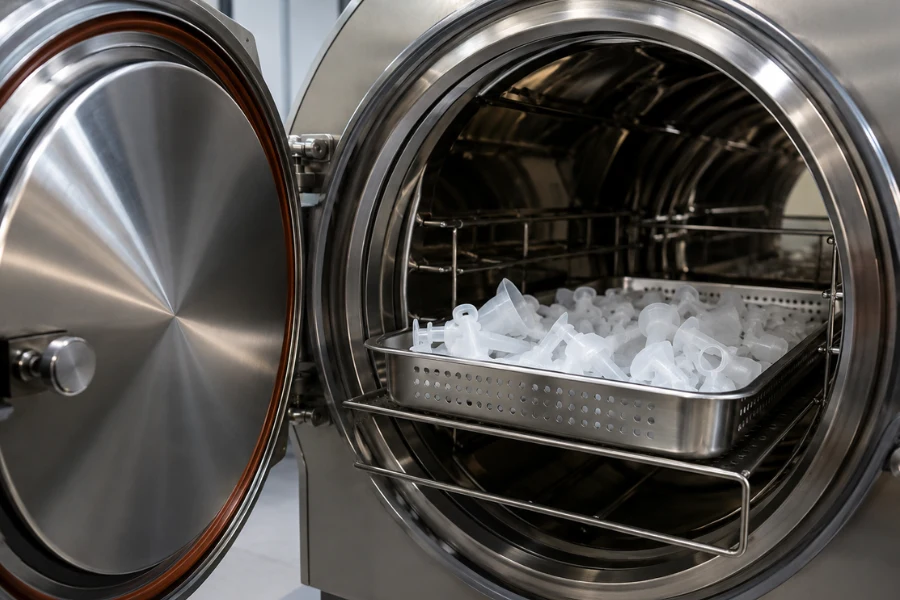
Steam sterilization, commonly referred to as autoclaving, is a high temperature saturated steam process operating typically between 121°C and 134°C, where pressure and heat work together to destroy bacteria, viruses, and bacterial spores within a controlled exposure cycle.
This method is widely used for reusable surgical instruments and durable medical components because of its strong sterilization efficiency and low operational complexity in hospital environments.
Materials such as polypropylene and selected medical grade polycarbonate formulations are typically compatible with repeated autoclave exposure, while lower thermal resistance polymers may experience hydrolysis, deformation, or dimensional instability over multiple cycles.
Although steam sterilization remains one of the most reliable terminal sterilization methods, its limitation lies in the combined thermal and moisture stress, which makes early-stage material selection critical during design and validation.
Ethylene Oxide Sterilization EtO Process
Ethylene oxide sterilization is a low temperature gaseous process typically operating between 37°C and 63°C, where gas molecules penetrate packaging and complex geometries to inactivate microorganisms through alkylation reactions at the cellular level.
This method is widely used in
medical device assembly workflows where multi-component structures, heat-sensitive materials, or sealed packaging systems cannot tolerate high temperature processing.
One of the key advantages of EtO sterilization is its broad compatibility with medical polymers, including ABS, PVC, polyethylene, polypropylene, and silicone-based elastomers, making it one of the most versatile sterilization options in medical plastic injection molding applications.
However, EtO processes require controlled aeration cycles to remove residual gas, and regulatory limits on residue levels must be strictly validated to ensure patient safety in long-term exposure scenarios.
Gamma Radiation Sterilization
Gamma irradiation uses high-energy photons emitted from cobalt-60 sources to destroy microbial DNA structures, enabling sterilization without heat or moisture exposure, which makes it suitable for pre-packaged and single-use medical products.
This method is widely applied in mass production environments where terminal sterilization is performed after final packaging, ensuring sterility is maintained until point of use.
Materials such as PETG, polycarbonate, and HDPE generally demonstrate acceptable performance under controlled radiation doses, while polypropylene and ABS may require stabilizers to reduce chain scission effects that lead to brittleness or discoloration.
From a material engineering perspective, radiation sterilization introduces molecular-level changes that must be evaluated during validation testing, especially for load-bearing or precision-fit components.
Electron Beam Sterilization
Electron beam sterilization operates using accelerated electrons instead of radioactive isotopes, delivering a high-dose-rate sterilization process with significantly reduced processing time compared to gamma irradiation.
Due to its lower penetration depth, this method is generally more suitable for thin-walled injection molded components or low-density assemblies rather than thick or highly compact geometries.
Material compatibility depends heavily on polymer formulation and stabilizer content, and performance data is typically provided by resin suppliers during medical grade material qualification.
Vaporized Hydrogen Peroxide Sterilization VHP
Vaporized hydrogen peroxide sterilization is a low-temperature oxidative process operating typically between 30°C and 50°C, where hydrogen peroxide vapor reacts with microbial structures and subsequently decomposes into water and oxygen without chemical residue.
This method is increasingly used as an alternative to ethylene oxide due to shorter cycle times, improved environmental safety, and reduced regulatory burden related to toxic gas handling.
Medical injection molded parts manufactured from polypropylene, polycarbonate, and selected engineered polymers can often be compatible with VHP processes, although validation depends on material grade and geometric complexity.
Its main limitation is penetration efficiency, particularly in long narrow lumens or densely assembled structures where vapor distribution may be restricted.

Chemical Disinfection Surface Level Processing
Chemical disinfection methods such as alcohol wiping or quaternary ammonium-based cleaning solutions are widely used for surface-level microbial reduction but do not achieve full sterilization standards defined by regulatory systems such as SAL 10⁻⁶.
These methods are typically applied to external housings, reusable device surfaces, and non-critical components where microbial reduction is required but full sterilization validation is not mandatory.
Certain engineering plastics designed for chemical resistance can tolerate repeated disinfection cycles without significant degradation, although they are not substitutes for validated sterilization processes in medical applications.
Material Compatibility in Medical Injection Molded Parts Sterilization
Material selection plays a decisive role in determining sterilization compatibility, since thermal resistance, radiation tolerance, and chemical stability vary significantly across polymer families used in medical injection molding.
Polypropylene is widely used for reusable components due to its ability to withstand repeated steam sterilization cycles, while medical-grade polycarbonate is often selected for transparent applications requiring moderate sterilization resistance.
Silicone and liquid silicone rubber materials demonstrate broad compatibility across multiple sterilization methods including steam, gamma radiation, and VHP, making them suitable for flexible and high-compliance medical components.
Materials such as PETG, ABS, and certain polyethylene grades are typically limited to ethylene oxide or radiation-based sterilization depending on formulation and additive systems.
Specialty materials such as Kydex and Boltaron are generally classified as disinfectant-resistant rather than sterilization-compatible, meaning they are suitable for chemical cleaning environments but not validated sterilization cycles.
Within integrated manufacturing workflows, SeaSkyMedical applies material qualification and sterilization pathway evaluation during early design stages, supported by
mold making and structured material validation under
material selection processes.
Pre Sterilization Preparation and Process Considerations
Before sterilization, medical injection molded parts must undergo controlled cleaning processes to remove residual contaminants such as mold release agents, machining oils, particulate matter, or biological residues that may interfere with sterilization effectiveness.
Packaging selection is also a critical factor, since steam sterilization requires heat-resistant materials, while ethylene oxide and radiation-based processes depend on gas or energy permeability to ensure complete microbial inactivation.
For reusable components, validation across multiple sterilization cycles is necessary to evaluate long-term mechanical stability, as repeated exposure may gradually affect clarity, tensile strength, or dimensional accuracy.
Manufacturing workflows often integrate secondary processing steps such as
medical device packaging and broader
secondary operation stages to ensure contamination control prior to sterilization.
Key Factors in Selecting a Sterilization Method
The selection of sterilization methods for medical injection molded components depends on a combination of material properties, device classification, structural complexity, and regulatory requirements rather than a single technical parameter.
Thermally stable polymers are typically compatible with steam sterilization, radiation-resistant materials are suitable for gamma or electron beam processing, and heat-sensitive or complex assemblies often require ethylene oxide or vaporized hydrogen peroxide systems.
Device classification also determines sterilization strategy, since components intended for direct contact with sterile tissues or bloodstream must meet stricter sterility assurance levels compared to external or non-critical structural parts.
Production scale and turnaround requirements may further influence selection, with gamma and electron beam sterilization preferred for high-volume disposable devices, while EtO and VHP are more commonly used for specialized or lower-throughput applications.
Within integrated manufacturing systems, SeaSkyMedical supports sterilization pathway evaluation alongside
product development and OEM-level production strategies such as
OEM medical components.
Conclusion
There is no universal sterilization method applicable to all medical injection molded parts, since each process interacts differently with polymer chemistry, part geometry, and regulatory constraints.
Steam sterilization remains the preferred method for reusable high-temperature-resistant components, ethylene oxide provides broad compatibility for heat-sensitive systems, and radiation or vapor-phase methods offer efficient solutions for single-use or pre-packaged devices.
A robust sterilization strategy must therefore be defined during early design stages, supported by validated material data and process testing to ensure consistent performance under real-world medical conditions.
By integrating sterilization considerations into design, material selection, and manufacturing workflows, manufacturers can reduce validation risks and ensure long-term product reliability.
SeaSkyMedical provides integrated support through ISO-compliant medical injection molding systems, cleanroom manufacturing environments, and engineering-driven process validation aligned with sterilization-compatible product development.