Introduction
Medical device manufacturers often select Liquid Silicone Rubber (LSR) when a component requires a combination of flexibility, biocompatibility, sealing reliability, and long-term environmental stability.
Unlike rigid medical plastics, LSR can repeatedly deform and recover while maintaining predictable performance. This makes it suitable for components where elasticity, soft contact, or compression recovery are essential functional requirements.
However, choosing LSR is not simply a material substitution decision. A successful medical silicone component depends on how the material interacts with part design, mold structure, processing parameters, quality requirements, and validation strategy.
For medical OEM teams, the important question is not only whether LSR can meet the functional requirements of a device. It is whether the entire manufacturing process can consistently produce qualified components at the required production volume.
This guide explains the engineering considerations behind medical LSR selection, liquid silicone rubber injection molding, tooling design, manufacturing risks, and the transition from prototype development to validated production.
What Is Medical Liquid Silicone Rubber (LSR)?
LSR Material Structure and Curing Mechanism
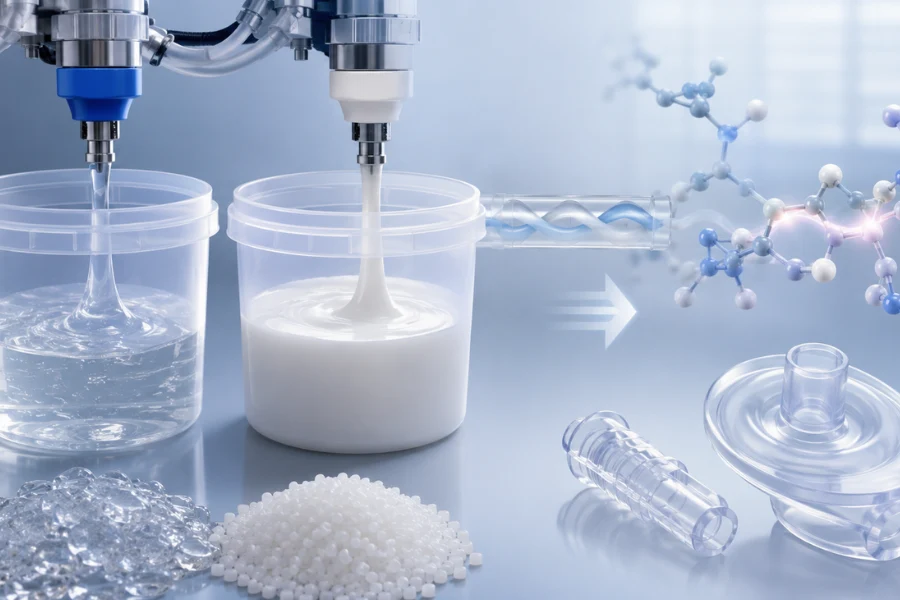
Liquid Silicone Rubber (LSR) is a two-component, low-viscosity, heat-curable silicone elastomer. Unlike thermoplastic materials that are repeatedly melted and solidified through temperature changes, LSR achieves its final properties through a platinum-catalyzed crosslinking reaction.
The material is supplied as two separate components:
- Component A contains the base silicone polymer
- Component B contains the platinum catalyst system
During molding, these components are combined through a precision metering system at a controlled 1:1 ratio. After mixing, the material begins a chemical curing reaction that creates a crosslinked silicone structure.
This curing mechanism gives LSR several characteristics that differentiate it from traditional medical plastics:
- Elastic recovery after compression or stretching
- Stable performance under temperature changes
- Resistance to many chemicals and cleaning agents
- Long-term flexibility compared with rigid polymers
The manufacturing behavior of LSR is fundamentally different from thermoplastic injection molding. The material does not enter the machine as solid pellets that are melted before injection. Instead, it remains in a liquid state and cures after entering a heated mold cavity.
This difference affects every stage of production, including material handling, tooling design, process control, and quality validation.
For OEM teams evaluating silicone components, understanding this processing difference is critical before selecting an appropriate manufacturing approach such as LSR injection molding.
LSR vs Thermoplastic Medical Materials
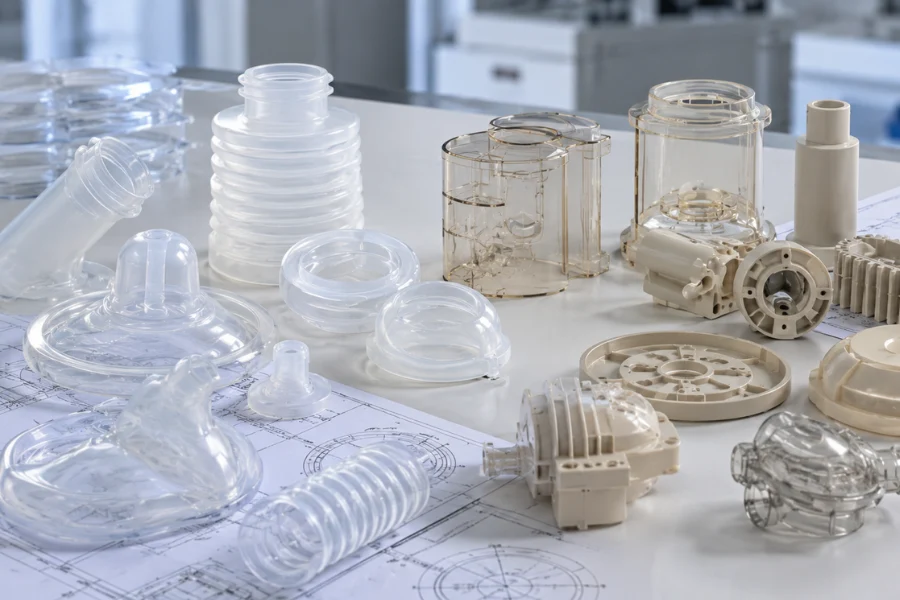
Medical device manufacturers often compare LSR with engineering thermoplastics such as PC, ABS, or PEEK. However, these materials typically solve different engineering problems.
The key decision is not which material has higher performance overall. The decision is which material characteristics best match the function of the component.
| Factor | Thermoplastic Medical Materials | Medical LSR |
|---|---|---|
| Material form | Solid resin pellets | Two-component liquid silicone |
| Processing mechanism | Melting and cooling | Mixing and chemical curing |
| Main performance advantage | Structural strength and dimensional stiffness | Elasticity, sealing, and soft-contact performance |
| Mold temperature | Cooling-based solidification | Heated curing environment |
| Typical applications | Housings, rigid structures, mechanical parts | Seals, valves, membranes, flexible interfaces |
For example, a medical device housing may require PC or PEEK because the component must maintain structural rigidity under mechanical loads.
A valve membrane or sealing element may require LSR because the component must repeatedly deform while maintaining reliable recovery and sealing force.
This difference is especially important during product development. Replacing a thermoplastic component with LSR does not automatically improve performance. The entire device design must be reviewed to determine whether flexibility, compression recovery, or temperature resistance provides a real functional advantage.
For applications where rigid plastic components remain necessary, manufacturers may evaluate broader medical plastic injection molding capabilities alongside silicone molding options.
Key Properties of Medical Grade LSR
Biocompatibility and Medical Safety Requirements
One of the main reasons medical manufacturers consider LSR is its ability to support applications involving human contact.
Selected medical-grade LSR formulations can meet requirements such as:
- USP Class VI testing
- ISO 10993 biological evaluation
- Skin-contact applications
- Fluid-contact applications
- Certain implant-related applications
However, “silicone” does not automatically mean medical-grade suitability.
Different LSR formulations may vary in:
- Purity level
- Additives
- Extractables profile
- Mechanical properties
- Regulatory documentation
Material selection should be based on the intended device application, expected contact duration, sterilization method, and required compliance pathway.
For example, a reusable respiratory component and a long-term implantable component may both use silicone materials, but their qualification requirements and manufacturing controls can be significantly different.
Sterilization Resistance and Chemical Stability
Medical components are frequently exposed to sterilization processes, cleaning chemicals, and biological environments. LSR is often selected because its silicone structure provides strong chemical stability and resistance to temperature changes.
Depending on the specific formulation and validation requirements, medical LSR can support sterilization methods including:
- Steam autoclaving
- Ethylene oxide (ETO)
- Gamma irradiation
- Electron beam sterilization
This performance makes LSR suitable for components that must maintain flexibility and mechanical properties after repeated processing cycles.
However, sterilization resistance should not be evaluated separately from part design. Thin sections, bonding interfaces, and assembled components may respond differently during repeated sterilization exposure.
A successful medical silicone design considers both material capability and the complete device structure.
Elastic Recovery, Compression Set, and Hardness Selection
Elastic recovery is one of the defining properties of LSR.
For medical components such as seals, valves, and flexible interfaces, the ability to return close to the original shape after deformation directly affects device reliability.
LSR hardness is commonly measured using Shore A durometer values.
| Shore A Hardness | Material Behavior | Typical Applications |
|---|---|---|
| 10A–20A | Very soft and highly flexible | Cushioning components, soft patient-contact surfaces |
| 30A–50A | Balanced flexibility and strength | O-rings, seals, valves, medical buttons |
| 60A–80A | Firmer and more supportive | Durable gaskets and structural silicone components |
A lower hardness value does not always represent a better medical solution.
Softer silicone may improve comfort for patient-contact applications, but excessive softness can create challenges related to:
- Dimensional inspection
- Assembly control
- Mechanical support
- Sealing force consistency
Higher hardness grades may provide improved stability where mechanical support or controlled deformation is more important.
Material selection should therefore be based on the functional requirements of the component rather than flexibility alone.
Temperature Performance and Mechanical Stability
Medical LSR maintains useful mechanical performance across a wide temperature range. Many formulations can operate from approximately -50°C to above 200°C depending on application requirements.
Important characteristics include:
- High flexibility
- Low compression set
- Good tear resistance
- Resistance to aging
- Stable performance during temperature fluctuations
These properties support applications where components experience repeated sterilization, environmental changes, or long service periods.
However, temperature resistance alone should not determine material selection. Medical engineers must also consider dimensional requirements, assembly conditions, expected lifecycle, and validation requirements before selecting an LSR grade.
Medical Applications of LSR Injection Molding
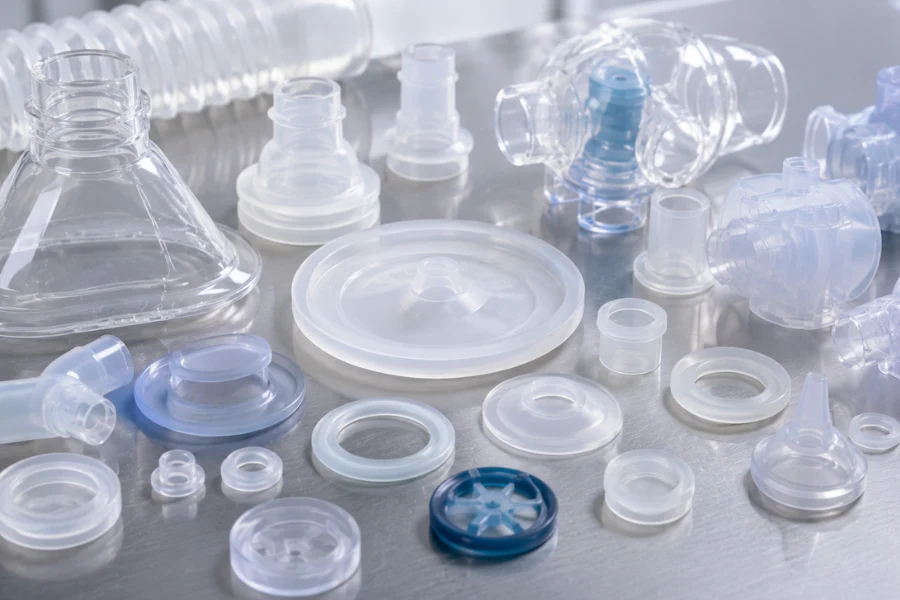
Liquid Silicone Rubber has become an important material option for medical device manufacturers because it combines flexibility, elastic recovery, chemical stability, and sterilization resistance.
However, LSR should not be selected simply because it is a high-performance silicone material. The correct choice depends on the functional requirements of the component, including deformation behavior, sealing performance, patient contact conditions, sterilization exposure, and expected production volume.
For medical OEM teams, the most successful LSR applications are usually those where the material’s elastic properties provide a clear functional advantage over rigid polymers.
Sealing and Fluid Control Components
Sealing and fluid control components are among the most common applications for medical LSR injection molding. These parts often require repeated compression, reliable recovery, and stable performance throughout the device lifecycle.
Typical applications include:
- O-rings
- Gaskets
- Diaphragms
- Valves
- Pump seals
- Medical connectors
LSR is often selected for these components because it can maintain sealing force after repeated deformation. This characteristic is especially important in fluid-handling systems where small changes in sealing performance may affect device reliability.
For example, a silicone valve inside a drug delivery device may open and close thousands of times during operation. The material must maintain predictable movement while resisting exposure to fluids, cleaning agents, and sterilization cycles.
However, sealing performance is not determined by material selection alone. Engineers must also evaluate:
- Compression ratio
- Part geometry
- Surface finish
- Mold precision
- Dimensional consistency
A well-designed LSR seal requires coordination between material properties and tooling design.
Respiratory and Drug Delivery Devices
Respiratory and drug delivery systems are among the most recognized medical applications for LSR because they require a balance between patient comfort, flexibility, and reliable performance.
Common LSR components include:
- Respiratory masks
- Flexible connectors
- Valve membranes
- Syringe components
- Drug delivery seals
In respiratory applications, softness and sealing performance must be carefully balanced.
A softer LSR grade may improve patient comfort during extended contact, but excessive softness can create challenges in assembly control or maintaining consistent sealing force.
For drug delivery components, chemical stability is equally important. Silicone materials must maintain performance when exposed to medications, cleaning solutions, or biological fluids.
The material selection process should therefore consider both user interaction and device function.
Wearable and Diagnostic Medical Components
The growth of wearable healthcare devices has increased demand for flexible materials that can protect sensitive electronics while maintaining patient comfort.
Medical LSR is commonly used in:
- Wearable sensor interfaces
- Flexible protective covers
- Medical electronics encapsulation
- Skin-contact components
LSR provides advantages in these applications because it can create soft external surfaces while protecting internal components from environmental exposure.
Self-adhesive LSR grades can also support overmolding with materials such as thermoplastics, metals, and electronic substrates.
This enables manufacturers to combine:
- Rigid structural components
- Flexible silicone interfaces
- Integrated sealing features
For complex multi-material medical devices, processes such as 2K injection molding may provide an approach for integrating different materials within a single manufacturing process.
However, multi-material medical components require careful engineering evaluation.
Important considerations include:
- Material compatibility
- Bond strength
- Thermal expansion differences
- Surface preparation
- Validation requirements
A successful overmolding process depends on maintaining a stable interface throughout the product lifecycle.
Surgical and Implantable Medical Components
Medical-grade LSR can also be considered for surgical and implant-related applications when the selected formulation meets the required biological and regulatory requirements.
Potential applications include:
- Surgical instrument components
- Long-term tissue-contact components
- Implantable silicone components
For these applications, material selection requires additional evaluation because not all silicone formulations are suitable for extended medical use.
Key considerations include:
- Biocompatibility testing
- Extractables and leachables evaluation
- Sterilization compatibility
- Long-term mechanical stability
- Regulatory documentation
In implantable or long-term contact applications, manufacturing consistency becomes equally important as material performance.
A qualified production process must maintain:
- Material traceability
- Controlled processing conditions
- Consistent inspection results
- Documented manufacturing history
How Medical LSR Injection Molding Works
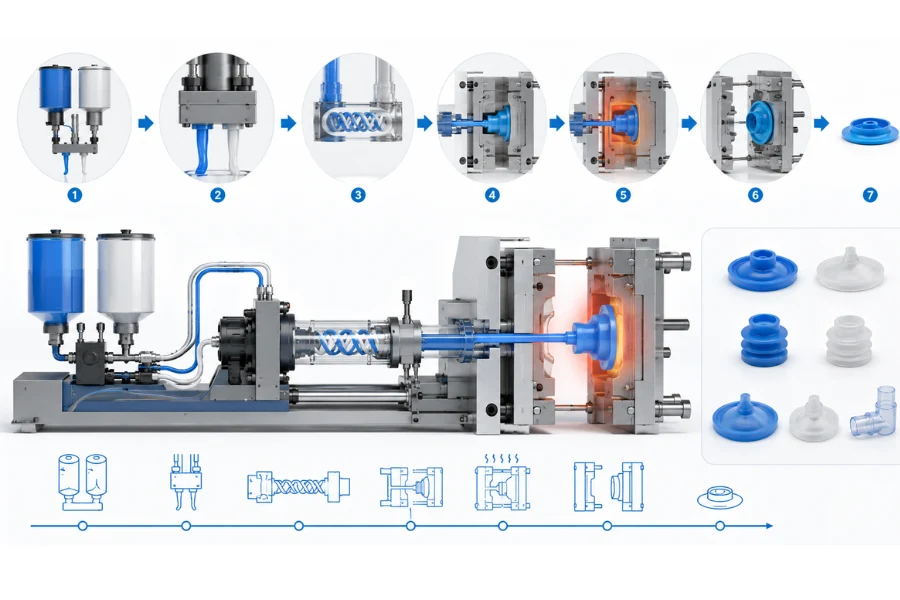
Medical LSR injection molding, also known as Liquid Injection Molding (LIM), is a specialized manufacturing process designed around the unique behavior of two-component silicone materials.
The process combines:
- Precision material metering
- Controlled mixing
- Cold runner delivery
- Injection into heated tooling
- Chemical curing
- Automated demolding
Unlike thermoplastic injection molding, where cooling solidifies the material, LSR molding uses heat to trigger a crosslinking reaction inside the mold cavity.
Material Metering and Mixing Process
LSR is supplied as two separate liquid components that remain stable before processing.
During production, the molding system performs several controlled steps:
- Component A and Component B are supplied from separate containers.
- Precision pumps deliver both components at a controlled 1:1 ratio.
- The materials pass through a static mixer before entering the mold system.
Accurate metering is essential because changes in the mixing ratio can influence:
- Cure speed
- Mechanical properties
- Dimensional consistency
- Final part performance
The static mixer must also provide uniform blending while minimizing air introduction.
Air trapped during mixing or injection may create:
- Internal voids
- Surface defects
- Incomplete filling
- Inconsistent mechanical performance
For medical applications, process stability is especially important because even small variations may affect validation results.
Cold Runner System and Temperature Control
One of the biggest differences between LSR molding and thermoplastic injection molding is temperature management.
In thermoplastic processing, the material is heated before injection.
In LSR processing, the approach is reversed:
- The material remains cool before injection.
- The mold provides heat for curing.
A cold runner system, also known as a cold deck, keeps the silicone material from curing before it reaches the cavity.
The main advantages include:
- Reduced material waste
- Improved automation capability
- Stable production cycles
- Reduced trimming requirements
However, temperature control must be carefully balanced.
If the runner system becomes too warm, premature curing may occur before the material reaches the cavity.
If mold temperature is insufficient, incomplete curing may affect:
- Elastic recovery
- Mechanical strength
- Dimensional stability
This temperature relationship is one reason why LSR manufacturing requires dedicated process knowledge rather than simply adapting conventional plastic injection molding methods.
Injection, Curing, and Demolding Process
After mixing, liquid silicone enters the mold cavity under controlled pressure. The heated mold activates the curing reaction and transforms the liquid material into a stable elastomer component.
A typical LSR molding cycle includes:
- Material metering
- A/B component mixing
- Injection through the cold runner system
- Heat-driven curing
- Mold opening
- Part removal and inspection
Typical processing ranges include:
| Process Parameter | Typical Range |
|---|---|
| Mold temperature | 170–220°C |
| Injection pressure | Approximately 20–60 MPa |
| Material temperature before injection | 15–25°C |
| Mixing ratio | 1:1 A/B |
Demolding requires special attention because LSR parts are flexible and elastic.
Unlike rigid plastic parts, silicone components may stretch during removal if the tooling strategy is not optimized.
Medical LSR molds may use:
- Stripper plates
- Automated robotic removal
- Optimized parting line design
- Specialized ejection strategies
The goal is not only to remove the part successfully but also to maintain:
- Dimensional accuracy
- Surface quality
- Production repeatability
Design Guidelines Before Medical LSR Tooling
LSR provides significant design flexibility, but medical components should be evaluated for manufacturability before tooling investment begins.
Early DFM review helps identify potential risks related to:
- Part geometry
- Material flow
- Tool complexity
- Demolding behavior
- Validation requirements
A design that is technically moldable may still create unnecessary production challenges if manufacturing considerations are not addressed early.
For this reason, early collaboration with engineers experienced in free mold tool design can help identify potential tooling risks before production molds are developed.
Wall Thickness and Geometry Optimization
LSR’s low viscosity allows it to fill thin sections and complex geometries effectively.
This capability supports designs such as:
- Flexible membranes
- Thin sealing features
- Soft-contact surfaces
- Complex silicone interfaces
However, greater design freedom does not eliminate the need for manufacturing discipline.
Engineers should evaluate:
- Wall thickness consistency
- Sudden thickness changes
- Stress concentration areas
- Functional deformation requirements
Uneven geometry may create differences in curing behavior, shrinkage, and dimensional stability.
For medical components, the goal is not to create the most complex possible geometry. The goal is to create a design that balances clinical function with repeatable manufacturing.
Thin Membrane and Flexible Feature Design
Thin silicone membranes are common in medical devices such as valves, pumps, and fluid control systems.
These features require careful consideration because performance depends on:
- Thickness uniformity
- Elastic response
- Tear resistance
- Mold filling behavior
A membrane that is too thin may increase manufacturing sensitivity, while excessive thickness may reduce flexibility and response speed.
The design should match the expected operating conditions rather than simply minimizing material thickness.
Undercuts and Demolding Strategy
LSR’s elasticity allows designers to incorporate features that would be difficult with rigid thermoplastics.
Examples include:
- Flexible locking features
- Silicone grips
- Complex sealing geometries
However, undercuts increase tooling complexity and may affect automated demolding.
Engineers should consider:
- Required deformation during removal
- Part orientation
- Mold opening sequence
- Automated handling requirements
A successful LSR design must consider the entire production cycle, not only cavity filling.
Tolerance Planning for Medical Silicone Parts
Tolerance control is a critical consideration in medical LSR component design because silicone behaves differently from rigid thermoplastic materials.
LSR parts can experience dimensional changes caused by:
- Material shrinkage
- Cure conditions
- Mold temperature variation
- Part geometry
- Material flow direction
- Measurement method
Unlike rigid plastics, silicone components may deform during inspection if the measurement process is not properly controlled. Therefore, tolerance requirements should consider both the functional requirement of the part and the natural behavior of elastomeric materials.
For example, a sealing component may require consistent compression performance rather than extremely tight dimensional control in every direction.
Overly restrictive tolerances can increase tooling complexity and production cost without improving device performance. A better approach is to define tolerances based on:
- Assembly requirements
- Sealing performance
- Functional movement
- Regulatory requirements
Early tolerance planning between product designers and molding engineers can prevent unnecessary tooling modifications after production begins.
Medical LSR Mold Design Considerations
The performance of a medical LSR component depends heavily on mold design. While LSR offers excellent flow characteristics and design flexibility, its low viscosity and curing behavior create specific tooling challenges.
Medical LSR molds must achieve a balance between:
- Complete cavity filling
- Effective air evacuation
- Flash prevention
- Dimensional stability
- Long-term production repeatability
A mold that produces a successful prototype may still require optimization before entering validated production.
For medical OEM projects, professional mold making capability is an important factor because LSR tooling requires precise control over parting surfaces, venting structures, and dimensional accuracy.
Shrinkage Control in LSR Parts
Shrinkage is one of the most important dimensional considerations in LSR molding.
Unlike thermoplastics, where shrinkage mainly occurs during cooling, LSR dimensional change is influenced by:
- Crosslinking reaction
- Cooling after demolding
- Material formulation
- Post-curing conditions
Typical LSR shrinkage is approximately 2.5% to 3% after demolding. Additional shrinkage of around 0.5% to 0.7% may occur after secondary curing depending on the material grade and processing conditions.
Factors affecting final dimensions include:
- Mold temperature
- Part thickness
- Flow direction
- Cavity pressure
- Cure time
- Demolding temperature
For medical components requiring assembly accuracy or sealing reliability, shrinkage compensation should be considered during tooling development.
A common mistake is transferring thermoplastic molding assumptions directly to LSR production. Silicone requires a different approach because dimensional behavior is influenced by both elastic recovery and curing characteristics.
Venting Design and Flash Prevention
Venting is one of the most important areas in medical LSR mold design.
Because LSR has extremely low viscosity, it can fill small features and thin sections effectively. However, this same characteristic increases the possibility of silicone flowing into small gaps between mold surfaces.
This creates one of the most common LSR molding challenges:
Flash formation.
Common causes include:
- Excessive parting line clearance
- Insufficient mold alignment
- Poor vent design
- Excessive injection pressure
- Tool wear over production cycles
A properly designed venting system must allow trapped air to escape while preventing silicone leakage.
Common venting approaches include:
- Precision parting line vents
- Vacuum-assisted venting
- Overflow structures
- Optimized filling paths
For complex medical components, poor air evacuation can lead to:
- Internal voids
- Incomplete filling
- Surface defects
- Inconsistent mechanical performance
The challenge in LSR mold design is achieving sufficient venting without creating additional flash risk.
Gate Design and Flow Control
Gate design affects filling balance, surface quality, and production consistency.
Although LSR flows easily due to its low viscosity, the filling process still requires careful control. Poor gate placement may create uneven filling, trapped air, or inconsistent curing conditions.
Important gate design considerations include:
- Gate location relative to functional areas
- Flow balance between cavities
- Minimizing visible marks
- Reducing material waste
Common LSR gating approaches include:
- Pin gates
- Submarine gates
- Cold runner gate systems
For medical components, the gate should ideally avoid critical areas such as:
- Sealing surfaces
- Patient-contact zones
- Precision assembly interfaces
In multi-cavity medical molds, balanced filling is especially important. A design that increases cavity quantity without considering flow balance may create variation between cavities.
Production efficiency must therefore be evaluated together with process consistency.
Parting Lines, Undercuts, and Demolding Challenges
LSR’s elasticity enables complex geometries that may not be practical with rigid materials.
However, flexible materials introduce different demolding considerations.
Potential risks include:
- Stretching during ejection
- Permanent deformation
- Surface damage
- Tear formation at thin sections
Medical LSR tooling may use:
- Stripper plates
- Multi-plate mold structures
- Automated robotic removal
- Optimized part retention designs
Parting line placement is especially important for sealing components.
A parting line located in a functional sealing area may create flash that affects leakage performance. A poorly designed separation surface may also increase inspection challenges during production.
The best tooling approach considers not only how the part is molded, but also how it will be removed, inspected, assembled, and validated.
Tooling Materials and Mold Maintenance Considerations
Medical LSR molds require high precision because small changes in tooling condition can influence flash control and dimensional consistency.
Production tooling is commonly designed using durable mold materials capable of maintaining accuracy during repeated high-temperature cycles.
Important tooling considerations include:
- Dimensional stability
- Surface durability
- Corrosion resistance
- Maintenance requirements
Although LSR does not always require the same surface finishing approach as some thermoplastic applications, mold surface condition still affects:
- Part appearance
- Release behavior
- Cleaning procedures
During long-term medical production, tooling maintenance becomes part of quality control.
Wear at:
- Parting surfaces
- Vent areas
- Alignment features
can gradually influence:
- Flash levels
- Dimensional variation
- Process stability
Preventive maintenance and tooling inspection help maintain consistent production performance.
Common Challenges in Medical LSR Manufacturing
Medical LSR molding provides significant advantages for complex silicone components, but production success depends on controlling several manufacturing risks.
Understanding these challenges during early development can reduce tooling changes, validation delays, and unexpected production issues.
Flash Formation in Medical Silicone Components
Flash is one of the most common defects in LSR molding because liquid silicone can enter extremely small mold gaps.
In medical applications, flash is not only a cosmetic issue.
It may affect:
- Sealing performance
- Assembly accuracy
- Visual inspection
- Device functionality
Flash prevention requires coordination between:
- Mold precision
- Parting line design
- Venting strategy
- Injection parameters
- Clamping conditions
The most effective approach is addressing flash risk during DFM and tooling development rather than relying on trimming after molding.
Air Entrapment and Filling Problems
LSR’s excellent flow characteristics can become challenging when parts contain:
- Thin membranes
- Deep cavities
- Complex channels
- Small functional features
Air trapped inside the cavity may result in:
- Voids
- Surface imperfections
- Incomplete filling
- Reduced mechanical consistency
Common solutions include:
- Improved venting locations
- Balanced flow design
- Controlled injection speed
- Mold flow evaluation
For complex medical parts, simulation and prototype testing can help identify potential filling issues before production tooling is completed.
Dimensional Variation During Production
Medical devices often require repeatable dimensions because silicone components frequently interact with other precision parts.
Dimensional variation may result from:
- Material batch differences
- Cure temperature changes
- Cycle variation
- Tool wear
- Environmental conditions
Maintaining dimensional stability requires more than setting machine parameters once.
A controlled process typically includes:
- Defined operating windows
- Process monitoring
- Inspection procedures
- Corrective action systems
For validated medical production, consistency across multiple manufacturing lots is usually more important than achieving a single acceptable sample.
Material Contamination and Controlled Manufacturing Risks
Medical silicone components often require strict contamination control because material purity and cleanliness can influence device safety.
Potential contamination sources include:
- Improper material storage
- Uncontrolled handling
- Equipment residue
- Inadequate cleaning procedures
A controlled medical manufacturing environment typically includes:
- Material traceability
- Documented handling procedures
- Controlled production areas
- Quality inspection systems
For medical OEM teams, manufacturing reliability depends on controlling the complete production process from incoming material management to final component release.
Quality and Validation Requirements for Medical LSR Production
Medical LSR manufacturing requires more than producing parts that meet dimensional requirements. Because silicone components are often used in devices involving patient contact, fluid management, and critical functions, manufacturers must demonstrate that materials, tooling, processes, and inspection methods can consistently deliver reliable results.
A validated medical manufacturing process connects multiple elements:
- Material control
- Tooling capability
- Process stability
- Inspection methods
- Documentation systems
For medical OEM teams, production readiness depends on proving that the process remains stable over time, not simply producing acceptable samples during initial trials.
Material Traceability and Documentation
Traceability is a fundamental requirement in medical component manufacturing.
Because LSR performance depends on material formulation, storage conditions, and processing parameters, manufacturers need clear records throughout the production lifecycle.
Important traceability factors include:
- Raw material batch information
- Supplier documentation
- Mixing records
- Processing parameters
- Inspection results
- Production history
Material traceability supports several critical activities:
- Root cause investigation
- Process improvement
- Regulatory documentation
- Product lifecycle management
For example, if a molded silicone component shows unexpected dimensional changes or mechanical performance issues after production, traceability allows engineers to evaluate whether the cause is related to material variation, tooling condition, process settings, or inspection methods.
Documentation is therefore not a separate administrative task. It is part of maintaining consistent medical manufacturing performance.
ISO 13485 and Controlled Medical Manufacturing
Medical LSR production often requires a quality management approach aligned with medical device manufacturing expectations.
A controlled manufacturing system typically focuses on:
- Documented procedures
- Process monitoring
- Risk management
- Corrective actions
- Supplier control
- Production records
For medical applications, manufacturers must consider not only whether a silicone component can be molded successfully, but whether the process can repeatedly produce the same quality level throughout the product lifecycle.
Depending on the application, manufacturers may also require controlled production environments to reduce contamination risks.
Important considerations include:
- Material handling procedures
- Equipment cleaning
- Personnel practices
- Environmental monitoring
- Component protection after molding
For medical components with strict cleanliness requirements, cleanroom injection molding can provide additional control over contamination risks during production.
IQ, OQ, and PQ Process Validation
Process validation provides documented evidence that equipment and manufacturing conditions can consistently produce acceptable medical components.
For LSR injection molding, validation typically evaluates the relationship between:
- Material behavior
- Mold performance
- Machine parameters
- Inspection requirements
The validation process commonly includes three stages.
Installation Qualification (IQ)
IQ confirms that manufacturing equipment, tooling, and supporting systems are installed according to defined requirements.
Typical evaluation areas include:
- Equipment installation
- Calibration status
- Utility connections
- Tooling verification
- Documentation review
The purpose is to confirm that the manufacturing environment is correctly established before process evaluation begins.
Operational Qualification (OQ)
OQ evaluates whether the LSR molding process operates consistently within defined operating ranges.
Important process factors may include:
- Injection pressure
- Mold temperature
- Cure time
- Material mixing ratio
- Machine settings
For LSR molding, controlling curing conditions is especially important because variations may influence:
- Elastic recovery
- Mechanical properties
- Dimensional stability
The goal of OQ is not simply identifying one successful setting. It is establishing a controlled operating window where the process remains predictable.
Performance Qualification (PQ)
PQ confirms that the complete production process can repeatedly manufacture acceptable parts under normal manufacturing conditions.
Evaluation may include:
- Multiple production lots
- Dimensional consistency
- Defect rates
- Process repeatability
- Functional inspection results
A successful PQ demonstrates that production quality does not depend on a single trial run or a specific operator adjustment.
For medical OEM projects, repeatability across multiple production cycles is often more important than achieving one perfect sample.
Production Inspection and Process Capability
Medical LSR production requires inspection methods that consider the behavior of flexible elastomeric materials.
Common inspection activities include:
- Dimensional measurement
- Visual inspection
- Material verification
- Functional testing
- Mechanical testing
However, silicone measurement requires appropriate methods because excessive measurement force may deform the part and create inaccurate results.
For example, a soft silicone seal may show different measurements depending on:
- Measurement equipment
- Applied pressure
- Part orientation
- Environmental conditions
High-volume medical production may also evaluate process capability through:
- Statistical process monitoring
- Variation analysis
- Defect tracking
- Continuous improvement activities
The objective is not only identifying defective parts but understanding whether the manufacturing process itself remains capable over time.
LSR Compared With Other Medical Materials
Material selection for medical devices requires balancing multiple factors, including flexibility, stiffness, sterilization requirements, manufacturing complexity, and lifecycle performance.
LSR provides unique advantages, but it is not a replacement for every medical material.
The correct selection depends on the role of the component within the device.
| Material | Advantages | Limitations | Typical Medical Applications |
|---|---|---|---|
| LSR | Elastic recovery, sterilization resistance, soft-contact performance | Lower rigidity, specialized molding requirements | Seals, valves, membranes, flexible interfaces |
| TPE | Flexible processing, thermoplastic manufacturing methods | Performance varies by formulation | Flexible grips and components |
| TPU | High elasticity, abrasion resistance, flexible mechanical performance | Different sterilization and chemical resistance characteristics | Flexible medical covers and components |
| PC | High strength, transparency, dimensional stability | Limited elasticity | Housings and structural parts |
| PEEK | High mechanical performance and chemical resistance | Higher material and processing cost | Advanced medical components |
| HCR Silicone | Silicone properties with different processing methods | Less suited for some automated molding processes | Traditional silicone molded components |
LSR vs TPE for Medical Components
TPE materials are often considered when manufacturers need flexibility combined with conventional thermoplastic processing methods.
Compared with TPE, LSR generally provides advantages in:
- High-temperature performance
- Compression recovery
- Sterilization resistance
- Long-term elasticity
However, TPE injection molding may be more suitable when:
- Existing thermoplastic equipment is preferred
- Recycling considerations are important
- The application does not require silicone-level performance
The decision should be based on the device environment rather than flexibility alone.
LSR vs TPU for Medical Applications
TPU is another flexible material commonly considered for medical components.
Compared with TPU, LSR generally provides:
- Better temperature resistance
- Stronger compression recovery
- Improved performance under repeated sterilization
However, TPU injection molding may provide advantages where engineers need:
- Higher abrasion resistance
- Thermoplastic processing methods
- Specific mechanical properties
The selection depends on whether the component requires silicone-like elasticity or thermoplastic flexibility.
LSR vs Engineering Thermoplastics
Engineering thermoplastics such as PC and PEEK remain important materials for medical devices requiring strength and dimensional stability.
Compared with these materials, LSR provides:
- Better flexibility
- Improved soft-contact performance
- More reliable sealing behavior
However, rigid thermoplastics are generally preferred for:
- Structural housings
- Load-bearing components
- Precision mechanical parts
In some medical devices, LSR and thermoplastics are complementary rather than competing materials.
A common example is a rigid polymer structure combined with an LSR sealing interface or soft patient-contact surface.
Medical LSR Manufacturing Cost and Scalability Considerations
Medical LSR projects require evaluation beyond initial tooling costs.
A complete cost assessment should consider:
- Material grade
- Tool complexity
- Number of cavities
- Automation level
- Validation requirements
- Inspection requirements
- Production volume
Key Cost Drivers in Medical LSR Molding
Several factors influence total manufacturing investment.
Tooling Complexity
Complex geometries, tight tolerances, undercuts, and multi-material designs may increase tooling requirements.
Early collaboration between product engineers and tooling specialists can help avoid unnecessary mold modifications.
Automation Requirements
High-volume medical production may require:
- Automated material handling
- Robotic demolding
- Automated inspection
Although automation increases initial investment, it can improve consistency and reduce production variation.
Validation and Quality Requirements
Medical manufacturing costs also include activities beyond molding itself.
These may include:
- Process validation
- Documentation
- Inspection procedures
- Quality management activities
For regulated medical devices, these activities are essential parts of commercialization rather than optional additions.
Prototype to Production Transition
Prototype development provides an opportunity to evaluate whether a design can transition successfully into production.
Important evaluation areas include:
- Part moldability
- Dimensional stability
- Assembly performance
- Functional testing
- Production repeatability
For early-stage development, manufacturers may combine different prototype approaches, including 3D prototype printing or machining-based evaluation methods such as CNC plastic machining, depending on project requirements.
A prototype that works successfully does not always guarantee a stable production process.
Early DFM review and manufacturing collaboration can identify potential issues before production tooling and validation investments are made.
How to Evaluate a Medical LSR Manufacturing Partner
Choosing an LSR manufacturing partner involves more than evaluating molding equipment.
Medical OEM teams should consider whether the supplier can support the complete product development process, from engineering review to validated production.
LSR Processing Experience
A qualified partner should understand:
- Two-component silicone systems
- Cold runner technology
- Curing control
- Flash prevention
- Silicone-specific tooling requirements
Tooling and Engineering Capability
LSR projects require close coordination between product design and mold development.
Important capabilities include:
- DFM analysis
- Mold design
- Prototype tooling
- Production tooling optimization
Medical Quality and Validation Support
Medical projects require manufacturing systems that support:
- Traceability
- Documentation
- Process validation
- Inspection control
Production Scalability
A supplier should be able to support the transition from early development to commercial production.
This includes:
- Prototype support
- Pilot runs
- Process optimization
- High-volume manufacturing
The strongest manufacturing partnerships are not based only on equipment capacity. They depend on whether the supplier can help manage technical risks throughout the product lifecycle.
Supporting Medical LSR Manufacturing From Prototype to Production
Medical LSR projects require coordination between material selection, product design, tooling development, process validation, and production control.
SeaSkyMedical supports medical OEM teams through an engineering-focused manufacturing approach, including:
- Medical injection molding support
- Precision mold manufacturing
- DFM review
- Prototype tooling
- Production tooling development
- Clean manufacturing considerations
- Medical component assembly support
For projects requiring integrated post-molding processes, medical device assembly capabilities can help combine molded silicone components with other device elements.
For OEM teams looking for a complete manufacturing partner, medical device contract manufacturing can provide broader support across product development, manufacturing, and production management.
A successful medical silicone project depends on more than selecting the right material. It requires aligning material performance, tooling design, process capability, and quality requirements into a stable production system.
FAQ
What is medical-grade LSR?
Medical-grade LSR is a specially formulated liquid silicone rubber designed for healthcare applications requiring biocompatibility, stable mechanical performance, and compatibility with medical manufacturing requirements.
Is LSR suitable for high-volume medical production?
Yes. LSR injection molding can support high-volume medical production through automated metering systems, cold runner technology, and repeatable curing processes. However, tooling investment, validation requirements, and production volume should be evaluated together.
Can LSR be combined with plastic components?
Yes. LSR can be overmolded with materials such as thermoplastics and metals to create components that combine rigid structures with flexible silicone features.
Why does LSR molding require special tooling?
LSR has different processing characteristics from thermoplastics, including low viscosity, chemical curing, and flash sensitivity. Specialized tooling is required for venting, alignment, and dimensional control.
What factors affect medical LSR molding cost?
Key factors include material selection, part complexity, tooling design, cavity quantity, automation requirements, validation activities, inspection requirements, and production volume.