An accurate quote for medical injection molding depends on complete and technically relevant project data.
For regulated products, quotation is not only about part geometry and resin cost. It reflects tooling design, cleanroom manufacturing, validation scope, and long-term production strategy defined by a medical injection molding manufacturer.
Providing structured information at the beginning allows an ISO 13485 medical molding supplier to evaluate feasibility, compliance impact, and cost drivers with predictable accuracy.
Definition of an Accurate Medical Injection Molding Quote

An accurate quotation in medical injection molding is a structured cost model that accounts for:
- Mold design and steel selection
- Machine tonnage and cycle time
- Medical grade material traceability
- Cleanroom manufacturing requirements
- Validation and documentation scope
- Secondary operations
In regulated programs, medical plastic injection molding services must integrate engineering and compliance considerations from the beginning.
Incomplete information often leads to tooling changes, validation delays, or cost revisions later in production.
Core Engineering Information Required
1. 3D Design Files and Technical Drawings
A complete 3D model in STEP or IGES format is typically required by any medical injection molding manufacturer.
The drawing should include:
- Critical dimensions
- Tolerance zones
- Wall thickness details
- Surface finish callouts
- Assembly interfaces
Tight tolerances such as ±0.02 mm are achievable in precision medical molding, but geometry and resin behavior must be reviewed before confirmation.
For early-stage projects, 3D prototype printing support is commonly used to validate geometry before mold investment.
2. Application Conditions and Device Classification
Application context directly influences material selection and validation scope.
You should clarify:
- Whether the part contacts skin or fluids
- Sterilization method
- Operating temperature
- Mechanical load exposure
- Device classification if known
Sterilization compatibility is especially critical in medical injection molding. Gamma or EO exposure can alter polymer properties.
Early evaluation within a structured medical product development process reduces downstream redesign risk.
3. Material Specification and Grade
Material selection is one of the primary cost drivers in custom medical injection molding.
The quotation should clearly state:
- Resin type
- Medical grade requirement
- Regulatory documentation
- Reinforcement or additives
- Color specification
For example, programs using elastomeric materials may require TPU injection molding or TPE injection molding depending on flexibility and sterilization compatibility.
Engineering thermoplastics such as nylon are commonly processed under controlled conditions in nylon injection molding applications.
Certified raw material traceability is typically required when working with an ISO 13485 medical molding supplier.
Production Volume and Tooling Strategy
4. Annual Demand and Lifecycle Forecast
Estimated annual volume determines mold configuration and steel selection.
| Annual Volume | Tooling Strategy | Cost Structure Impact |
|---|---|---|
| Low | Pre-hardened steel, single cavity | Lower tooling cost, higher unit cost |
| Medium | Hardened steel, limited cavities | Balanced investment |
| High | Multi-cavity hardened mold | Higher tooling cost, optimized unit cost |
Proper planning requires collaboration with experienced mold making specialists to align steel grade, cavity number, and lifecycle expectations.
Accurate forecasting prevents premature mold wear or unnecessary capital investment.
5. Micro Features and Advanced Molding Requirements

Many medical device components molding projects involve:
- Thin wall sections under 0.5 mm
- Micro ribs or snap features
- Insert molding
- Overmolding
- High tolerance plastic medical parts
Projects involving miniature components often require dedicated micro injection molding medical capabilities.
When metal inserts or multi-material structures are required, medical insert molding processes must be evaluated during quotation.
These features influence gating design, cooling balance, and machine selection.
Cleanroom Manufacturing and Compliance Requirements
6. Cleanroom Production Environment
Controlled manufacturing is often required for medical consumables injection molding.
Clarify:
- Class 7 or Class 8 cleanroom requirement
- Assembly under controlled conditions
- Clean packaging requirements
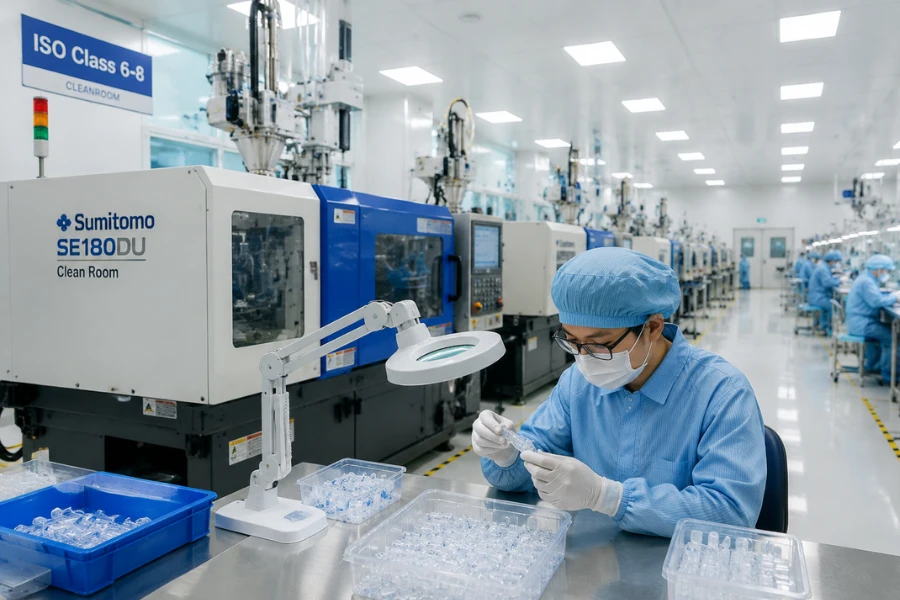
Cleanroom medical manufacturing increases operational overhead due to airflow control, gowning protocols, and environmental monitoring.
Facilities offering cleanroom injection molding integrate molding, inspection, and packaging under controlled conditions.
7. Validation and Quality System Scope
Medical OEM injection molding solutions often require:
- IQ OQ PQ validation
- Process capability studies
- Material traceability
- Risk analysis documentation
- Batch record retention
Projects managed under structured medical device contract manufacturing programs typically define validation scope early in the quotation phase.
Validation activities influence engineering workload and overall cost modeling.
Surface Finish and Cosmetic Requirements
Surface finish affects tooling complexity and yield rate.
Specify:
- Polished or textured surface
- Finish standard reference
- Laser marking
- Printing
- Assembly labeling
High-gloss surfaces may require premium tool steel and tighter process windows.
Textured finishes increase machining complexity but may reduce visible cosmetic variation.
Secondary Operations and Integrated Manufacturing
Many regulated programs require additional processes such as:
- Ultrasonic welding
- Insert installation
- Final assembly
- Clean packaging
- Inspection documentation
Integrated medical device assembly services reduce transfer risk between suppliers.
Sterile barrier preparation and labeling are commonly handled through structured medical device packaging solutions.
When secondary processes are defined early, overall project cost modeling becomes more accurate.
How Information Translates Into Pricing
The quotation process generally includes:
- Design for manufacturability review
- Material compatibility analysis
- Mold concept development
- Machine tonnage and cycle estimation
- Validation scope assessment
- Cost modeling
Each input parameter affects tooling investment, compliance workload, or unit price.
Complete information allows a medical injection molding manufacturer to align tooling, cleanroom production, and quality documentation under a unified structure.
Practical Checklist Before Requesting a Quote
Prepare the following before contacting a medical injection molding manufacturer:
- 3D CAD file
- Tolerance drawing
- Estimated annual quantity
- Resin specification
- Sterilization method
- Cleanroom requirement
- Secondary process scope
- Validation expectations
This structure allows an ISO 13485 medical molding supplier to generate a reliable and technically aligned quotation.
FAQ
How long does it take to receive a medical injection molding quote?
Standard quotations can typically be prepared within several business days. Projects involving complex validation, cleanroom requirements, or precision micro injection molding may require extended engineering review.
Do I need to select a material before requesting a quote?
Not necessarily. A medical injection molding manufacturer can recommend suitable medical grade plastics based on sterilization, application, and mechanical performance requirements.
Why does annual volume affect tooling cost?
Annual volume determines cavity count and steel hardness selection. Higher volumes usually justify hardened multi-cavity molds to reduce long-term unit cost.
Can early-stage projects receive a quotation?
Yes. Preliminary cost ranges can be provided during early development, especially when supported by product development and prototype validation.
Does cleanroom manufacturing increase part cost?
Yes. Cleanroom medical manufacturing requires environmental monitoring, contamination control systems, and enhanced inspection protocols, which increase operational cost.
Conclusion
An accurate medical injection molding quote is built on technical clarity and complete data.
When geometry, material, compliance scope, and production volume are defined early, a medical injection molding manufacturer can model tooling investment and unit pricing with higher precision.
For structured evaluation of your custom medical plastic parts program, you may Get a Quote or Contact SeaSkyMedical for more information.