Selecting a medical injection molding supplier requires a structured evaluation process that goes beyond cost, production capacity, and delivery schedules. For FDA-regulated medical device manufacturing, suppliers must demonstrate that their quality systems, manufacturing processes, documentation practices, and compliance controls can consistently support product requirements.
A supplier’s capability directly influences medical device quality, regulatory readiness, and long-term production stability. This is especially important for injection molded medical components because part performance depends on controlled materials, validated processes, qualified tooling, and consistent manufacturing conditions.
A well-designed FDA supplier evaluation process helps medical device manufacturers identify qualified suppliers, reduce supply chain risks, and establish reliable manufacturing partnerships.
This guide provides an FDA supplier evaluation checklist specifically for medical injection molding suppliers, covering qualification steps, audit criteria, required documentation, process validation capability, and ongoing supplier monitoring.
Why FDA Supplier Evaluation Matters for Medical Device Manufacturing
Medical device manufacturers often rely on external suppliers for materials, molded components, assemblies, and complete production support. Selecting the right supplier is essential because supplier performance can directly influence product quality, regulatory compliance, and commercialization timelines.
For companies evaluating outsourced production, medical device contract manufacturing services require a supplier with controlled processes, documented quality systems, and the ability to support regulated production requirements.
FDA purchasing controls require manufacturers to establish procedures for evaluating and controlling suppliers based on their ability to meet specified requirements. Supplier decisions should be supported by documented evaluations, objective evidence, and risk-based controls.
For medical injection molding suppliers, evaluation should consider multiple technical and quality factors, including:
- Quality Management System (QMS)
- Medical manufacturing experience
- Injection molding capability
- Material compliance
- Process validation readiness
- Traceability systems
- Change control procedures
A supplier may have modern equipment and competitive pricing but still create risks if it cannot provide validation records, maintain lot traceability, or control process variation.
For example, inconsistent injection molding parameters can affect:
- Part dimensions
- Mechanical performance
- Assembly fit
- Sterilization compatibility
- Regulatory documentation
Therefore, supplier qualification should focus on manufacturing reliability rather than only supplier availability or cost.
FDA Supplier Evaluation Requires a Risk-Based Approach
FDA supplier evaluation is not a one-size-fits-all process. The level of supplier qualification should depend on the potential impact of supplied products or services on medical device safety and effectiveness.
Medical device manufacturers should evaluate suppliers based on:
- Component criticality
- Product application
- Manufacturing complexity
- Regulatory impact
- Supplier history
A risk-based supplier classification commonly includes:
| Supplier Risk Level | Typical Examples | Recommended Evaluation Approach |
|---|---|---|
| High Risk | Critical medical components, contract manufacturing, validated processes | Detailed qualification, supplier audit, quality agreement, continuous monitoring |
| Medium Risk | Custom injection molded medical components | Capability review, documentation evaluation, performance tracking |
| Low Risk | Standard commercial components | Basic qualification and periodic review |
For medical injection molding suppliers, higher risk situations usually involve components that affect:
- Device safety
- Patient contact
- Functional performance
- Sterility requirements
- Regulatory submissions
The purpose of risk classification is to determine how much supplier oversight is appropriate.
A critical medical component supplier may require an on-site audit and validation review, while a lower-risk supplier may only require documentation verification.
Five-Step FDA Supplier Evaluation Process

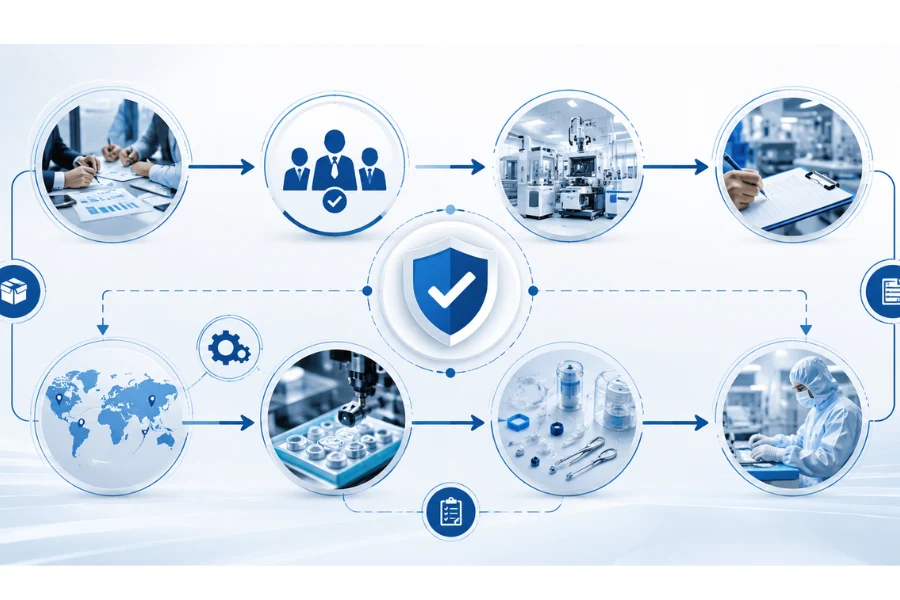
A systematic supplier qualification process helps manufacturers move from initial supplier selection to long-term supplier management.
The following five-step framework combines FDA purchasing control principles with practical medical injection molding supplier evaluation requirements.
Step 1 Define Supplier Requirements and Evaluation Criteria
Before reviewing potential suppliers, manufacturers should define clear evaluation requirements based on product needs and regulatory expectations.
A supplier evaluation criteria document should typically include:
Manufacturing Capability Requirements
The evaluation should determine whether the supplier has the technical capability to manufacture the required components.
Important considerations include:
- Injection molding equipment capability
- Mold design and manufacturing support
- Material processing experience
- Production capacity
- Secondary operations
- Inspection capability
For medical injection molding projects, suppliers should demonstrate experience with similar:
- Part geometry
- Tolerance requirements
- Engineering plastics
- Production volumes
- Quality requirements
A supplier experienced in consumer plastic products may not have the same process controls required for medical applications.
Medical manufacturers should also review whether the supplier can support advanced tooling requirements through capabilities such as medical mold manufacturing and mold qualification processes.
Quality System Requirements
The supplier’s quality system should be evaluated before approval.
Key areas include:
- ISO 13485 certification
- Document control
- CAPA management
- Internal audit procedures
- Nonconformance handling
- Record retention
A mature quality system provides evidence that manufacturing activities are controlled and repeatable.
Regulatory and Lifecycle Requirements
Supplier evaluation should also consider long-term product support.
Important questions include:
- Can the supplier support process validation?
- Can the supplier maintain production after launch?
- Can the supplier manage engineering changes?
- Can the supplier support regulatory documentation needs?
Medical devices often remain in production for years, making supplier stability an important qualification factor.
Step 2 Screen Suppliers and Evaluate Manufacturing Capability
After defining supplier requirements, manufacturers can begin evaluating potential medical injection molding suppliers.
The initial screening stage focuses on determining whether a supplier has the necessary technical capability, quality foundation, and manufacturing experience to support the project.
Supplier information collection should include:
- Company background and manufacturing history
- Medical device manufacturing experience
- Facility capabilities
- Quality certifications
- Production equipment information
- Previous project experience
- Engineering support capability
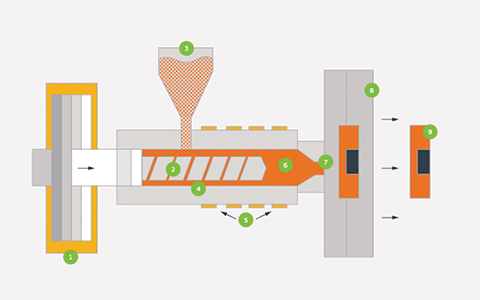
For injection molded medical components, manufacturers should request evidence that the supplier can manage the complete production process, including:
- Material receiving and storage
- Mold installation and maintenance
- Injection molding process control
- Dimensional inspection
- Final product release
- Production record management
A supplier’s ability to explain its manufacturing workflow is often a strong indicator of technical maturity.
For example, an experienced medical injection molding supplier should be able to explain how it controls:
- Critical process parameters
- Mold maintenance intervals
- Material lot traceability
- Inspection frequency
- Nonconforming product handling
Step 3 Compare Suppliers Using a Qualification Scoring System
After reviewing candidate suppliers, manufacturers should compare suppliers using a structured evaluation scorecard.
A scoring system creates a consistent method for evaluating supplier capability across multiple categories.
Step 3 Compare Suppliers Using a Qualification Scoring System
After reviewing candidate suppliers, manufacturers should compare suppliers using a structured evaluation scorecard.
A scoring system creates a consistent method for evaluating supplier capability across multiple categories rather than relying only on price, production capacity, or supplier claims.
A practical medical injection molding supplier evaluation scorecard may include:
| Evaluation Category | Evaluation Criteria |
|---|---|
| Quality Management System | ISO 13485, SOP control, CAPA, internal audits |
| Manufacturing Capability | Injection molding equipment, tooling capability, production capacity |
| Process Control | Injection parameters, SPC, inspection methods |
| Validation Capability | IQ/OQ/PQ experience, process qualification records |
| Material Management | Resin documentation, lot traceability, storage controls |
| Engineering Support | DFM review, design feedback, technical communication |
| Supply Reliability | Delivery performance, capacity planning |
The scoring process should be based on objective evidence rather than supplier statements.
Supporting evidence may include:
- Quality certificates
- Validation records
- Inspection reports
- Sample part evaluations
- Production capability documentation
- Previous medical manufacturing experience
A supplier with strong production capability but weak documentation control may require additional monitoring before approval.
Similarly, a supplier with ISO 13485 certification but limited experience with medical components may require additional technical evaluation.
The purpose of supplier scoring is to answer three key questions:
- Can the supplier manufacture the required component?
- Can the supplier consistently control the production process?
- Can the supplier provide documented evidence of compliance?
Step 4 Conduct Supplier Audits and Capability Reviews
Supplier audits provide a deeper assessment of whether documented systems match actual manufacturing practices.
For critical medical device suppliers, especially suppliers producing components that directly affect device safety or effectiveness, an on-site audit may be necessary.
A supplier audit may review:
- Manufacturing areas
- Quality laboratories
- Material storage
- Mold management systems
- Production records
- Validation documents
- Change control procedures
For medical injection molding suppliers, the audit should evaluate how the supplier controls the relationship between materials, tooling, process parameters, and inspection requirements.
Medical Injection Molding Process Capability Review

A qualified supplier should demonstrate control over the complete injection molding workflow.
Important evaluation areas include:
Injection Molding Equipment Capability
Manufacturers should review:
- Injection molding machine specifications
- Process monitoring capability
- Preventive maintenance procedures
- Equipment calibration records
- Production capacity
Equipment capability should match component requirements.
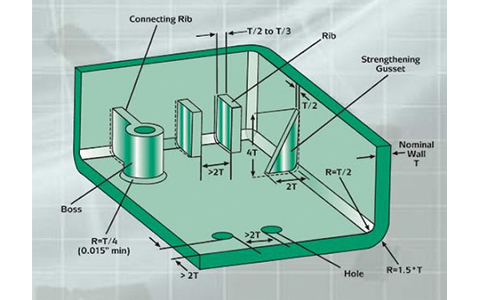
For example, thin-wall medical components, micro features, or tight-tolerance parts may require more precise process control compared with standard plastic components.
Manufacturers should also consider whether the supplier provides broader medical plastic injection molding capabilities that support regulated medical production.
Mold Management Capability
Mold condition directly affects injection molded part consistency.
Supplier evaluation should include:
- Mold design experience
- Mold qualification records
- Preventive maintenance schedules
- Tool repair procedures
- Mold change history
A supplier should have documented processes to ensure molds remain capable throughout production.
Poor mold management can contribute to:
- Flash
- Dimensional variation
- Surface defects
- Unexpected production interruptions
For suppliers producing complex medical components, capabilities such as medical insert molding should also be evaluated when the product design requires embedded metal or other inserts.
Process Control and Inspection Capability
Manufacturers should review how suppliers control production variation.
Important evaluation areas include:
- Process parameter monitoring
- First Article Inspection (FAI)
- Statistical Process Control (SPC)
- Measurement equipment calibration
- Final inspection procedures
A reliable supplier should understand which characteristics are critical and how they are monitored during production.
Step 5 Perform Continuous Supplier Monitoring and Re-Evaluation
Supplier qualification does not end after approval.
Medical device manufacturers should establish ongoing supplier monitoring systems to ensure suppliers continue meeting quality and regulatory requirements throughout the product lifecycle.
Common supplier performance indicators include:
| KPI Category | Examples |
|---|---|
| Quality Performance | Defect rate, rejection rate, nonconformance trends |
| Delivery Performance | On-time delivery, lead time stability |
| Corrective Actions | CAPA response and effectiveness |
| Change Management | Notification and approval of changes |
| Documentation Quality | Record accuracy and completeness |
Periodic supplier reviews help identify potential risks before they affect production.
Re-evaluation may be required when suppliers experience:
- Process changes
- Material changes
- Manufacturing location changes
- Quality performance issues
- Ownership changes
A mature supplier management system treats qualification as an ongoing quality process rather than a one-time approval event.
FDA Supplier Evaluation Checklist for Medical Injection Molding Suppliers
A practical supplier evaluation checklist should help procurement, engineering, and quality teams verify whether a supplier has the required capabilities.
The following checklist focuses specifically on medical injection molding supplier qualification.
1. Regulatory Compliance and Certification Review
The first evaluation area is whether the supplier has an appropriate regulatory and quality foundation.
| Evaluation Item | Checklist Questions | Evidence Required |
|---|---|---|
| FDA Facility Registration | Is applicable registration information available? | Registration records |
| ISO 13485 Certification | Does the supplier maintain a medical device QMS? | Current certificate |
| 21 CFR Part 820 Compliance | Are purchasing controls and quality procedures established? | Quality documentation |
| Quality System Documentation | Are procedures controlled and maintained? | SOPs and quality manual |
ISO 13485 certification is an important indicator of quality system maturity, but certification alone does not confirm manufacturing capability.
Manufacturers should also verify whether the supplier applies its quality system effectively to actual medical injection molding operations.
2. Material Compliance and Traceability Evaluation
Material control is a critical part of medical injection molding supplier qualification.
The supplier should demonstrate that materials are properly controlled from receipt through production.
| Evaluation Item | Checklist Questions | Evidence Required |
|---|---|---|
| Resin Compliance | Does material meet required specifications? | Material compliance documents |
| Material Certificates | Are material properties documented? | Material certificates |
| Lot Traceability | Can material batches be traced? | Batch records |
| Storage Control | Are materials stored according to requirements? | Storage procedures |
For regulated medical applications, traceability should connect finished components with:
- Material supplier
- Resin lot number
- Production batch
- Inspection results
This information supports quality investigations and regulatory documentation when necessary.
A supplier with strong traceability practices can respond more effectively to quality issues and support long-term product lifecycle management.
3. Quality System and Document Control Assessment
A medical injection molding supplier must demonstrate that manufacturing activities are supported by controlled procedures, complete quality records, and effective document management practices.
During supplier evaluation, manufacturers should review whether the supplier has established systems for:
- Document control
- Record retention
- Inspection procedures
- Nonconformance management
- Corrective and Preventive Action (CAPA)
- Internal quality audits
A mature quality system provides objective evidence that manufacturing processes are defined, monitored, and repeatable.
Key documents to review include:
| Evaluation Item | Checklist Questions | Evidence Required |
|---|---|---|
| Standard Operating Procedures (SOPs) | Are manufacturing and inspection procedures documented and controlled? | Approved SOP documents |
| Production Records | Are manufacturing activities recorded by batch or lot? | Production history records |
| Certificate of Analysis (CoA) | Are material or product test results available? | CoA reports |
| Certificate of Compliance | Are products released according to specifications? | Compliance certificates |
| First Article Inspection (FAI) | Are initial part dimensions verified? | FAI reports |
| Calibration Records | Are measurement tools controlled? | Calibration records |
For medical device manufacturing, documentation quality is part of product quality.
A supplier that produces acceptable parts but cannot provide complete manufacturing records may create challenges during:
- Regulatory audits
- Customer inspections
- Product investigations
- Corrective action activities
Manufacturers should evaluate not only whether documents exist, but whether documentation reflects actual production practices.
4. Process Validation Capability Review
Process validation is one of the most important evaluation areas when selecting a medical injection molding supplier.
A supplier may successfully produce prototype parts, but commercial medical device manufacturing requires confidence that the process can consistently produce conforming components over repeated production cycles.
Supplier evaluation should review capability in:
- Installation Qualification (IQ)
- Operational Qualification (OQ)
- Performance Qualification (PQ)
- Process capability studies
- Statistical Process Control (SPC)
- Validation documentation management
IQ Installation Qualification Evaluation
Installation Qualification verifies that equipment, tooling, and supporting systems are installed according to defined requirements.
During supplier evaluation, manufacturers should review whether the supplier maintains records for:
- Injection molding machine installation
- Equipment specifications
- Utility requirements
- Calibration status
- Mold installation procedures
- Supporting equipment qualification
For medical injection molding, IQ should confirm that production equipment and tooling are suitable for manufacturing the intended components.
Examples include:
- Injection molding machine capacity matching part requirements
- Temperature control systems meeting process needs
- Proper mold installation procedures
- Documented equipment qualification records
A supplier with a structured IQ process is better prepared for production transfer and regulatory documentation requirements.
OQ Operational Qualification Evaluation
Operational Qualification verifies that the molding process operates within an established and controlled process window.
For injection molding suppliers, important process parameters may include:
| Process Parameter | Evaluation Purpose |
|---|---|
| Melt temperature | Controls material flow and molding consistency |
| Injection pressure | Influences cavity filling and part quality |
| Holding pressure | Controls shrinkage and dimensional stability |
| Cooling time | Affects cycle consistency and part performance |
| Mold temperature | Influences surface quality and material behavior |
A mature supplier should be able to explain how process parameters are selected, monitored, and controlled.
Many suppliers use engineering studies such as Design of Experiments (DOE) to identify suitable operating ranges before production validation.
The goal of OQ is not simply to find one successful molding condition, but to establish a reliable operating window that supports repeatable production.
PQ Performance Qualification Evaluation
Performance Qualification confirms that the validated process can consistently produce acceptable components under normal production conditions.
Supplier evaluation should review:
- Validation protocols
- Production validation records
- Dimensional inspection results
- Process capability studies
- Production batch data
For medical injection molding, PQ should demonstrate that the supplier can repeatedly achieve:
- Required dimensions
- Functional specifications
- Material performance requirements
- Production consistency
Process capability indicators such as Cpk may be reviewed for critical characteristics when required by product specifications.
A supplier with strong validation experience can better support the transition from product development to commercial manufacturing.
5. Cleanroom and Contamination Control Evaluation
Environmental control requirements depend on the medical device application, component risk level, and manufacturing requirements.
For suppliers producing medical injection molded components, manufacturers should evaluate whether appropriate contamination control systems are established.
Important evaluation areas include:
| Evaluation Item | Checklist Questions |
|---|---|
| Cleanroom Classification | Is the required environmental classification defined and maintained? |
| Cleaning Procedures | Are cleaning methods documented and controlled? |
| Personnel Control | Are contamination risks from personnel managed? |
| Environmental Monitoring | Are conditions regularly monitored? |
| Material Handling | Are materials protected from contamination? |
A clean production area alone does not demonstrate effective contamination control.
Manufacturers should verify that suppliers have documented procedures supporting:
- Environmental control
- Cleaning verification
- Personnel practices
- Material handling controls
For products requiring controlled manufacturing environments, suppliers should demonstrate appropriate cleanroom injection molding capabilities and contamination control systems.
The appropriate cleanroom requirements should be determined based on product risk, application requirements, and regulatory expectations.
Supplier Quality Agreement and Change Control Requirements
A Supplier Quality Agreement (SQA) establishes clear responsibilities between the medical device manufacturer and supplier.
For critical suppliers, an SQA helps define expectations related to:
- Product specifications
- Quality responsibilities
- Inspection requirements
- Documentation requirements
- Change notification
- Corrective action responsibilities
For medical injection molding suppliers, change control is especially important because manufacturing changes may affect product performance and regulatory compliance.
Controlled changes may include:
- Resin supplier changes
- Material formulation changes
- Mold modifications
- Process parameter adjustments
- Equipment replacement
- Manufacturing location changes
A supplier should have a documented change control process that evaluates potential impact before implementation.
For example, changing a resin supplier may influence:
- Mechanical properties
- Chemical resistance
- Dimensional stability
- Regulatory documentation
Without proper change management, manufacturers may face unexpected validation activities or additional regulatory risks.
FDA Supplier Evaluation Checklist Template
The following checklist can be used as a practical framework when evaluating medical injection molding suppliers.
| Evaluation Category | Key Questions | Required Evidence |
|---|---|---|
| Regulatory Compliance | Does the supplier meet applicable FDA and quality requirements? | Certifications and quality records |
| Quality System | Are procedures documented and controlled? | SOPs, quality manual |
| Manufacturing Capability | Can the supplier produce required components? | Equipment and capability information |
| Material Control | Are materials compliant and traceable? | Material certificates, lot records |
| Validation Capability | Can the supplier support IQ/OQ/PQ? | Validation protocols and reports |
| Inspection Capability | Are critical characteristics verified? | FAI, inspection reports |
| Clean Manufacturing Environment | Are contamination controls appropriate? | Environmental records |
| Change Management | Are process changes reviewed and controlled? | Change control procedures |
| Documentation | Are records complete and accessible? | Production and quality records |
| Supplier Monitoring | Is performance continuously reviewed? | KPI reports and audit history |
This checklist should be adapted according to:
- Device classification
- Component criticality
- Regulatory requirements
- Manufacturing complexity
A supplier evaluation process should support informed qualification decisions rather than become a simple document collection exercise.
How to Identify a Mature Medical Injection Molding Supplier
Supplier evaluation should not only confirm whether a supplier meets minimum requirements. It should also help manufacturers identify suppliers with stronger technical capability, better process control, and greater long-term reliability.
A mature medical injection molding supplier usually demonstrates capability in four key areas.
Strong Quality System Implementation
A capable supplier does not treat quality documentation as a certification requirement only. The quality system should be integrated into daily manufacturing operations.
Indicators of a mature quality system include:
- Controlled work instructions
- Effective CAPA procedures
- Complete production records
- Regular internal audits
- Clear responsibility ownership
- Fast access to quality documentation
During supplier evaluation, manufacturers should review whether quality procedures are actively used on the production floor.
A documented procedure without evidence of implementation may indicate a gap between the supplier’s quality system and actual manufacturing practices.
Engineering and DFM Support Capability
Medical injection molding suppliers should contribute engineering knowledge during product development, not only manufacture parts after receiving drawings.
A technically capable supplier can support:
- Design for Manufacturing (DFM) review
- Material selection discussions
- Mold design recommendations
- Part tolerance evaluation
- Process risk identification
Early supplier involvement can help identify potential issues before tooling investment.
For example:
- Difficult draft angles
- Uneven wall thickness
- Potential warpage risks
- Gate location concerns
- Material flow challenges
Suppliers that provide engineering support through product development services can help manufacturers improve manufacturability before production begins.
Validation and Production Transfer Experience
Medical device manufacturing often requires transferring products from development into validated production. A supplier’s ability to support this transition is an important factor during supplier evaluation.
A mature medical injection molding supplier should understand the complete manufacturing lifecycle, including:
- Prototype molding
- Engineering validation builds
- Process qualification
- Production ramp-up
- Long-term manufacturing support
During evaluation, manufacturers should ask:
- Has the supplier supported IQ/OQ/PQ activities before?
- Can the supplier provide validation documentation?
- How are process changes evaluated?
- How is production consistency monitored after launch?
Suppliers with previous medical manufacturing experience are usually better prepared to support regulatory expectations and production challenges.
Transparent Traceability and Documentation Practices
Traceability is one of the most important indicators of supplier maturity.
A reliable medical injection molding supplier should be able to connect:
- Raw material batches
- Production records
- Inspection results
- Finished product shipments
Strong traceability systems support:
- Root cause investigations
- CAPA activities
- Regulatory audits
- Customer quality reviews
Manufacturers should evaluate not only whether traceability exists, but also how quickly relevant records can be retrieved.
A supplier that can provide complete and organized documentation demonstrates stronger process control and quality system maturity.
Questions to Ask Before Selecting a Medical Injection Molding Supplier
A supplier evaluation process becomes more effective when manufacturers ask specific technical questions rather than only requesting certifications.
Manufacturing Capability Questions
Manufacturers should evaluate:
- What types of medical components have you manufactured?
- What injection molding technologies do you support?
- What materials do you regularly process?
- How do you control critical dimensions?
- How do you manage mold maintenance?
- What production volumes can you support?
These questions help determine whether the supplier has experience with similar manufacturing challenges.
For example, suppliers supporting complex medical components may require experience with specialized processes such as custom plastic molding, tight-tolerance production, or application-specific material control.
Quality System Questions
Manufacturers should ask:
- How are nonconformities handled?
- How is CAPA effectiveness verified?
- How are quality records maintained?
- How are inspection methods controlled?
- How are customer complaints managed?
The answers provide insight into the supplier’s quality culture.
A strong supplier should be able to explain not only what procedures exist, but also how those procedures are applied during daily production.
Validation Questions
Important validation-related questions include:
- Can you support IQ/OQ/PQ activities?
- How are critical process parameters identified?
- Do you use DOE during process development?
- How are process windows established?
- How is process capability monitored?
These questions help determine whether the supplier can support regulated production requirements.
Change Control Questions
Manufacturers should understand how suppliers manage changes.
Recommended questions include:
- How are material changes evaluated?
- How are tooling changes controlled?
- How are customers notified before changes?
- Are process changes validated before implementation?
Effective change management reduces unexpected quality risks.
Common Mistakes When Evaluating Medical Injection Molding Suppliers
Choosing Suppliers Based Only on Manufacturing Cost
Cost is an important procurement factor, but it should not be the primary qualification criterion for regulated medical components.
A lower-cost supplier may lack:
- Validation experience
- Documentation capability
- Process control maturity
- Long-term production stability
Supplier selection should consider total manufacturing risk rather than initial quotation value alone.
A supplier with stronger engineering support, quality systems, and validation capability may provide better long-term value.
Accepting Certifications Without Reviewing Actual Capability
Certifications provide useful information, but they do not replace technical evaluation.
A supplier may hold ISO 13485 certification but still lack experience with:
- Specific medical materials
- Complex geometries
- Tight tolerances
- Validation requirements
Manufacturers should evaluate how the supplier applies its quality system to actual manufacturing processes.
Ignoring Tooling Capability
For injection molded medical components, tooling capability directly affects production consistency.
Supplier evaluation should include:
- Mold design experience
- Tool maintenance procedures
- Mold qualification process
- Spare tooling strategy when required
A weak tooling management system can create recurring production issues.
For projects requiring dedicated tooling support, manufacturers should evaluate whether suppliers provide structured engineering assistance such as free mold tool design support during product development.
Skipping Supplier Re-Evaluation After Approval
Supplier qualification should continue throughout the product lifecycle.
Changes that may require reassessment include:
- New manufacturing location
- Major equipment changes
- Material substitutions
- Quality performance issues
- Ownership changes
Continuous monitoring helps ensure that supplier capability remains aligned with product requirements.
Final FDA Supplier Evaluation Checklist Summary
A comprehensive FDA supplier evaluation process helps medical device manufacturers select suppliers that can support safe, consistent, and compliant production.
The evaluation should focus on four core dimensions:
| Evaluation Dimension | Key Assessment Areas |
|---|---|
| Regulatory Compliance | FDA requirements, ISO 13485, applicable quality standards |
| Quality System | QMS, CAPA, document control, supplier agreements |
| Manufacturing Capability | Injection molding, tooling, process control, validation support |
| Traceability | Material records, production history, inspection documentation |
For medical injection molding suppliers, qualification should be based on demonstrated capability, documented processes, and manufacturing reliability.
A supplier that understands regulatory expectations, controls production variation, and maintains complete traceability can provide stronger support throughout medical device development and commercialization.
Medical manufacturers should also consider whether a supplier can support additional production requirements beyond molding, such as medical device assembly and other downstream manufacturing operations when developing a complete supply chain strategy.
FAQ
What should be included in an FDA supplier evaluation checklist?
An FDA supplier evaluation checklist should review supplier quality systems, manufacturing capability, regulatory compliance, process validation capability, material traceability, documentation control, and ongoing performance monitoring.
For medical injection molding suppliers, additional evaluation areas include mold capability, injection molding process control, clean manufacturing requirements, and IQ/OQ/PQ support.
Does FDA require medical device suppliers to have ISO 13485 certification?
FDA supplier control requirements focus on ensuring manufacturers evaluate and control suppliers based on risk and supplier capability.
ISO 13485 certification is widely recognized as an important quality management framework for medical device suppliers, but manufacturers should also evaluate actual manufacturing capability, process controls, and documentation practices.
When should a medical injection molding supplier be audited?
Supplier audits are typically considered for higher-risk suppliers, including suppliers producing critical medical components or providing processes that directly affect device safety and effectiveness.
Audit frequency should be determined based on supplier risk, performance history, product requirements, and regulatory expectations.
What documents should a medical injection molding supplier provide?
Common supplier evaluation documents include:
- ISO 13485 certificate
- Quality manual
- Material compliance documentation
- Certificate of Analysis (CoA)
- First Article Inspection (FAI) reports
- IQ/OQ/PQ validation records
- Traceability records
- Change control procedures
- Supplier Quality Agreement documents
How often should suppliers be re-evaluated?
Supplier re-evaluation frequency depends on supplier risk level, product impact, and performance history.
Manufacturers should consider reassessment after:
- Significant process changes
- Quality issues
- Material changes
- Production location changes
- Regulatory concerns
Conclusion
FDA supplier evaluation is not simply a purchasing checklist. For medical device manufacturers, it is a structured risk management process that helps verify whether suppliers can consistently deliver safe, compliant, and reliable components.
A qualified medical injection molding supplier should demonstrate:
- A controlled quality management system
- Stable manufacturing processes
- Effective validation capability
- Complete traceability
- Reliable change management
By evaluating suppliers based on documented capability rather than cost alone, manufacturers can reduce production risks and establish stronger long-term supply chain relationships.
SeaSkyMedical supports medical device OEMs with medical plastic injection molding, mold manufacturing, DFM support, clean manufacturing environments, and scalable production solutions. Manufacturers evaluating injection molding suppliers should consider quality systems, process validation, and production reliability as key factors when selecting a long-term manufacturing partner.