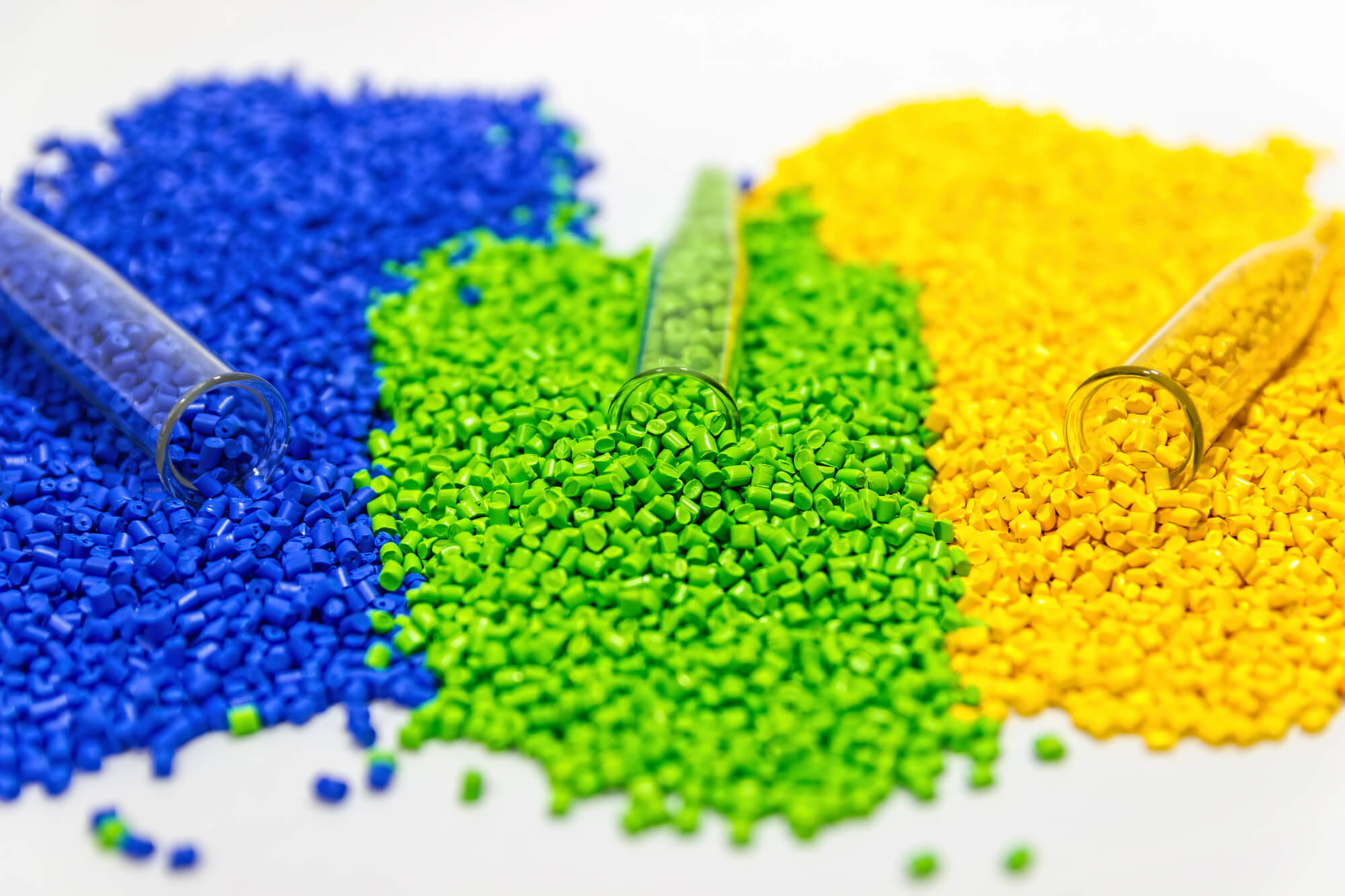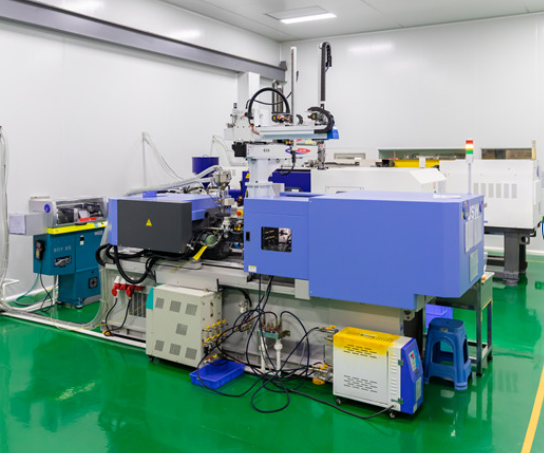
Choosing the right plastic material for a medical device requires more than comparing basic material properties.
Medical OEM teams must evaluate how a material performs throughout the complete product lifecycle, including injection molding, assembly, sterilization, repeated use, and long-term reliability.
Medical Nylon, also known as Polyamide (PA), is widely used for functional medical components because it combines mechanical strength, wear resistance, chemical resistance, and injection molding flexibility.
However, nylon also has unique processing characteristics that require careful engineering control. Its moisture absorption, shrinkage behavior, crystallization, and sterilization response can directly affect final part performance.
For medical device manufacturers, selecting the correct nylon grade requires evaluating:
- Mechanical requirements
- Sterilization conditions
- Dimensional tolerance
- Chemical exposure
- Production volume
- Validation requirements
This guide explains how medical nylon is selected, processed, and manufactured for injection molded medical components, including PA grade comparison, medical applications, sterilization considerations, molding requirements, and quality control factors.
For OEM projects requiring complete manufacturing support, SeaSkyMedical provides medical plastic injection molding solutions covering material evaluation, tooling development, injection molding, and production support.
What Is Medical Nylon (PA)?
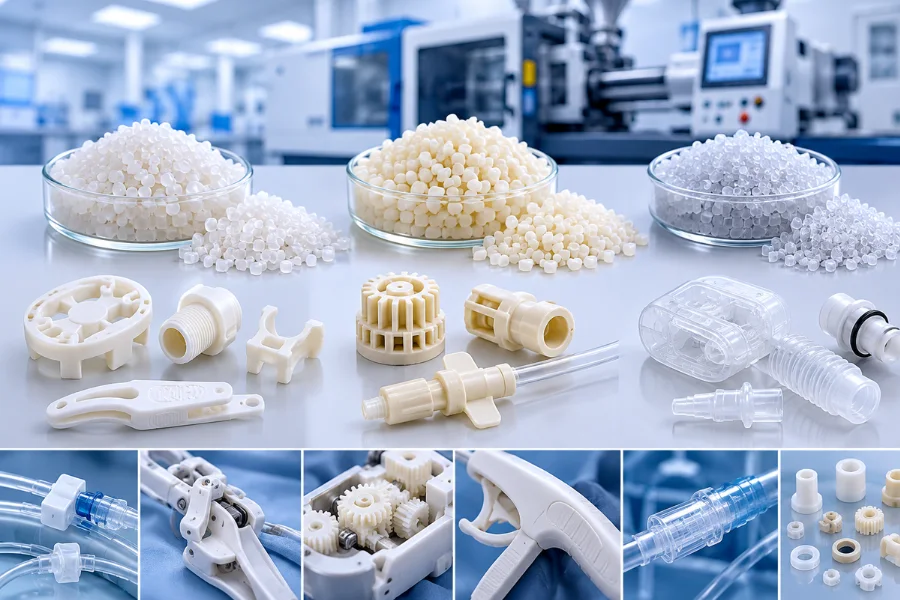
Medical Nylon refers to polyamide-based engineering thermoplastics used for medical and healthcare-related applications.
Nylon is a family of synthetic polymers containing repeating amide structures within its molecular structure. Different chemical structures create different polyamide grades with variations in:
- Mechanical strength
- Flexibility
- Moisture absorption
- Thermal performance
- Chemical resistance
Common nylon grades include:
- PA6
- PA66
- PA12
- PA11
- PA610
- PA612
Each grade provides a different balance of performance.
For example:
- PA6 provides good toughness and impact resistance
- PA66 provides higher stiffness and heat resistance
- PA12 provides lower moisture absorption and improved dimensional stability
For medical plastic component manufacturing, the correct material choice depends on the function of the component rather than selecting the strongest material available.
Why Nylon Is Used in Medical Device Manufacturing
Nylon is generally selected for medical components that require functional performance rather than only appearance.
Its combination of mechanical properties and injection molding capability makes it suitable for components exposed to repeated mechanical stress, movement, chemical exposure, or dimensional requirements.
High Mechanical Strength
According to polymer material references, nylon provides excellent tensile strength, compressive strength, and impact resistance.
These properties allow nylon components to maintain structural performance under repeated loading.
Potential medical applications include:
- Device housings
- Structural supports
- Mechanical components
- Connectors
For example, a medical device component exposed to repeated assembly or mechanical movement may require a material with higher toughness rather than a rigid but brittle plastic.
Wear Resistance and Low Friction
Nylon provides good abrasion resistance and self-lubricating characteristics.
This makes it suitable for selected moving components where reduced friction and durability are important.
Potential applications include:
- Internal mechanisms
- Sliding components
- Gear-related parts
The material’s wear performance can help extend component service life in mechanical applications.
Chemical Resistance
Medical components may encounter:
- Cleaning agents
- Disinfectants
- Fluids
- Chemical environments
Nylon provides resistance to many oils, weak acids, and alkaline conditions.
However, strong acids and oxidizing agents may affect polyamide materials.
Therefore, chemical compatibility should be evaluated based on the actual application environment.
Injection Molding Capability
Nylon has good melt flow characteristics, allowing manufacturers to produce:
- Complex geometries
- Thin-wall features
- Integrated structures
- Precision molded components
For medical components requiring complex plastic designs, manufacturers typically combine material selection with professional medical device contract manufacturing capabilities to manage design, tooling, molding, and production requirements.
However, good flowability also requires careful process control.
Because nylon flows easily, excessive pressure or improper tooling design may increase risks such as:
- Flash
- Internal stress
- Dimensional variation
Medical Nylon Material Selection Guide
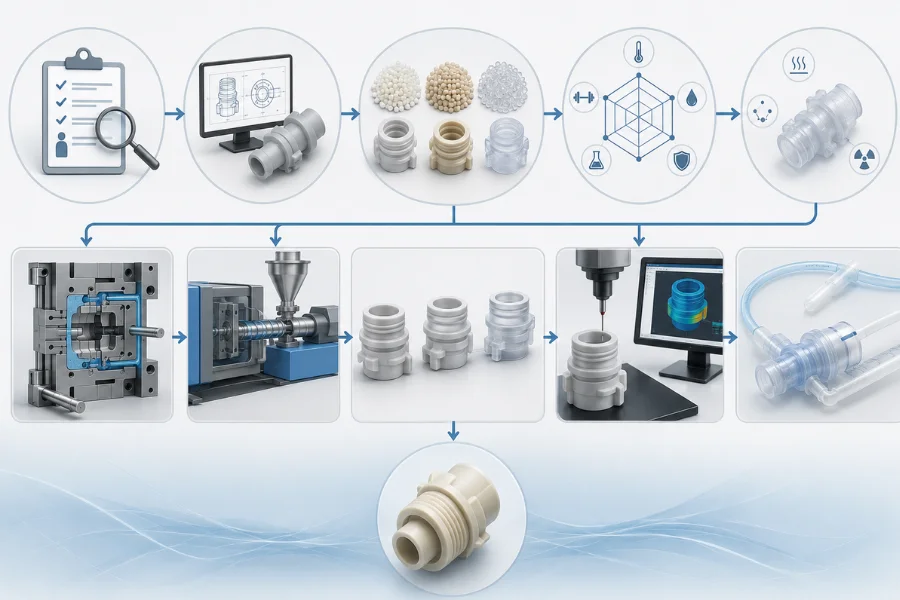
There is no universal “best” nylon material for all medical applications.
The appropriate grade depends on the performance requirements of the final component.
| Medical Requirement | Material Consideration |
|---|---|
| High toughness and impact resistance | PA6 may provide a balanced solution |
| Higher stiffness and heat resistance | PA66 may be considered |
| Lower moisture absorption | PA12 may provide advantages |
| Higher strength and rigidity | Glass-filled nylon may be suitable |
| Tight dimensional requirements | Consider moisture behavior and shrinkage |
| Repeated sterilization exposure | Evaluate thermal and environmental stability |
Material selection should happen during early product development because resin choice influences:
- Part design
- Mold design
- Processing conditions
- Validation strategy
Early engineering evaluation through medical product development helps reduce material selection risks and improve production planning.
PA6 vs PA66 vs PA12 for Medical Applications
Understanding the differences between nylon grades helps OEM teams select the appropriate material for different medical applications.
| Feature | PA6 | PA66 | PA12 |
|---|---|---|---|
| Mechanical strength | Good | Higher | Moderate |
| Toughness | High | Good | High |
| Heat resistance | Moderate | Higher | Moderate |
| Moisture absorption | Higher | Higher | Lower |
| Dimensional stability | Moderate | Moderate | Better |
| Processing difficulty | Lower | Higher | Lower |
| Typical consideration | General functional parts | Structural components | Precision applications |
PA6 Selection Considerations
PA6 provides a good balance between toughness, strength, and processability.
It may be considered for:
- General medical components
- Mechanical parts
- Durable plastic structures
Its good flow characteristics also make it suitable for injection molding applications requiring complex geometries.
However, PA6 has higher moisture absorption compared with some other nylon grades.
For precision medical components, engineers should evaluate how moisture exposure may affect:
- Dimensional accuracy
- Assembly performance
- Long-term mechanical properties
PA66 Selection Considerations
PA66 provides higher stiffness and temperature resistance compared with PA6.
It may be considered for:
- Higher load components
- Structural applications
- Parts exposed to elevated temperatures
Because PA66 has higher processing temperatures and crystallinity, molding parameters require careful control.
Manufacturers need to manage:
- Resin drying
- Melt temperature
- Cooling conditions
- Shrinkage compensation
PA12 Selection Considerations
PA12 provides lower moisture absorption compared with PA6 and PA66.
This can help improve:
- Dimensional stability
- Long-term consistency
- Precision assembly performance
PA12 may be considered for:
- Precision connectors
- Fluid-related components
- Small functional parts
For applications where moisture-related dimensional variation is a major concern, PA12 can provide advantages.
Glass-Filled Nylon Selection Considerations
Glass-filled nylon improves:
- Strength
- Stiffness
- Heat resistance
- Dimensional stability
The reference material data shows that glass fiber reinforcement can significantly reduce shrinkage.
For example:
- PA6 shrinkage: approximately 0.8–2.5%
- PA6 with 30% glass fiber: approximately 0.35–0.45%
However, reinforced nylon requires additional considerations:
- Increased mold wear
- Fiber orientation effects
- Directional shrinkage
- Tooling material selection
For high-volume medical production, glass-filled nylon selection should be evaluated together with mold lifecycle requirements.
Professional nylon injection molding experience helps manufacturers balance material performance, tooling requirements, and production stability.
Medical Applications of Nylon Injection Molded Components
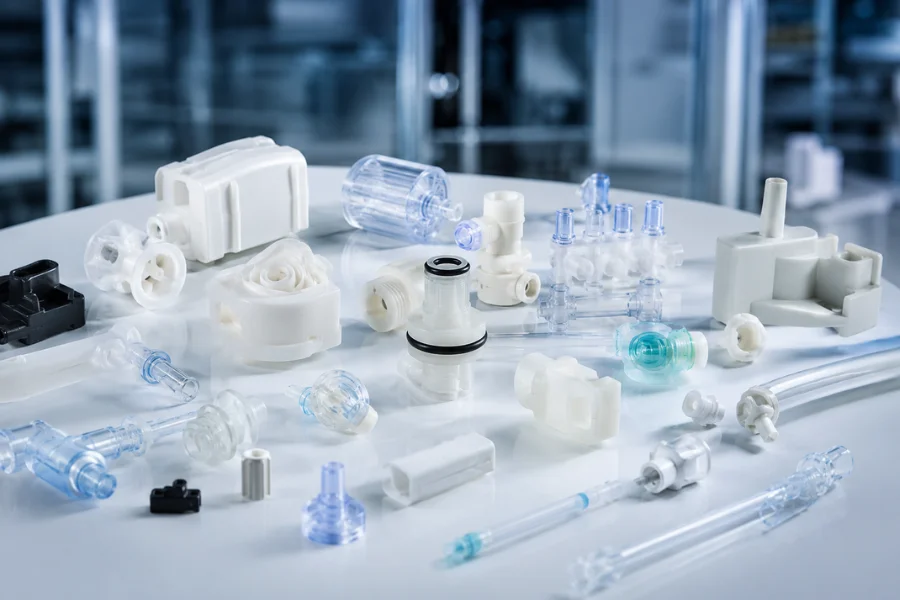
Medical nylon is generally selected for components that require mechanical reliability, dimensional consistency, and long-term durability.
Unlike commodity plastics used mainly for cost reduction or appearance, nylon is typically chosen for functional medical components where material performance directly affects device operation.
The final material selection depends on:
- Mechanical loading
- Chemical exposure
- Sterilization method
- Required tolerance
- Production environment
For OEM projects requiring complete support from design to manufacturing, OEM medical components require careful coordination between material selection, tooling, injection molding, and quality control.
Medical Device Housings and Structural Components
Medical equipment housings require materials that can withstand:
- Repeated handling
- Cleaning procedures
- Mechanical impact
- Long-term use
Nylon provides:
- High toughness
- Good impact resistance
- Chemical resistance
- Design flexibility
Injection molding allows manufacturers to integrate structural features into a single component, including:
- Mounting points
- Reinforcement ribs
- Snap features
- Internal supports
For handheld medical devices and diagnostic equipment, nylon can provide a balance between lightweight design and mechanical durability.
When developing complex plastic structures, professional custom plastic molding capabilities help manufacturers evaluate material behavior, tooling requirements, and production feasibility.
Precision Connectors and Assembly Components
Medical connectors often require stable dimensions because small variations can affect assembly performance.
Material considerations include:
- Moisture-related dimensional changes
- Shrinkage control
- Mechanical strength
- Chemical resistance
PA12 may provide advantages in precision applications because of its lower moisture absorption compared with other nylon grades.
Potential applications include:
- Fluid connectors
- Tubing interfaces
- Precision fittings
- Device assembly components
For these components, dimensional consistency is often more important than maximum strength.
Additional processes such as medical device assembly may also be required when molded nylon components are integrated into complete medical products.
Fluid Management Components
Medical fluid systems require materials that maintain performance when exposed to liquids, cleaning agents, and environmental conditions.
Nylon may be considered for selected fluid-related components because of:
- Chemical resistance
- Mechanical strength
- Injection molding capability
Potential applications include:
- Connectors
- Fittings
- Valve-related components
- Fluid handling structures
Material selection should consider:
- Fluid compatibility
- Pressure requirements
- Temperature range
- Sterilization conditions
For applications requiring different polymer characteristics, engineers may also compare nylon with other medical plastics during the material selection process.
Mechanical Components Inside Medical Equipment
Nylon has traditionally been used for mechanical parts because of its wear resistance and self-lubricating characteristics.
The reference material identifies nylon as suitable for components such as:
- Gears
- Bearings
- Rollers
- Sliding parts
- Mechanical supports
Similar characteristics can provide value in medical equipment mechanisms where repeated movement occurs.
Examples include:
- Internal drive components
- Positioning mechanisms
- Mechanical adjustment parts
For these applications, engineers should evaluate:
- Fatigue resistance
- Friction requirements
- Service cycle count
- Environmental exposure
Medical-Grade Nylon Requirements
The term “medical nylon” does not simply refer to any nylon resin used near healthcare products.
For medical device applications, manufacturers typically need to evaluate additional requirements beyond standard material performance.
Important considerations include:
- Material documentation
- Batch traceability
- Manufacturing consistency
- Application-specific testing
- Regulatory requirements
Medical manufacturing requires stronger material control compared with many industrial applications because small variations may affect product reliability.
Material Documentation and Traceability
Material control is important because nylon properties can change depending on:
- Resin grade
- Moisture condition
- Processing history
Important material information may include:
- Resin grade identification
- Supplier documentation
- Batch records
- Processing records
Traceability helps manufacturers identify potential variation sources and maintain consistent production quality.
For nylon components, this is particularly important because moisture exposure and processing conditions can influence material performance.
A controlled manufacturing system supported by medical device contract manufacturing processes helps OEM teams manage documentation, production consistency, and quality requirements.
Medical Nylon and Biocompatibility Considerations
The reference material notes that nylon has characteristics such as being non-toxic, odorless, and resistant to biological degradation.
However, medical device suitability depends on the specific application.
Manufacturers should evaluate:
- Contact type
- Duration of exposure
- Device classification
- Applicable testing requirements
Material selection should always consider the complete device design rather than evaluating resin properties alone.
For regulated medical products, verification and validation activities may be required to confirm that the selected material and manufacturing process meet project requirements.
Sterilization Compatibility of Medical Nylon
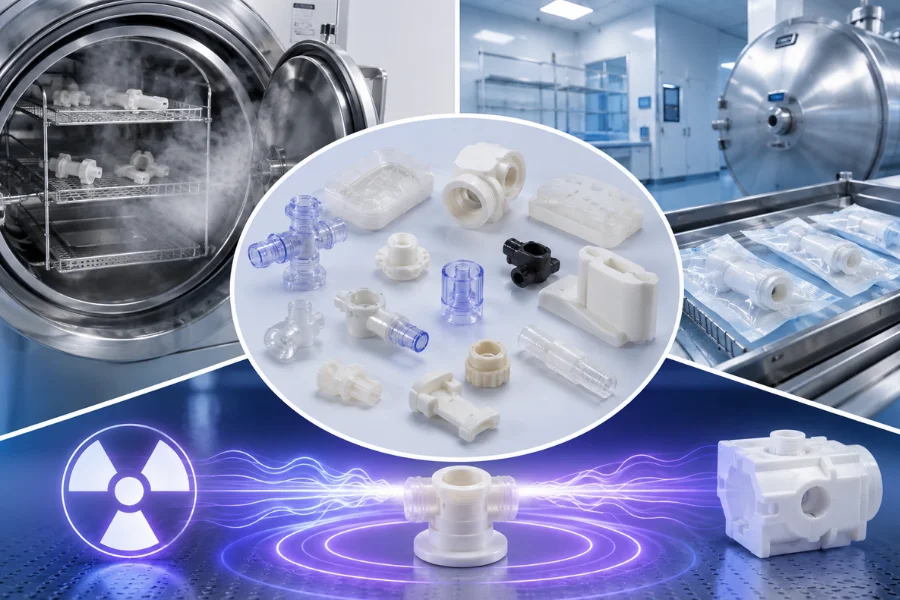
Sterilization is one of the most important factors when selecting nylon for medical applications.
A nylon component that performs well during injection molding may experience changes after exposure to repeated sterilization cycles.
Engineers should evaluate:
- Temperature exposure
- Moisture exposure
- Chemical interaction
- Radiation effects
- Mechanical property changes
Sterilization compatibility should be considered during material selection, not after product development is complete.
The sterilization process can influence:
- Resin selection
- Part design
- Dimensional requirements
- Validation planning
Steam Sterilization Considerations
Steam sterilization uses elevated temperatures combined with moisture.
For nylon materials, moisture exposure requires special attention because polyamide structures naturally absorb water.
Potential concerns include:
- Dimensional changes
- Mechanical property variation
- Long-term performance changes
For example, a precision connector requiring tight assembly tolerance may require additional evaluation because absorbed moisture can influence dimensions.
When evaluating nylon for steam sterilization, engineers should consider:
- Nylon grade selection
- Moisture absorption behavior
- Reinforcement type
- Number of sterilization cycles
- Required dimensional tolerance
Ethylene Oxide (EtO) Sterilization Considerations
EtO sterilization is commonly used for medical devices that cannot tolerate high-temperature sterilization.
Compared with steam sterilization, EtO reduces thermal stress on polymer components.
However, nylon components should still be evaluated for:
- Chemical compatibility
- Long-term material stability
- Residual exposure considerations
For medical OEM projects, EtO compatibility should be confirmed through testing based on the actual device application.
Gamma Sterilization Considerations
Gamma sterilization uses high-energy radiation to eliminate microorganisms.
Radiation exposure may influence polymer structures and potentially affect:
- Mechanical strength
- Appearance
- Long-term durability
For nylon components, evaluation may include:
- Mechanical testing after irradiation
- Dimensional inspection
- Functional performance verification
The impact depends on:
- Nylon grade
- Additives
- Radiation dose
- Product lifetime requirements
Choosing Nylon Based on Sterilization Requirements
A practical material selection approach is to evaluate the relationship between nylon grade and sterilization environment.
| Requirement | Key Nylon Consideration |
|---|---|
| Steam sterilization | Evaluate moisture absorption and dimensional stability |
| EtO sterilization | Evaluate chemical compatibility and long-term stability |
| Gamma sterilization | Evaluate radiation effects on mechanical properties |
| Repeated sterilization cycles | Verify long-term performance through testing |
| Precision assemblies | Prioritize dimensional stability |
Sterilization should be part of the initial material selection process because it can influence:
- Resin choice
- Part design
- Mold tolerance
- Validation strategy
A complete medical manufacturing workflow may also include V&V medical device support to confirm product performance and process reliability.
Medical Nylon Manufacturing Requires More Than Material Selection
Selecting a suitable nylon grade is only the first step.
A successful medical nylon component requires coordination between:
- Material engineering
- Product design
- Mold development
- Injection molding
- Quality control
- Validation
For medical OEM teams, the goal is not simply producing a plastic part.
The goal is producing a reliable component that maintains performance throughout manufacturing, sterilization, assembly, and end use.
Medical Nylon Injection Molding Process Considerations
Medical nylon injection molding requires precise control of material preparation, tooling design, processing parameters, and quality verification.
Compared with many general-purpose plastics, nylon has more complex processing requirements because of:
- High moisture absorption
- Semi-crystalline behavior
- Shrinkage variation
- Sensitivity to thermal history
For medical components, injection molding performance directly influences:
- Dimensional accuracy
- Mechanical reliability
- Assembly consistency
- Long-term device performance
A successful medical nylon molding process should control the complete manufacturing workflow, including:
- Resin preparation
- Injection parameters
- Mold design
- Cooling performance
- Dimensional inspection
- Process validation
For projects requiring complete tooling development, manufacturers often combine nylon material expertise with professional mold making capabilities to ensure consistent production performance.
Nylon Resin Drying Before Injection Molding
Material preparation is one of the most important steps when processing nylon.
Polyamide materials are highly hygroscopic, meaning nylon pellets absorb moisture from the surrounding environment.
According to the reference material, nylon must be dried before molding because moisture absorption can cause:
- Surface defects
- Dimensional changes
- Reduced mechanical performance
Unlike some plastics where moisture mainly affects appearance, moisture inside nylon resin can influence the final mechanical performance of molded components.
Why Moisture Control Is Critical
During injection molding, nylon is exposed to high processing temperatures.
If excessive moisture remains inside the resin, water can react with the polymer during processing and reduce material performance.
Common issues include:
- Silver streaks
- Gas formation
- Surface marks
- Mechanical property reduction
- Dimensional instability
For medical components, moisture control is especially important because small dimensional changes can affect:
- Assembly accuracy
- Functional performance
- Product reliability
Proper material handling should include:
- Dry resin before molding
- Controlled material storage
- Reduced exposure after drying
- Material traceability
Nylon Injection Molding Parameters
Nylon grades have different processing windows because of differences in melting behavior and crystallization characteristics.
The reference injection molding data provides the following typical ranges:
| Nylon Grade | Barrel Temperature | Mold Temperature | Injection Pressure |
|---|---|---|---|
| PA6 | 200–240°C | 60–100°C | 80–110 MPa |
| Glass-filled PA6 | 200–250°C | 80–120°C | 90–130 MPa |
| PA66 | 250–280°C | 60–120°C | 80–130 MPa |
| Glass-filled PA66 | 230–270°C | 100–120°C | 80–130 MPa |
| PA612 | 200–230°C | 40–70°C | 70–120 MPa |
| PA1010 | 180–240°C | 40–80°C | 70–100 MPa |
These values provide general guidance.
Actual molding parameters should be optimized according to:
- Part geometry
- Wall thickness
- Mold design
- Material grade
- Required tolerance
Melt Temperature Control
Nylon requires careful melt temperature management.
The temperature must be high enough to achieve:
- Complete melting
- Stable filling
- Good feature replication
However, excessive temperature or long residence time can cause:
- Polymer degradation
- Reduced mechanical performance
- Material discoloration
The reference material specifically notes that molten nylon has limited thermal stability and should not remain at high temperatures inside the barrel for extended periods.
For medical components, stable cycle management helps maintain consistent material performance.
Mold Temperature and Crystallization Control
Nylon is a semi-crystalline thermoplastic.
During cooling, crystallization behavior influences:
- Shrinkage
- Mechanical properties
- Dimensional stability
The reference material indicates that nylon crystallinity can reach approximately 40%.
Because mold temperature affects crystallization, tooling temperature control is an important factor during medical component development.
Proper mold temperature management helps improve:
- Repeatability
- Dimensional consistency
- Mechanical performance
Injection Pressure Control
Nylon has relatively good flowability because of its low melt viscosity.
This provides advantages when molding complex medical geometries.
However, excessive injection pressure can increase risks such as:
- Flash formation
- Internal stress
- Mold wear
Insufficient pressure may cause:
- Short shots
- Incomplete filling
- Poor replication of fine features
Injection profiles should be optimized according to:
- Flow distance
- Gate location
- Part thickness
- Material behavior
Mold Design Considerations for Medical Nylon Components
Nylon mold design requires attention to shrinkage, cooling, flow behavior, and ejection.
For medical components requiring precise dimensions, tooling design should be considered during early product development rather than after molding problems occur.
Gate Design Selection
The reference material indicates that nylon can use various gate types, including:
- Direct gate
- Side gate
- Pin gate
- Ring gate
- Disk gate
Gate selection affects:
- Filling balance
- Weld line location
- Internal stress
- Dimensional consistency
For medical components, gate location should be evaluated during DFM review.
A poorly positioned gate may create:
- Weak weld lines
- Uneven shrinkage
- Flow-related defects
Cooling System Design
Nylon molding generates significant heat during processing.
The reference material highlights that nylon parts require cooling systems designed for uniform heat removal.
Poor cooling design can result in:
- Warpage
- Uneven shrinkage
- Dimensional variation
- Longer cycle time
Effective cooling design should consider:
- Cooling channel placement
- Heat distribution
- Mold temperature stability
For precision medical components, cooling design is often a key factor in achieving repeatable dimensions.
Venting Design
Because nylon has good flow characteristics, proper venting is necessary to remove trapped air during filling.
Insufficient venting may cause:
- Burn marks
- Short shots
- Surface defects
According to the reference tooling data, the recommended vent depth for nylon is approximately:
0.01 mm
Vent locations should be considered near:
- End-of-fill areas
- Thin sections
- Complex cavity regions
Draft Angle and Ejection Design
Proper draft angles reduce the risk of part damage during ejection.
The reference design data recommends:
- Cavity draft angle: 25′–45′
- Core draft angle: 20′–45′
Insufficient draft may lead to:
- Difficult demolding
- Surface damage
- Increased production variation
For medical components with strict appearance or dimensional requirements, ejection design should be reviewed before tooling production.
Design for Manufacturability (DFM) for Medical Nylon Parts
A DFM review helps identify manufacturing risks before mold development begins.
For nylon medical components, important design considerations include:
- Wall thickness
- Flow path
- Gate location
- Cooling balance
- Shrinkage compensation
- Ejection requirements
Professional free mold tool design support can help identify potential molding risks before tooling investment.
Wall Thickness Control
Uneven wall thickness can create:
- Different cooling rates
- Sink marks
- Warpage
- Dimensional variation
Maintaining consistent wall thickness improves:
- Filling stability
- Cooling performance
- Production repeatability
Thin-Wall Nylon Injection Molding
Thin-wall medical components require careful process optimization.
Potential risks include:
- Premature cooling
- Incomplete filling
- Weld line weakness
Engineers should evaluate:
- Injection speed
- Melt temperature
- Gate design
- Venting
For complex precision parts, early simulation and DFM analysis can reduce tooling adjustments during later production stages.
Glass-Filled Nylon Tooling Considerations
Glass-filled nylon provides higher strength and dimensional stability but creates additional tooling challenges.
Glass fibers can increase:
- Mold wear
- Surface abrasion
- Maintenance requirements
For high-volume medical production, manufacturers should evaluate:
- Tool steel selection
- Mold lifecycle
- Maintenance planning
Proper tooling management is especially important when producing reinforced nylon components over long production cycles.
Medical Nylon Process Validation and Quality Control
Medical manufacturing requires a controlled and repeatable process.
Producing acceptable parts once is not enough.
The process must demonstrate consistent performance throughout production.
A complete quality approach may include:
- Material verification
- Process qualification
- Dimensional inspection
- Functional testing
- Documentation control
Material Verification
Material control includes:
- Resin identification
- Supplier documentation
- Batch traceability
- Storage control
This helps ensure consistent material behavior during production.
Process Qualification
Medical injection molding projects may require qualification activities such as:
Installation Qualification (IQ)
Confirms equipment and tooling are installed correctly.
Operational Qualification (OQ)
Confirms the molding process operates within defined parameters.
Performance Qualification (PQ)
Confirms the process consistently produces acceptable parts during production.
These activities help demonstrate process reliability for medical manufacturing.
ISO 13485 Manufacturing Considerations
For medical device suppliers, quality management systems are an important consideration during supplier evaluation.
Medical injection molding suppliers may need controlled processes related to:
- Documentation
- Traceability
- Process control
- Inspection records
- Change management
A structured quality system helps manufacturers maintain consistent production performance and support long-term OEM partnerships.
For manufacturers requiring controlled production environments, cleanroom injection molding can support applications where contamination control and manufacturing consistency are important.
Medical Nylon Manufacturing Requires Engineering Integration
Successful nylon medical components depend on coordination between:
- Material selection
- Product design
- Mold engineering
- Injection molding
- Quality control
- Validation
For medical OEM teams, selecting the resin is only the beginning.
The final reliability of a component depends on how well the entire manufacturing system is controlled.
Common Medical Nylon Injection Molding Defects and Solutions
Medical nylon injection molding requires stable control of material preparation, tooling design, and processing parameters.
Because nylon is sensitive to moisture, temperature changes, and shrinkage behavior, improper processing can affect:
- Surface quality
- Dimensional accuracy
- Mechanical performance
- Production consistency
For medical components, defect prevention is especially important because part variation may affect assembly, device function, and validation results.
Silver Streaks and Moisture-Related Defects
Silver streaks are one of the most common issues associated with nylon injection molding.
Causes
The primary cause is excessive moisture inside the nylon resin.
Because polyamide materials absorb moisture from the environment, insufficient drying can create vapor during high-temperature processing.
Common causes include:
- Inadequate resin drying
- Poor material storage
- Excessive exposure to humidity
- Improper material handling
Impact on Medical Components
Moisture-related defects can affect more than appearance.
Potential effects include:
- Reduced mechanical strength
- Inconsistent material performance
- Dimensional variation
- Lower production reliability
For medical plastic components, these risks are especially important because even small variations may affect assembly accuracy and long-term device performance.
Solutions
Manufacturers can reduce moisture-related defects through:
- Proper resin drying
- Controlled material storage
- Shortened exposure after drying
- Process monitoring
For nylon projects, combining material expertise with professional nylon injection molding experience helps reduce moisture-related processing risks.
Flash Formation
Flash occurs when molten plastic escapes from the mold parting surface or other areas during injection.
Causes
Nylon has good flowability because of its relatively low melt viscosity.
While this helps fill complex geometries, it can also increase flash risk if molding conditions are not optimized.
Common causes include:
- Excessive injection pressure
- Insufficient clamping force
- Mold surface wear
- Incorrect venting
- Excessive melt temperature
Solutions
Flash risk can be reduced through:
- Optimizing injection pressure
- Improving mold sealing conditions
- Maintaining tooling surfaces
- Adjusting molding parameters
For precision medical components, controlling flash is important because additional trimming operations may introduce further variation.
Warpage and Dimensional Distortion
Warpage is a common challenge in nylon injection molding.
Because nylon is a semi-crystalline polymer, cooling conditions strongly influence final part dimensions.
Causes
Common causes include:
- Uneven cooling
- Non-uniform wall thickness
- Incorrect mold temperature
- Uneven shrinkage
- Glass fiber orientation
Solutions
Manufacturers can reduce warpage through:
- Balanced cooling system design
- Uniform wall thickness
- Optimized gate location
- Proper holding pressure
- Mold flow analysis
For medical parts requiring tight tolerances, warpage control should begin during product design and tooling development.
Dimensional Variation in Medical Nylon Parts
Dimensional stability is one of the most important factors when selecting nylon for medical components.
Nylon dimensions may change because of:
- Moisture absorption
- Shrinkage behavior
- Crystallization differences
- Process variation
Reference material data shows that nylon shrinkage varies significantly by grade.
| Material | Shrinkage Range |
|---|---|
| PA6 | 0.8–2.5% |
| PA66 | 1.5–2.2% |
| PA6 with 30% glass fiber | 0.35–0.45% |
| PA66 with 30% glass fiber | 0.4–0.55% |
For medical components requiring precision assembly, engineers should consider:
- Material selection
- Moisture conditioning
- Mold compensation
- Process stability
PA6 vs PA66 vs PA12 Selection Based on Medical Requirements
Different medical applications require different material priorities.
A practical comparison helps OEM teams select the appropriate nylon grade.
| Requirement | Recommended Consideration |
|---|---|
| High toughness and impact resistance | PA6 |
| Higher stiffness and heat resistance | PA66 |
| Lower moisture absorption | PA12 |
| Higher mechanical reinforcement | Glass-filled Nylon |
| Precision dimensional control | PA12 or reinforced grades |
| Moving mechanical parts | PA6, PA66, or reinforced nylon |
The final selection should consider the complete device environment rather than one individual material property.
Example Medical Nylon Material Selection Scenarios
Understanding practical scenarios can help engineers evaluate material options.
Precision Medical Connector
Requirement:
- Stable dimensions
- Reliable assembly
- Lower moisture influence
Potential consideration:
PA12 may provide advantages because lower moisture absorption can help reduce dimensional changes.
For connector projects requiring additional machining or modification after molding, CNC plastic machining may also support prototype development or secondary processing requirements.
Mechanical Component Inside Medical Equipment
Requirement:
- Repeated movement
- Wear resistance
- Mechanical durability
Potential consideration:
PA6, PA66, or glass-filled nylon may be considered depending on load requirements.
Structural Medical Component
Requirement:
- Higher stiffness
- Long-term mechanical stability
Potential consideration:
PA66 or reinforced nylon may provide improved mechanical performance.
Material selection should always be confirmed through engineering evaluation and application-specific testing.
How to Select a Medical Nylon Injection Molding Supplier
Choosing the right manufacturing partner is an important part of medical component development.
A capable supplier should provide more than molding equipment.
Important evaluation factors include:
Material Engineering Capability
The supplier should understand:
- Nylon grade selection
- Moisture control requirements
- Shrinkage behavior
- Sterilization considerations
A supplier with material expertise can help OEM teams avoid problems caused by selecting unsuitable materials or processing conditions.
Mold Design and Tooling Experience
Nylon components require tooling knowledge related to:
- Cooling design
- Venting
- Gate selection
- Shrinkage compensation
Professional mold making capabilities are important because tooling directly influences dimensional stability and production consistency.
Medical Manufacturing Controls
Medical projects typically require attention to:
- Documentation
- Traceability
- Process consistency
- Inspection procedures
Suppliers should understand medical manufacturing expectations rather than only general plastic molding requirements.
Production Scalability
A supplier should support different development stages, including:
- Prototype molding
- Design verification
- Pilot production
- Full-scale manufacturing
Services such as 3D prototype printing can also support early product development before committing to production tooling.
Medical Nylon Injection Molding at SeaSkyMedical
SeaSkyMedical supports medical OEM teams developing precision plastic components that require controlled material processing and reliable injection molding performance.
The company provides engineering-focused manufacturing support, including:
- Medical injection molding
- Precision mold making
- DFM analysis
- Prototype tooling
- Cleanroom manufacturing
- Production support
For complete medical manufacturing projects, SeaSkyMedical combines injection molding with additional capabilities such as secondary operation support and product integration services.
For nylon medical components, successful production requires integration between:
- Material selection
- Product design
- Mold engineering
- Injection parameters
- Quality control
- Validation
By combining material knowledge with manufacturing experience, SeaSkyMedical helps OEM customers develop reliable medical plastic components from early design stages through production.
FAQ About Medical Nylon (PA)
Is nylon suitable for medical device manufacturing?
Nylon can be suitable for medical devices when the selected grade meets the required mechanical, dimensional, chemical, and sterilization requirements.
Its strength, wear resistance, and injection molding capability make it useful for many functional medical components.
What is the difference between PA6 and PA66 for medical applications?
PA6 generally provides good toughness and impact resistance.
PA66 typically provides higher stiffness and temperature resistance.
The better choice depends on the component requirements, operating environment, and manufacturing conditions.
Why does nylon need drying before injection molding?
Nylon absorbs moisture from the environment.
If moisture remains in the resin during molding, it can cause:
- Silver streaks
- Reduced mechanical performance
- Dimensional instability
- Surface defects
Proper drying helps maintain stable molding performance.
Can nylon withstand medical sterilization?
The answer depends on the nylon grade and sterilization method.
Steam sterilization, EtO sterilization, and gamma sterilization expose materials to different conditions.
Compatibility should be evaluated through testing and validation based on the intended application.
Why is glass-filled nylon used?
Glass-filled nylon improves:
- Strength
- Stiffness
- Heat resistance
- Dimensional stability
However, it may also increase mold wear and introduce directional shrinkage effects.
Tooling and process parameters should be adjusted accordingly.
What are common nylon injection molding defects?
Common defects include:
- Silver streaks caused by moisture
- Flash caused by excessive pressure or tooling issues
- Warpage caused by uneven cooling
- Dimensional variation caused by moisture and shrinkage
Proper material preparation, mold design, and process control can reduce these risks.
Conclusion
Medical Nylon (PA) remains an important engineering material for medical device manufacturing because it combines mechanical strength, wear resistance, chemical resistance, and injection molding flexibility.
However, successful medical nylon component production requires more than selecting a suitable resin.
Manufacturers must evaluate:
- Material behavior
- Sterilization compatibility
- Mold design
- Processing parameters
- Dimensional control
- Validation requirements
For medical OEM teams, nylon selection should be part of a complete engineering strategy that connects material selection, product design, tooling, molding, and quality management.
SeaSkyMedical provides medical injection molding and manufacturing support for companies developing precision plastic components.
Through controlled processes and engineering collaboration, medical nylon components can achieve consistent quality, reliable performance, and long-term production stability.