Medical manufacturing risk assessment is a systematic process used to identify, evaluate, control, and continuously monitor risks that may affect the safety, quality, performance, or regulatory compliance of a medical device throughout its lifecycle. Guided by ISO 14971, supported by ISO 13485, and integrated with engineering practices such as Design for Manufacturability (DFM), Failure Modes and Effects Analysis (FMEA), Moldflow analysis, process validation (IQ/OQ/PQ), and Statistical Process Control (SPC), effective medical manufacturing risk assessment helps manufacturers minimize defects, maintain process capability, satisfy regulatory requirements, and consistently deliver safe, high-quality medical devices.
Whether producing disposable consumables, diagnostic devices, or implantable components through medical device contract manufacturing, identifying manufacturing risks before mass production is significantly more effective—and far less costly—than correcting failures after products reach the market.
Why Medical Manufacturing Risk Assessment Matters
Unlike many industrial products, medical devices directly influence patient health and clinical outcomes. A manufacturing defect that appears minor—such as a small weld line, slight dimensional variation, or microscopic contamination—may compromise device functionality, reduce sterilization effectiveness, or even create patient safety hazards.
Medical manufacturing risk assessment therefore extends far beyond quality inspection. It provides a structured methodology for identifying hazards, evaluating their potential impact, implementing risk control measures, and continuously monitoring manufacturing performance throughout the entire product lifecycle.
For manufacturers specializing in medical plastic injection molding, proactive risk assessment is essential for achieving stable production, regulatory compliance, and long-term product reliability.
An effective medical manufacturing risk assessment program helps manufacturers:
- Reduce manufacturing defects before production begins.
- Improve product reliability and manufacturing consistency.
- Support ISO 14971 and ISO 13485 compliance.
- Minimize recalls, complaints, and CAPA investigations.
- Improve process validation success.
- Strengthen supplier qualification and material traceability.
- Increase customer confidence during regulatory audits.
Rather than relying on end-of-line inspection alone, manufacturers build quality into every stage of product development—from design controls and material qualification to production controls, sterilization validation, packaging, and post-market surveillance.
Medical Manufacturing Risk Assessment Framework
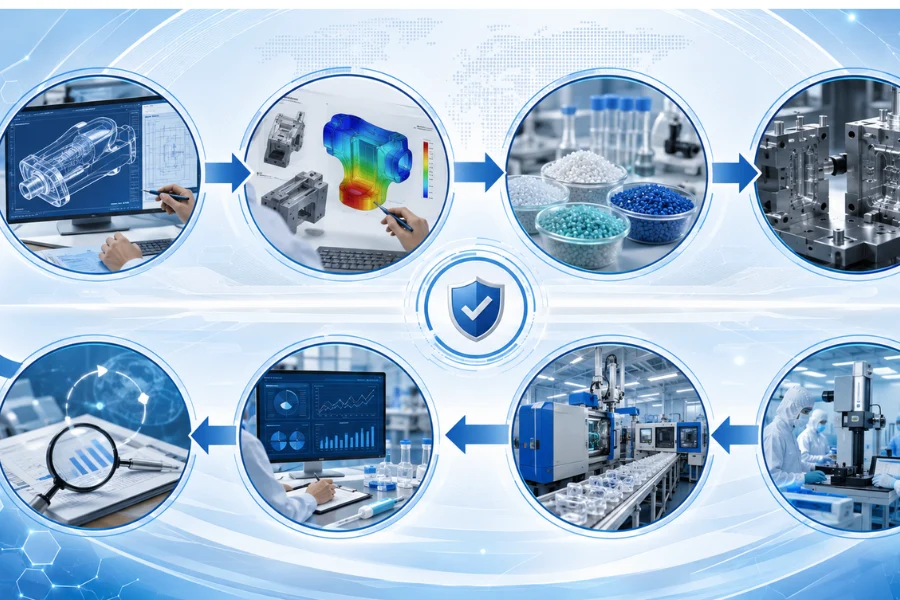
High-performing medical device manufacturers typically organize risk management into several interconnected stages rather than treating it as a one-time engineering exercise.
| Manufacturing Stage | Primary Objective | Typical Risk Assessment Activities |
|---|---|---|
| Product Design | Eliminate design-related risks | Design Controls, DFM Review, Hazard Analysis |
| Material Selection | Ensure material suitability | Biocompatibility, supplier qualification, sterilization compatibility |
| Mold Development | Improve manufacturability | Moldflow analysis, gate optimization, cooling analysis |
| Process Development | Establish stable production | CPP optimization, DOE, OQ studies |
| Process Validation | Demonstrate repeatability | IQ, OQ, PQ |
| Mass Production | Maintain process capability | SPC, Cp/Cpk monitoring, process monitoring |
| Post-Market Activities | Continuous improvement | Complaint Handling, CAPA, Change Control, Risk Management File updates |
This lifecycle approach ensures that manufacturing risks are continuously identified, evaluated, controlled, and reviewed as products evolve, production volumes increase, or regulatory requirements change.
Medical Manufacturing Risks Across the Product Lifecycle
Medical manufacturing risks begin long before the first production run. Decisions made during product development frequently determine manufacturing stability, production cost, validation complexity, and long-term product reliability.
Design Risk
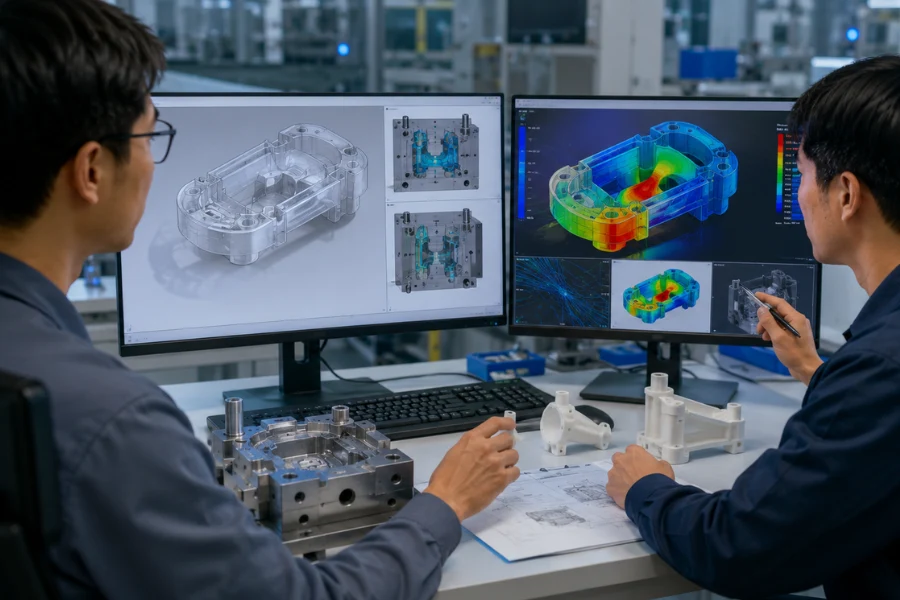
Product design is often the earliest opportunity to eliminate manufacturing risks. If a design ignores injection molding principles, no amount of process optimization can completely compensate for poor manufacturability.
During Design for Manufacturability (DFM) reviews and free mold tool design planning, engineers evaluate:
- Wall thickness uniformity
- Draft angle
- Rib and boss design
- Undercuts
- Tolerance stack-up
- Gate location
- Assembly interfaces
- Mold cavity filling behavior
For example, excessive wall thickness differences may increase differential cooling, resulting in sink marks, warpage, or residual stress. Poor gate placement may generate weld lines across structural regions, reducing mechanical strength.
Modern medical manufacturers frequently perform Moldflow analysis before tooling begins to simulate:
- Plastic flow front
- Air trap locations
- Weld line formation
- Cavity pressure
- Cooling performance
- Predicted shrinkage
- Fiber orientation (when applicable)
Resolving these issues during design significantly reduces tooling modifications, shortens development cycles, and improves first-pass validation success.
Material Qualification Risk

Material selection affects far more than mechanical performance. Every medical-grade polymer must satisfy application-specific requirements related to biocompatibility, sterilization compatibility, chemical resistance, dimensional stability, and long-term aging performance.
A structured medical material selection strategy helps manufacturers reduce technical uncertainty while ensuring the selected resin is suitable for both manufacturing and clinical use.
Typical considerations include:
| Material | Typical Medical Applications | Sterilization Considerations |
|---|---|---|
| Polycarbonate (PC) | Transparent housings | May discolor after repeated gamma sterilization |
| ABS | Equipment housings | Limited resistance to repeated steam sterilization |
| Polypropylene (PP) | Disposable devices | Excellent chemical resistance |
| PEEK | Surgical instruments | Outstanding autoclave performance |
| Liquid Silicone Rubber (LSR) | Seals, valves | Excellent biocompatibility and flexibility |
Material qualification should also verify:
- Supplier consistency
- Material certifications
- ISO 10993 documentation
- Lot-to-lot variation
- Resin drying requirements
- Sterilization compatibility
- Shelf-life stability
Complete material traceability ensures that every production lot can be linked to its original resin batch, supporting rapid investigations should quality issues arise.
Manufacturing Risk Matrix
Not every manufacturing issue presents the same level of concern. Risk assessment combines the severity of a potential failure with its likelihood of occurrence and the manufacturer’s ability to detect the problem before product release.
A simplified medical manufacturing risk matrix is shown below.
| Risk Level | Severity | Typical Example | Recommended Action |
|---|---|---|---|
| Low | Cosmetic only | Minor flow mark | Monitor during routine inspection |
| Medium | Functional impact | Small dimensional deviation | Improve process capability and verification |
| High | Device malfunction | Leakage, connector failure | Implement immediate risk control measures |
| Critical | Patient safety risk | Sterility failure, implant fracture | Eliminate hazard before production release |
For higher-risk products, manufacturers often extend this assessment using FMEA, assigning Severity (S), Occurrence (O), and Detection (D) scores to calculate a Risk Priority Number (RPN). The results help engineering teams prioritize corrective actions, optimize manufacturing processes, and document decisions within the Risk Management File.
This structured evaluation supports not only ISO 14971 compliance but also continuous improvement through CAPA, Root Cause Analysis, and Change Control, ensuring that residual risk remains acceptable throughout the product lifecycle.
Mold Design Risk
Even the most optimized product design cannot compensate for poor mold engineering. In medical injection molding, mold design directly affects dimensional accuracy, repeatability, production efficiency, and regulatory compliance.
Because medical components often require strict tolerances, validated manufacturing processes, and long-term production stability, tooling must be designed to minimize process variation from the beginning.
A comprehensive mold making process should consider not only tool durability but also how mold design influences product quality, process capability, and validation requirements.
Critical mold design considerations include:
- Gate location and gate type
- Runner balancing
- Cooling channel layout
- Venting efficiency
- Shrinkage compensation
- Ejection system design
- Mold cavity balance
- Insert positioning accuracy
Improper gate placement can create weld lines in structural regions, reducing burst strength or increasing leakage risk. Poor vent design may trap air inside the mold cavity, leading to burn marks, short shots, or gas voids. Uneven cooling channels frequently cause differential shrinkage, resulting in warpage and dimensional instability.
To reduce these risks before tooling is manufactured, engineering teams commonly perform Moldflow analysis to evaluate:
- Plastic flow front progression
- Weld line locations
- Air trap formation
- Cavity pressure distribution
- Cooling efficiency
- Shrinkage prediction
- Clamp force requirements
- Cycle time optimization
By identifying potential manufacturing issues during tool development, manufacturers can significantly reduce tooling modifications, shorten validation timelines, and improve first-pass production success.
Manufacturing Process Risk
After tooling has been validated, process consistency becomes one of the most important factors affecting product quality.
Medical manufacturing requires much tighter process control than conventional plastic molding because even small parameter variations may influence:
- Device performance
- Sterilization compatibility
- Dimensional stability
- Mechanical strength
- Long-term reliability
Instead of depending only on finished-product inspection, manufacturers establish validated operating windows for Critical Process Parameters (CPPs) and continuously monitor them throughout production.
Typical CPPs include:
- Melt temperature
- Mold temperature
- Injection speed
- Injection pressure
- Holding pressure
- Packing time
- Cooling time
- Back pressure
- Screw recovery
- Clamp force
Maintaining these parameters within validated limits helps ensure every production batch remains consistent while minimizing manufacturing variation.
Typical Critical Process Parameters Reference
Although actual processing conditions vary depending on resin type, part geometry, mold design, and equipment capability, the following ranges represent common engineering reference values during medical injection molding process development.
| Critical Process Parameter | Typical Reference Range | Potential Risk if Uncontrolled |
|---|---|---|
| Melt Temperature | 220–320°C (material dependent) | Resin degradation, discoloration |
| Mold Temperature | 40–120°C | Warpage, dimensional variation |
| Injection Pressure | 70–150 MPa | Short shots or flash |
| Injection Speed | Medium to High | Jetting, weld lines, burn marks |
| Holding Pressure | 50–90% of injection pressure | Sink marks, internal voids |
| Packing Time | 2–8 seconds | Shrinkage variation |
| Cooling Time | 8–30 seconds | Residual stress, deformation |
These values are general engineering references. Actual parameters should be established through Design of Experiments (DOE), process optimization, and formal validation studies.
Rather than searching for one perfect machine setting, experienced manufacturers establish a robust process window that can tolerate normal production variation while maintaining product quality.
Modern injection molding systems increasingly integrate real-time process monitoring technologies, allowing engineers to identify abnormal trends before defective products are produced.
Common monitoring methods include:
- Machine data collection
- Cavity pressure monitoring
- Automated inspection systems
- Statistical Process Control (SPC)
- Process capability analysis
- Predictive maintenance
Manufacturing stability is commonly evaluated through Cp and Cpk analysis to confirm that process variation remains within specification limits.
Maintaining stable Critical Quality Attributes (CQAs) requires effective control of CPPs, validated production procedures, and continuous process monitoring.
Common Injection Molding Defects and Their Medical Risks
Many molding defects that appear cosmetic in consumer products can become serious quality or patient safety concerns in medical applications.
A small defect may affect:
- Structural integrity
- Sealing performance
- Sterility
- Assembly accuracy
- Functional reliability
Understanding the relationship between injection molding defects and medical device risks is therefore an essential part of manufacturing risk assessment.
| Injection Molding Defect | Typical Root Cause | Potential Medical Device Risk |
|---|---|---|
| Weld Line | Poor flow convergence | Reduced strength, leakage |
| Short Shot | Incomplete cavity filling | Functional failure |
| Flash | Excessive cavity clearance | Particle contamination |
| Bubble / Void | Moisture or trapped gas | Internal structural weakness |
| Silver Streak | Wet resin or gas release | Cosmetic defects, reduced mechanical properties |
| Warpage | Uneven cooling or shrinkage | Assembly failure, dimensional deviation |
| Burn Marks | Trapped gas | Material degradation |
| Sink Marks | Insufficient packing | Reduced dimensional accuracy |
For example:
- A weld line located on a fluid pathway connector may reduce burst strength and increase leakage risk.
- Flash around sealing surfaces may generate loose particles after trimming, increasing contamination risks.
- Internal voids may weaken load-bearing components without being visible during routine inspection.
- Warpage may prevent proper alignment between mating components, resulting in leakage or inaccurate dosing.
These examples demonstrate why medical manufacturers focus on defect prevention rather than defect detection.
Failure Mode vs Preventive Control
A mature medical manufacturing risk assessment system does not simply record failures after they occur. It connects each potential failure mode with preventive engineering controls.
| Potential Failure Mode | Typical Root Cause | Preventive Engineering Control |
|---|---|---|
| Flash | Mold wear, excessive pressure | Mold maintenance, process optimization |
| Weld Line | Poor gate location | Gate redesign, Moldflow optimization |
| Short Shot | Poor filling | Flow simulation, vent optimization |
| Bubble / Void | Moisture, trapped gas | Proper resin drying, improved venting |
| Warpage | Uneven cooling | Cooling channel optimization |
| Residual Stress | Improper packing or cooling | Process validation and CPP optimization |
| Contamination | Poor environmental control | Cleanroom monitoring and validated cleaning procedures |
| Dimensional Variation | Process instability | SPC monitoring, Cp/Cpk improvement |
Linking failure modes with preventive controls supports:
- Hazard Analysis
- Verification Activities
- Validation Activities
- Root Cause Analysis
- Corrective and Preventive Action (CAPA)
By addressing potential failures before they reach production, manufacturers can reduce process variation, improve validation outcomes, and maintain acceptable residual risk throughout the product lifecycle.
Risk Assessment Tools Used in Medical Manufacturing
Medical manufacturing relies on multiple complementary engineering tools rather than a single risk assessment method. Each tool evaluates risks from a different perspective, helping manufacturers build a comprehensive understanding of product safety, manufacturing capability, and regulatory compliance.
Leading medical device manufacturers integrate these tools throughout the product lifecycle to support:
- Hazard Analysis
- Risk Control Measures
- Verification Activities
- Validation Activities
- Residual Risk Evaluation
- Continuous Improvement
A strong risk management system does not treat these tools as separate activities. Instead, they work together to prevent failures before they affect production or patient safety.
Failure Modes and Effects Analysis (FMEA)
Failure Modes and Effects Analysis (FMEA) is one of the most widely used engineering methods for identifying potential failures before production begins.
FMEA evaluates how individual failure modes may affect product performance and prioritizes corrective actions based on:
- Severity (S)
- Occurrence (O)
- Detection (D)
These factors are commonly used to calculate a Risk Priority Number (RPN), helping engineering teams determine which risks require immediate attention.
For medical injection molding projects, typical failure modes analyzed through FMEA include:
- Flash formation
- Short shots
- Weld lines
- Material contamination
- Tool wear
- Dimensional variation
- Assembly failure
- Sterilization-related degradation
However, FMEA should not be considered a replacement for ISO 14971 risk management.
ISO 14971 provides the overall framework for identifying hazards, evaluating risks, implementing risk controls, and managing residual risk throughout the medical device lifecycle. FMEA is an engineering analysis tool that supports this process by identifying potential product and process failures.
A complete medical manufacturing risk management system typically combines FMEA with:
- Risk Management File
- Hazard Analysis
- Design Controls
- Process Validation
- CAPA procedures
- Change Control
Design for Manufacturability (DFM)
Many manufacturing risks originate during product design rather than during production.
A component may meet functional requirements but still create manufacturing challenges due to:
- Complex geometry
- Excessive tolerance requirements
- Poor wall thickness distribution
- Difficult mold release
- Unbalanced filling behavior
DFM reviews help identify these risks before tooling investment begins.
For medical injection molded components, DFM evaluations typically include:
- Wall thickness optimization
- Draft angle review
- Gate location assessment
- Moldability analysis
- Assembly requirements
- Tolerance stack-up evaluation
- Material compatibility review
By addressing manufacturing concerns during the design stage, companies can reduce:
- Tooling modifications
- Development delays
- Validation failures
- Production instability
This is especially important for medical devices because design changes after validation may require additional verification activities, documentation updates, and regulatory review.
Moldflow Analysis
Moldflow analysis is a critical simulation tool used to predict injection molding behavior before physical tooling is manufactured.
Instead of discovering problems during mold trials, engineers can evaluate potential risks during the design stage.
Moldflow analysis can predict:
- Plastic flow front behavior
- Filling imbalance
- Weld line locations
- Air trap risks
- Cavity pressure distribution
- Cooling performance
- Shrinkage
- Warpage
- Residual stress
For medical components requiring tight tolerances, Moldflow analysis helps engineers optimize:
- Gate location
- Runner design
- Cooling layout
- Injection parameters
- Part geometry
By identifying these issues early, manufacturers can reduce tooling iterations and improve validation efficiency.
Statistical Process Control (SPC)
After production begins, maintaining process stability becomes a critical part of risk management.
Statistical Process Control (SPC) uses manufacturing data to identify process variation before it results in nonconforming products.
Common SPC monitoring parameters include:
- Critical dimensions
- Injection pressure
- Cavity pressure
- Cycle time
- Melt temperature
- Weight variation
- Process capability indicators
Key capability measurements include:
Cp (Process Capability)
Measures the potential capability of a process based on specification limits.
Cpk (Process Capability Index)
Evaluates actual process performance by considering process centering and variation.
A stable process with strong Cp/Cpk performance provides objective evidence that manufacturing can consistently produce components within specification.
Process Validation: Why Final Inspection Is Not Enough
One of the biggest differences between medical manufacturing and conventional plastic production is that quality cannot rely only on final inspection.
Finished-product inspection may identify visible defects, but it cannot fully detect:
- Internal stress
- Molecular degradation
- Process drift
- Long-term reliability issues
- Hidden contamination risks
Medical manufacturers therefore validate the manufacturing process itself to demonstrate that it can repeatedly produce compliant products.
This process is commonly structured around:
- Installation Qualification (IQ)
- Operational Qualification (OQ)
- Performance Qualification (PQ)
Installation Qualification (IQ)
IQ confirms that manufacturing equipment, tooling, facilities, and supporting systems are properly installed according to documented requirements.
Typical IQ activities include:
- Injection molding machine verification
- Mold identification confirmation
- Equipment calibration review
- Utility verification
- Cleanroom environment confirmation
- Documentation review
The goal of IQ is to confirm that the manufacturing environment is suitable before process evaluation begins.
Operational Qualification (OQ)
OQ establishes the validated operating range for Critical Process Parameters (CPPs).
During OQ, engineers evaluate how process variables affect product quality, including:
- Melt temperature
- Mold temperature
- Injection speed
- Injection pressure
- Holding pressure
- Cooling time
The objective is not to identify one perfect machine setting.
Instead, OQ establishes a robust operating window that can consistently produce acceptable parts despite normal manufacturing variation.
For example, a validated process window may define acceptable ranges for:
| Process Parameter | Risk Controlled |
|---|---|
| Melt Temperature | Prevents resin degradation |
| Injection Speed | Controls filling defects |
| Packing Pressure | Reduces sink marks and voids |
| Cooling Time | Controls residual stress |
| Mold Temperature | Improves dimensional stability |
Performance Qualification (PQ)
PQ verifies that the validated process can consistently produce conforming products during normal production conditions.
Unlike OQ, which establishes operating limits, PQ demonstrates repeatability using:
- Production equipment
- Production materials
- Normal operators
- Standard manufacturing procedures
Evaluation may include:
- Dimensional inspection
- Functional testing
- Process capability studies
- SPC data review
- Product performance verification
Successful PQ demonstrates that the manufacturing system is reliable for long-term production rather than only capable of producing acceptable prototype samples.
Medical Manufacturing Risk Checklist
Before releasing a medical product into mass production, manufacturers should verify that critical risks have been identified, controlled, and documented.
| Manufacturing Risk Review Item | Purpose |
|---|---|
| Design Controls Completed | Ensures product requirements are defined |
| Hazard Analysis Approved | Identifies potential safety risks |
| DFM Review Completed | Reduces manufacturability issues |
| Moldflow Analysis Completed | Predicts filling and molding risks |
| Material Qualification Completed | Confirms resin suitability |
| Sterilization Compatibility Verified | Prevents post-sterilization failures |
| CPPs Identified | Defines critical process controls |
| IQ/OQ/PQ Completed | Confirms process validation |
| Cp/Cpk Evaluated | Confirms process capability |
| SPC Monitoring Established | Detects process variation |
| Traceability System Verified | Supports investigation and recall control |
| Risk Management File Updated | Maintains lifecycle compliance |
This checklist provides a practical framework for ensuring manufacturing risks are addressed before commercial production begins.
Cleanroom Manufacturing and Contamination Risk
For many medical devices, contamination control is as important as dimensional accuracy.
Products intended for sterile applications are often manufactured in controlled environments such as ISO Class 7 or ISO Class 8 cleanrooms to minimize:
- Airborne particles
- Microbial contamination
- Environmental variation
- Product handling risks
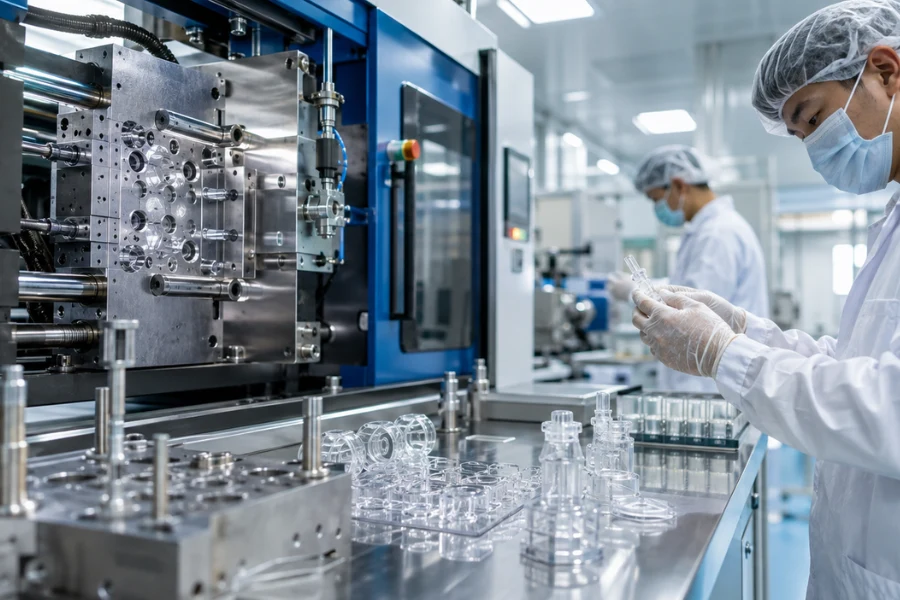
A qualified cleanroom injection molding environment typically includes:
- HEPA-filtered air systems
- Controlled personnel gowning
- Environmental monitoring
- Temperature and humidity control
- Cleaning validation
- Material flow management
- Equipment sanitation procedures
Contamination risks should also be evaluated throughout the manufacturing process, including:
- Resin handling
- Mold maintenance
- Trimming operations
- Secondary operations
- Packaging activities
Because contamination may not always be detected through final inspection, prevention remains the most effective risk control strategy.
Medical Manufacturing Lifecycle Risk Management
Medical manufacturing risk assessment is not a single engineering activity. It is a continuous process that evolves throughout the entire product lifecycle.
| Lifecycle Stage | Main Risk Management Activities |
|---|---|
| Product Concept | Hazard Identification |
| Product Design | Design Controls, DFM Review |
| Material Selection | Qualification and Compatibility Testing |
| Mold Development | Tool Design, Moldflow Analysis |
| Process Development | DOE, CPP Identification |
| Validation | IQ/OQ/PQ |
| Mass Production | SPC, Process Monitoring, Traceability |
| Post-Market Stage | Complaint Handling, CAPA, Change Control |
| Continuous Improvement | Risk Management File Updates |
By continuously reviewing manufacturing data, customer feedback, complaints, corrective actions, and process performance, manufacturers can ensure that residual risk remains acceptable while improving product reliability over time.
Best Practices for Reducing Manufacturing Risks
Although every medical device has unique functional requirements and manufacturing challenges, several proven practices can significantly reduce manufacturing risks across different products, materials, and production environments.
The most effective risk management strategy is not based on detecting failures after production. Instead, it focuses on preventing risks before they become quality issues through early engineering analysis, validated processes, and continuous production monitoring.
Begin Risk Assessment During Product Design
The most cost-effective opportunity to reduce manufacturing risk occurs before tooling and mass production begin.
Early Design Controls, Hazard Analysis, and Design for Manufacturability (DFM) reviews help identify potential problems before they become expensive tooling or validation issues.
Key design considerations include:
- Uniform wall thickness
- Proper draft angles
- Optimized gate locations
- Reasonable tolerance requirements
- Appropriate material selection
- Assembly feasibility
- Sterilization compatibility
For complex medical components, early collaboration between product designers and manufacturing engineers helps ensure that the final design can be produced consistently under validated conditions.
A strong product development process reduces:
- Tool redesign
- Engineering changes
- Validation delays
- Production instability
- Regulatory risks
Select Qualified Medical-Grade Materials
Material selection is one of the most important risk control decisions in medical manufacturing.
A polymer that performs well in conventional applications may not be suitable for medical devices due to differences in:
- Patient contact requirements
- Sterilization methods
- Chemical exposure
- Long-term aging
- Regulatory requirements
Manufacturers should evaluate:
- Biocompatibility
- ISO 10993 requirements
- Sterilization compatibility
- Mechanical performance
- Chemical resistance
- Material consistency
- Supplier qualification
- Resin traceability
For example:
- Polycarbonate may provide excellent transparency but requires evaluation for gamma sterilization compatibility.
- ABS may be suitable for equipment housings but may have limitations in repeated autoclave environments.
- PEEK may be selected for high-temperature sterilization applications.
- LSR may be preferred for flexible medical components requiring excellent biocompatibility.
A qualified material selection process reduces the likelihood of late-stage failures caused by material incompatibility.
Validate Manufacturing Processes Instead of Inspecting Quality In
Inspection identifies defects after they occur.
Validation demonstrates that a manufacturing process can consistently prevent defects from occurring.
A robust medical manufacturing validation strategy includes:
- IQ
- OQ
- PQ
- Process capability studies
- DOE optimization
- SPC monitoring
By validating the relationship between process parameters and product quality, manufacturers can establish repeatable production conditions rather than depending only on finished-product inspection.
This approach is especially important for medical injection molding because many critical characteristics cannot be fully verified through visual inspection alone.
Examples include:
- Internal residual stress
- Material degradation
- Hidden voids
- Long-term dimensional stability
- Sterilization performance
Continuously Monitor Manufacturing Performance
Even validated processes can change over time due to:
- Tool wear
- Equipment aging
- Material variation
- Environmental changes
- Maintenance activities
- Operator differences
Continuous process monitoring helps identify these changes before they affect product quality.
Modern medical manufacturing systems may include:
- Machine data collection
- Cavity pressure monitoring
- Automated vision inspection
- Dimensional measurement systems
- SPC software
- Predictive maintenance systems
These technologies allow manufacturers to detect process drift early and maintain stable production conditions.
Maintain Complete Traceability
Traceability is a fundamental requirement in medical manufacturing because every component must be linked back to its production history.
A comprehensive traceability system should record:
- Resin lot number
- Material supplier
- Drying parameters
- Injection molding machine
- Mold identification
- Operator information
- Production date
- Critical Process Parameters
- Inspection results
- Sterilization batch
- Packaging records
Complete traceability enables manufacturers to:
- Perform faster root cause investigations
- Reduce recall scope
- Support regulatory audits
- Improve CAPA effectiveness
- Manage engineering changes
For OEM customers, strong traceability is an important indicator of manufacturing maturity.
How to Evaluate a Medical Manufacturing Partner’s Risk Management Capability
Selecting a medical manufacturing partner requires more than comparing production capacity or unit pricing.
For medical device OEMs, the right supplier should demonstrate a mature risk management system that integrates engineering capability, quality systems, process validation, and regulatory compliance.
Before selecting a manufacturing partner, procurement and engineering teams should evaluate the following capabilities:
| Evaluation Item | Why It Matters |
|---|---|
| ISO 13485 Quality System | Demonstrates medical device quality management capability |
| ISO 14971 Risk Management Process | Shows structured hazard identification and risk control |
| DFM Engineering Support | Reduces manufacturing risks before tooling |
| Moldflow Analysis Capability | Helps optimize mold design and filling behavior |
| Mold Development Experience | Ensures stable tooling performance |
| IQ/OQ/PQ Validation Experience | Demonstrates validated manufacturing processes |
| Cleanroom Manufacturing Capability | Reduces contamination risks |
| Material Traceability System | Supports investigation and regulatory compliance |
| SPC and Cp/Cpk Monitoring | Confirms process stability |
| Sterilization Compatibility Evaluation | Reduces post-production failures |
| CAPA and Change Control Procedures | Supports continuous improvement |
A capable supplier should not only manufacture components but also provide engineering support throughout the product lifecycle.
For example, SeaSkyMedical supports OEM customers through integrated manufacturing capabilities including:
- Medical device contract manufacturing
- OEM medical components manufacturing
- Medical injection molding
- Tool development
- Process validation support
This integrated approach helps customers reduce development uncertainty and establish reliable production processes.
Engineering Case Study 1: Material Qualification Prevents Sterilization Failure
A medical device manufacturer developed a transparent polycarbonate housing for a diagnostic device.
During prototype development, injection molded parts successfully passed:
- Dimensional inspection
- Visual inspection
- Mechanical testing
However, during sterilization validation, repeated gamma exposure caused visible yellowing of the component.
Although the part remained mechanically functional, the optical change created concerns regarding:
- Product appearance
- Long-term material stability
- Customer acceptance
The engineering team performed a structured risk assessment that included:
- Material qualification review
- Sterilization compatibility analysis
- Aging evaluation
- Alternative resin assessment
- Risk Management File update
The issue was identified before commercial production, avoiding:
- Production delays
- Inventory losses
- Customer complaints
- Potential redesign costs
This example demonstrates why sterilization compatibility should be evaluated during material selection rather than after production begins.
Engineering Case Study 2: Moldflow Analysis Eliminates Manufacturing Risk
A medical device manufacturer was developing a precision injection molded connector housing requiring tight dimensional control.
Initial simulation identified several potential risks:
- Weld lines near locking features
- Air traps in thin-wall sections
- Uneven cavity pressure distribution
- Localized shrinkage
Without optimization, these issues could have caused:
- Poor connector retention
- Assembly inconsistency
- Increased rejection rates
Engineers improved the design through:
- Gate location optimization
- Runner balancing
- Vent improvement
- Cooling channel adjustment
- Process parameter refinement
After tooling completion and validation:
- Dimensional consistency improved
- Process capability increased
- Warpage was reduced
- Production stability improved
By identifying risks before mold manufacturing, the project avoided costly tooling modifications after production launch.
Frequently Asked Questions
What is medical manufacturing risk assessment?
Medical manufacturing risk assessment is a systematic process used to identify, evaluate, control, and monitor risks that may affect medical device safety, manufacturing quality, regulatory compliance, and product reliability throughout the entire lifecycle.
How does ISO 14971 apply to medical manufacturing?
ISO 14971 provides a structured framework for identifying hazards, evaluating risks, implementing risk controls, managing residual risks, and maintaining risk management activities throughout the medical device lifecycle.
What is the difference between ISO 14971 and FMEA?
ISO 14971 is the overall medical device risk management standard, while FMEA is an engineering analysis method used to identify and evaluate potential failure modes. FMEA supports ISO 14971 activities but does not replace the complete risk management process.
Why is process validation more important than final inspection?
Final inspection can detect some product defects, but it cannot guarantee long-term process stability or identify all hidden risks. Process validation through IQ, OQ, and PQ demonstrates that manufacturing processes can repeatedly produce compliant products.
How can injection molding defects affect medical device safety?
Injection molding defects such as weld lines, flash, short shots, voids, and warpage may affect structural strength, sealing performance, assembly accuracy, or contamination control. Preventing these defects through engineering controls is more effective than relying only on inspection.
What documents are included in a medical manufacturing risk management system?
Typical documentation includes:
- Risk Management Plan
- Risk Management File
- Hazard Analysis
- FMEA records
- Design Verification documents
- Process Validation records
- IQ/OQ/PQ documentation
- CAPA records
- Change Control records
- Complaint Handling records
- SPC reports
- Traceability records
Conclusion
Medical manufacturing risk assessment is not simply a regulatory requirement. It is a complete engineering approach for preventing failures, improving manufacturing consistency, and ensuring medical devices remain safe and reliable throughout their lifecycle.
Successful medical manufacturers integrate risk management into every stage of production:
- Product development
- Material qualification
- DFM review
- Mold design
- Injection molding process development
- Process validation
- Cleanroom manufacturing
- Production monitoring
- Post-market improvement
By combining ISO 14971 risk management principles, ISO 13485 quality systems, advanced engineering tools such as Moldflow analysis, FMEA, SPC, and validated manufacturing processes, manufacturers can reduce uncertainty and deliver higher-quality medical components.
At SeaSkyMedical, proactive risk management is integrated into every medical device manufacturing project. Through engineering support, material evaluation, precision tooling, cleanroom injection molding, validation support, and quality control systems, SeaSkyMedical helps medical device companies reduce manufacturing risks and build reliable production solutions.
A strong medical manufacturing partner does not simply produce parts—it helps customers identify risks earlier, control processes more effectively, and bring safer medical devices to market with greater confidence.