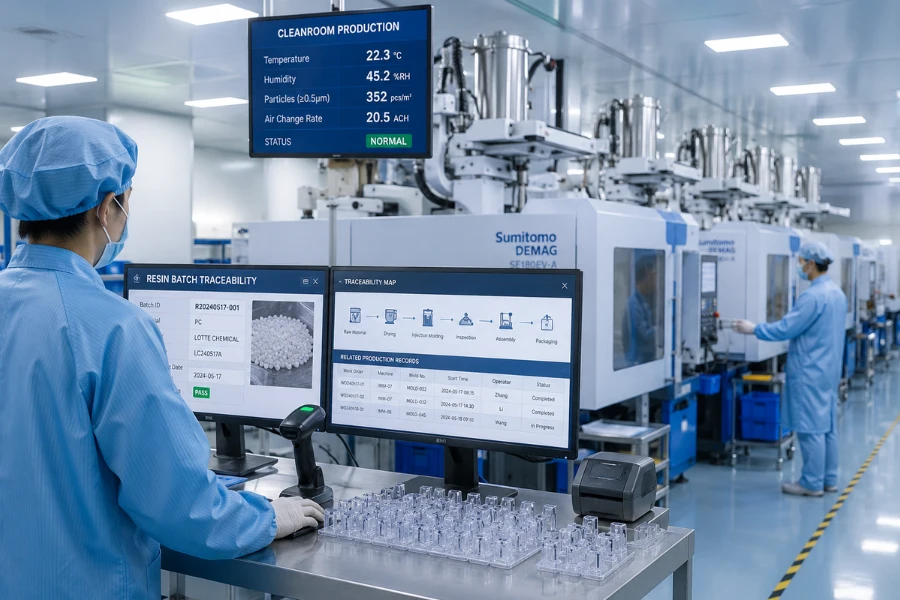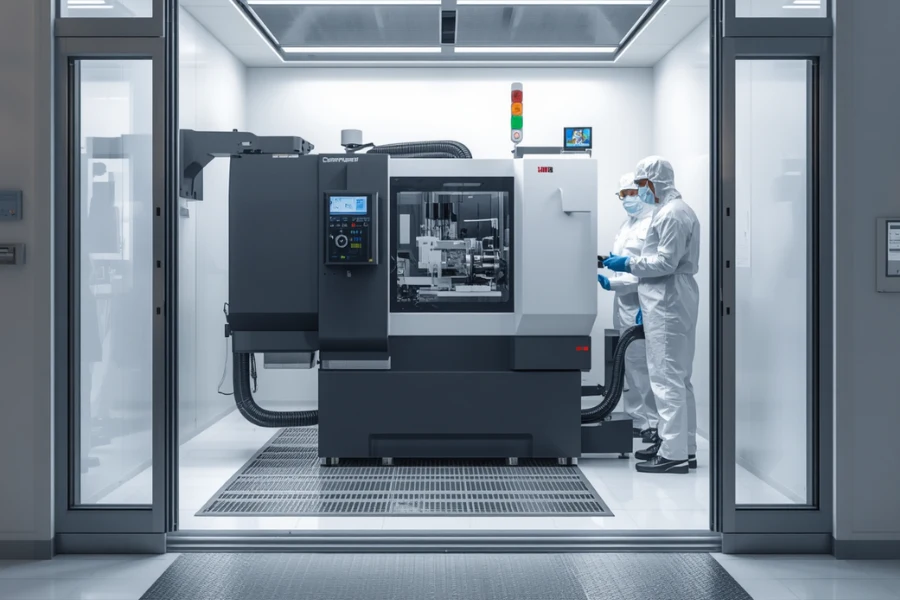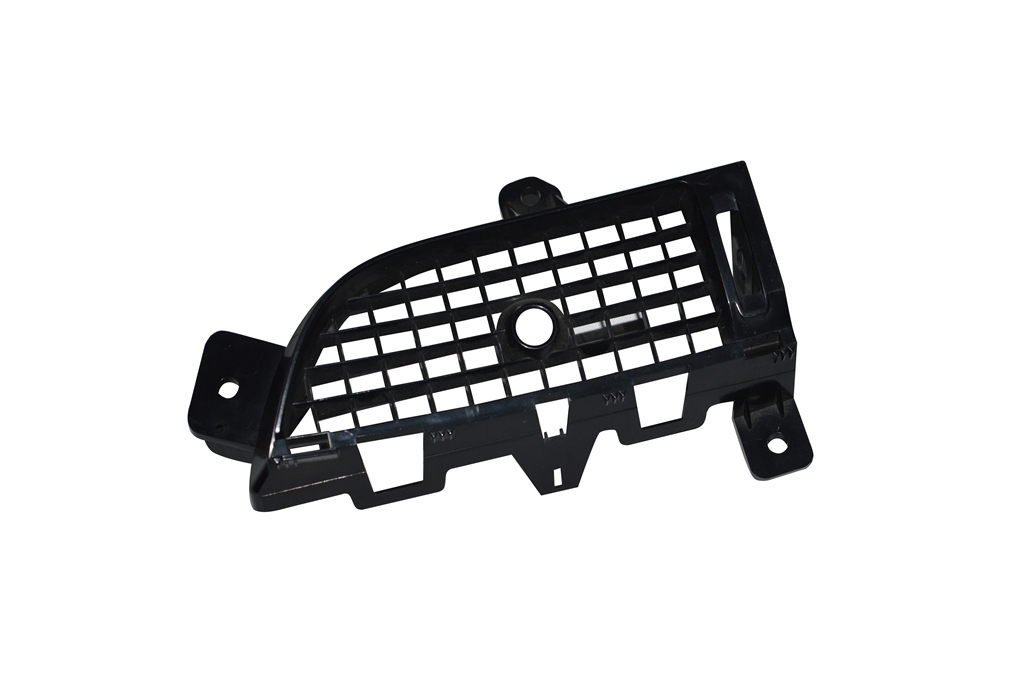
Injection molding encompasses several manufacturing processes used to produce polymer components with different material properties, geometries, and functional requirements. Conventional thermoplastic injection molding is the most widely used approach, while specialized methods address multi-material construction, miniature features, thin walls, hollow sections, and chemically cured materials.
The main types of injection molding include thermoplastic and thermoset molding, overmolding, insert molding, two-shot molding, micro injection molding, precision molding, thin-wall molding, gas-assisted molding, liquid silicone rubber (LSR) molding, structural foam molding, and reaction injection molding (RIM).
These are not mutually exclusive categories. Some describe the material and solidification mechanism, while others describe how components are integrated or how specific geometric requirements are achieved.
What Is Injection Molding and How Does It Work?
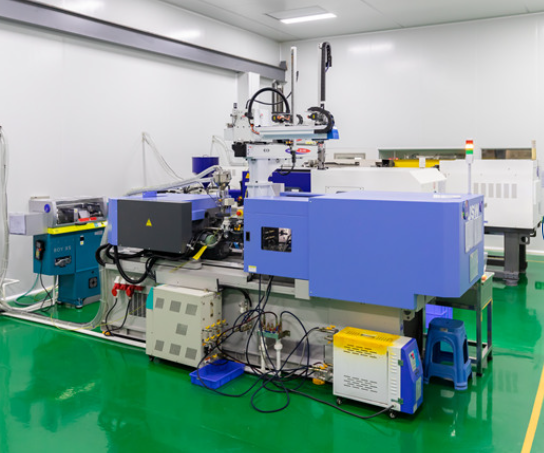
Injection molding forms components by introducing a controlled amount of material into a closed mold cavity. The material fills the cavity, solidifies or cures, and is then removed.
In conventional thermoplastic injection molding, polymer pellets enter a heated barrel containing a reciprocating screw. The rotating screw conveys, melts, and mixes the polymer through external heating and mechanical shear.
The process follows five main stages.
- Plasticization: The screw rotates to melt and meter the polymer.
- Injection: The screw advances, forcing molten polymer into the mold cavity.
- Packing and holding: Pressure compensates for material shrinkage while the gate remains open to melt flow.
- Cooling: The polymer solidifies sufficiently for demolding.
- Ejection: The mold opens, and the finished component is released.
Thermoset and LSR molding differ because their materials undergo chemical curing rather than solidifying solely through cooling.
For a detailed explanation of machine operation and cycle stages, see the injection molding process.
What Are the Main Types of Injection Molding?
Injection molding technologies can be grouped according to four characteristics.
- Material and curing mechanism: Thermoplastic, thermoset, LSR, and reaction injection molding.
- Material or component integration: Overmolding, insert molding, and two-shot molding.
- Dimensional and geometric requirements: Micro, precision, and thin-wall injection molding.
- Specialized cavity-filling or internal-structure methods: Gas-assisted and structural foam injection molding.
These groups overlap. For example, a miniature medical component may require precision molding, while a two-shot component may also include thin-wall features.
Injection Molding Types Comparison
| Injection molding type | How it works | Best suited for | Main limitation |
|---|---|---|---|
| Conventional thermoplastic | Injects molten thermoplastic into a cooler mold | Repeatable plastic housings, connectors, and components | Shrinkage, cooling, and tooling requirements |
| Thermoset | Injects a material that chemically cures in the mold | Selected heat-resistant and electrically insulating parts | Cure control and material handling |
| Overmolding | Molds material over an existing substrate | Grips, seals, and multi-material surfaces | Adhesion and substrate compatibility |
| Insert molding | Injects polymer around a preformed insert | Embedded contacts, pins, and threaded inserts | Insert positioning and residual stress |
| Two-shot molding | Uses coordinated injection stages for multiple material regions | Integrated multi-color or hard-soft components | Specialized tooling and equipment |
| Micro molding | Produces miniature parts or micro-scale features | Microfluidic and miniature precision components | Shot control, handling, and inspection |
| Precision molding | Controls dimensional variation through tooling and process control | Tight-tolerance functional components | Material-dependent dimensional variation |
| Thin-wall molding | Fills thin sections across demanding flow lengths | Lightweight housings and thin-section components | Premature freezing and filling pressure |
| Gas-assisted molding | Introduces pressurized gas into selected molten regions | Components requiring internal hollow channels | Gas penetration and channel control |
| LSR molding | Injects liquid silicone that cures in a heated mold | Flexible seals, valves, and elastomeric parts | Mixing, cure, and flash control |
| Structural foam molding | Produces a cellular core within a molded component | Lightweight, relatively large structural parts | Surface appearance and cell consistency |
| Reaction injection molding | Mixes reactive liquids that cure in the mold | Large polymer panels and housings | Reaction chemistry and cure control |
Conventional Thermoplastic Injection Molding
Conventional thermoplastic injection molding heats and plasticizes polymer resin before injecting it into a comparatively cooler mold. The material solidifies as it loses heat and can generally be reheated and remelted, although repeated processing may affect its properties.
Common thermoplastics include polypropylene (PP), polyethylene (PE), acrylonitrile butadiene styrene (ABS), polycarbonate (PC), polyamide (PA), and polyoxymethylene (POM).
The process is widely used for housings, connectors, caps, mechanical components, and medical device parts. Its suitability depends on whether the selected resin can meet the component’s mechanical, chemical, dimensional, and service requirements.
Gate location, packing pressure, mold temperature, and cooling uniformity influence shrinkage and warpage. These factors must be considered during part and mold design rather than corrected solely through machine settings.
For medical components, medical plastic injection molding may also require documented material selection, contamination controls, and traceability appropriate to the intended application.
Thermoset Injection Molding
Thermoset injection molding processes reactive polymer compounds that undergo irreversible crosslinking during molding.
Unlike thermoplastics, fully cured thermosets cannot be remelted and reshaped through ordinary heating.
The material must remain processable while traveling through the injection unit, then cure under controlled conditions in the mold. This requires managing temperature, residence time, and curing behavior to avoid premature crosslinking.
Materials may include selected phenolic, epoxy, and polyester molding compounds.
Thermoset injection molding is used for applications requiring properties such as electrical insulation, dimensional stability, or resistance to elevated temperatures, depending on the formulation.
Its principal limitations are cure-related cycle requirements, specialized material handling, and the inability to remelt fully cured scrap.
Overmolding
Overmolding introduces a secondary material over an existing substrate to add a functional surface or combine different material properties.
For example, a thermoplastic elastomer (TPE) may be molded over a rigid polymer housing to create a flexible grip or sealing feature.
The interface between the two materials is critical.
Compatible materials may develop thermal or chemical bonding, while other combinations require mechanical interlocking features. Some combinations cannot provide adequate adhesion without additional design or surface treatment.
The substrate must also withstand the temperature and pressure of the secondary molding operation.
Overmolding is commonly used for grips, flexible interfaces, protective features, and selected medical component assemblies.
Insert Molding
Insert molding integrates a preformed component into a molded plastic part.
The insert is positioned inside the mold before polymer is injected around it. After solidification, the insert remains embedded or mechanically retained.
Typical inserts include metal contacts, threaded bushings, pins, and reinforcing elements.
The main benefit is integrating components that would otherwise require separate assembly operations.
However, injection pressure can displace poorly supported inserts, while differences in thermal expansion may generate residual stress around the interface.
The mold must provide reliable insert positioning without obstructing polymer flow or damaging the insert.
For a more detailed comparison of these related methods, see overmolding and insert molding.
Two-Shot and Multi-Shot Injection Molding
Two-shot injection molding, also called 2K molding, forms a component using two coordinated injection stages.
Multi-shot molding extends this principle to additional materials or molding stages.
The process typically uses specialized tooling that repositions a partially molded component between cavities. Depending on the machine and mold design, repositioning may involve rotation, indexing, or transfer.
The materials may have different colors, hardness levels, or functional properties.
They usually form distinct regions of the component rather than being mixed into a homogeneous material.
Compared with separately molding and assembling components, two-shot molding can integrate multiple material regions within a coordinated production cycle.
However, the tooling investment, material compatibility, and production volume must justify the process.
Micro Injection Molding
Micro injection molding manufactures miniature components or parts containing extremely small functional features.
It is not defined by one universal maximum part dimension.
At small scales, the relationship between shot volume, gate size, feature dimensions, and material flow becomes especially important.
A small variation in delivered melt volume may represent a substantial proportion of the material required for an individual part.
Micro molding may therefore require specialized plasticization and injection control, precision tooling, and carefully designed ejection mechanisms.
Typical applications include microfluidic components, miniature connectors, and small medical device parts.
Inspection is another important constraint. Features that are difficult to access or measure may require optical measurement or other appropriate metrology methods.
Precision Injection Molding
Precision injection molding focuses on controlling dimensional variation in components with demanding functional requirements.
It is better understood as a high-control manufacturing approach than as a completely separate material-processing mechanism.
Precision requirements depend on the specified tolerances, material behavior, geometry, measurement conditions, and intended function.
For example, a precision connector may require controlled internal dimensions to maintain assembly fit across production batches.
Polymer shrinkage, mold deflection, temperature variation, and post-molding dimensional changes can all affect the final result.
Achieving repeatable dimensions requires coordinated part design, tooling, process control, and measurement.
Precision molding does not eliminate these sources of variation. It establishes appropriate controls to keep them within the component’s specified limits.
Thin-Wall Injection Molding
Thin-wall injection molding addresses components with demanding flow-length-to-wall-thickness relationships.
A wall thickness below 1 mm may qualify as thin in some applications, but thickness alone is not a universal definition.
Thin sections cool rapidly as molten polymer travels through the mold.
If the melt loses flowability before the cavity is filled, the component may develop short shots, incomplete features, or inconsistent packing.
Thin-wall molding may therefore require suitable resin flow characteristics, rapid filling, appropriate gate placement, and effective mold temperature control.
Applications include thin housings, packaging, and selected medical components.
Reducing wall thickness must also be balanced against structural stiffness, warpage, impact performance, and functional requirements.
Gas-Assisted Injection Molding
Gas-assisted injection molding uses pressurized gas, commonly nitrogen, during a controlled stage of the injection molding cycle.
The gas enters selected regions of the molten polymer, displacing material to create internal channels or helping maintain pressure against the cavity surface.
This approach can be useful for components containing thick sections that would otherwise be difficult to pack effectively.
Typical applications include handles, thick ribs, and parts designed with hollow internal features.
The gas path must be coordinated with the component geometry, gate position, material behavior, and injection sequence.
Uncontrolled penetration can cause uneven wall thickness, unwanted breakthrough, or incomplete filling.
Gas-assisted molding differs from structural foam molding because it generally produces defined gas channels rather than a distributed cellular core.
Liquid Silicone Rubber Injection Molding
Liquid silicone rubber (LSR) injection molding uses a reactive liquid silicone formulation that cures into an elastomer.
The process typically meters and mixes two material components before introducing them into a heated mold.
The curing reaction forms a flexible, crosslinked silicone component.
LSR molding is used for seals, diaphragms, valves, and other flexible components requiring material properties that suitable silicone grades can provide.
Its processing characteristics differ from conventional thermoplastic molding.
Mixing accuracy, material temperature, mold sealing, venting, and cure conditions influence component quality.
Flash control can be particularly important because low-viscosity silicone may enter small gaps in the mold.
For medical applications, suitability must be established for the specific silicone grade, intended contact conditions, and applicable product requirements. Silicone should not be assumed to be biocompatible solely because it belongs to the LSR material family.
Structural Foam Injection Molding
Structural foam injection molding uses a blowing mechanism to produce a cellular structure within a molded polymer component.
The resulting part may have a relatively dense outer skin surrounding a lower-density core.
Depending on the formulation and process, the cellular structure can reduce material usage and component weight.
Structural foam molding is often considered for larger housings and structural components where reduced density is desirable.
However, foam formation can affect surface appearance, local mechanical properties, and dimensional consistency.
The size and distribution of cells depend on material selection, gas generation or introduction, pressure, temperature, and mold filling conditions.
The process is less suitable when a component requires very fine surface details or appearance standards that the selected foam process cannot reliably achieve.
Reaction Injection Molding
Reaction injection molding (RIM) mixes reactive liquid components before introducing them into a mold.
The materials chemically react and form a polymer inside the cavity.
Polyurethane systems are common examples, although the exact chemistry depends on the application.
Unlike conventional thermoplastic injection molding, RIM does not require melting a solid thermoplastic feedstock in a reciprocating-screw barrel.
Its relatively low-viscosity starting materials can be useful for producing certain large molded components, including panels and housings.
The process requires control of component ratios, mixing, reaction kinetics, mold temperature, and curing conditions.
RIM is not automatically suitable for components requiring the same materials, dimensions, or production characteristics as conventional precision thermoplastic molding.
Other Specialized Injection Molding Technologies
Several additional technologies extend injection molding beyond the main process categories.
Co-injection or sandwich molding uses controlled delivery of different polymer melts to create layered material regions, often with a core-and-skin structure. Unlike typical two-shot molding, the materials may occupy different layers within the same component cross-section.
Metal injection molding (MIM) combines fine metal powder with a binder to create moldable feedstock. After molding, the component undergoes debinding and sintering, making these post-molding stages essential to the manufacturing process.
Cube molding uses a rotating or indexing mold arrangement to coordinate molding, cooling, part transfer, or ejection across multiple stations. It is a specialized tooling and production configuration rather than a method for producing cube-shaped parts.
What Are the Different Types of Injection Molds?
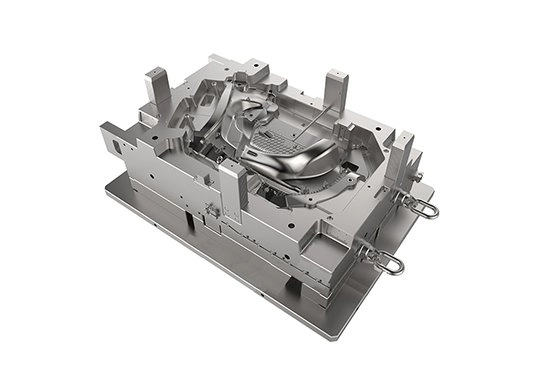
Injection molds can be classified by plate structure, runner design, cavity arrangement, and mechanisms used to release molded features.
These classifications describe the tooling rather than the polymer processing method.
Two-Plate vs. Three-Plate Injection Molds
A two-plate injection mold generally uses one primary parting plane between its moving and stationary sections.
This configuration is widely used for components that can be filled and ejected through relatively straightforward mold-opening arrangements.
A three-plate mold introduces an additional separation movement, commonly allowing the runner system and molded parts to be released separately.
Three-plate molds can provide greater flexibility for certain pin-gate locations but introduce additional mold components and opening movements.
For a detailed comparison, see two-plate and three-plate molds.
Cold Runner vs. Hot Runner Injection Molds
Cold runner systems allow polymer in the runner passages to solidify during the molding cycle.
The runner material is removed after molding and may be eligible for reprocessing, depending on the resin and quality requirements.
Hot runner systems maintain polymer in designated runner passages at controlled temperatures between cycles.
They can reduce solidified runner waste and support certain high-volume or multi-cavity applications.
However, hot runners introduce additional heating controls, maintenance requirements, and potential material degradation risks if residence time or temperature is poorly managed.
The choice depends on resin stability, production volume, gate design, material cost, and tooling economics.
Single-Cavity vs. Multi-Cavity Injection Molds
A single-cavity mold produces one molded component per molding cycle.
A multi-cavity mold produces multiple components during the same cycle, potentially increasing output without proportionally increasing the number of machine cycles.
However, multi-cavity molds require appropriate runner balancing, consistent filling, and sufficient machine capacity.
They also involve higher tooling complexity and may require more demanding process control to maintain consistency between cavities.
Side-Action, Unscrewing and Specialized Injection Molds
Components with undercuts, side holes, or molded threads may require additional mold mechanisms.
Side-action molds use moving cores or slides to release features that cannot be removed along the primary opening direction.
Unscrewing molds use controlled rotational movement to release certain threaded features.
Removable-insert molds allow selected tooling elements to be separated from the component outside the main mold-opening sequence.
These arrangements expand the range of moldable geometries but may increase cycle time, tooling cost, and maintenance requirements.
Types of Injection Molding Machines
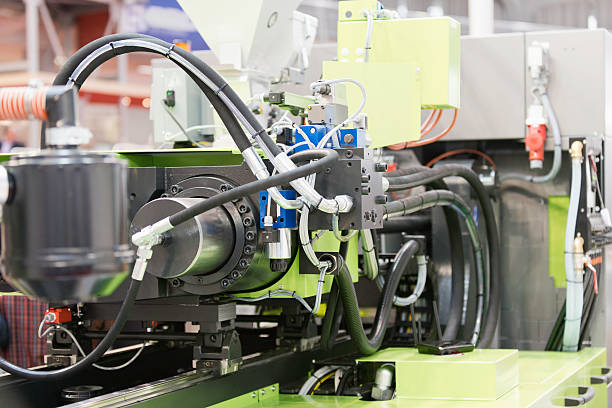
Injection molding machines can be classified according to their physical arrangement, plasticizing mechanism, and drive system.
| Machine type | Configuration | Common application consideration |
|---|---|---|
| Horizontal | Clamping arrangement and injection axis are generally horizontal | Automated production and part removal |
| Vertical | Clamping arrangement is generally vertical | Insert placement and selected overmolding operations |
| Angle | Injection and clamping axes are arranged at an angle, commonly perpendicular | Specialized tooling and processing layouts |
Machine drive systems may be hydraulic, electric, or hybrid.
These configurations differ in their methods of generating machine movement and controlling injection, clamping, and other operations.
Another distinction concerns plasticization.
Plunger-type machines use a plunger to move material through the injection system, while reciprocating-screw machines use a rotating screw to melt and meter polymer before injection.
Modern conventional thermoplastic molding predominantly uses reciprocating-screw systems.
Equipment selection should consider shot capacity, clamping force, mold dimensions, material characteristics, injection performance, and automation requirements.
How Is Injection Molding Different From Other Plastic Molding Processes?
Injection molding is one of several methods used to manufacture plastic products.
Other processes differ in how they shape material and the types of geometry they can produce.
| Plastic molding process | Basic mechanism | Typical applications |
|---|---|---|
| Injection molding | Injects material into a closed mold cavity | Housings, connectors, precision components |
| Compression molding | Compresses a measured material charge inside a mold | Rubber parts and thermoset components |
| Blow molding | Inflates a heated parison or preform inside a mold | Bottles and hollow containers |
| Extrusion | Continuously forces material through a shaping die | Tubing, profiles, and insulation |
| Rotational molding | Rotates a heated mold to distribute polymer along its interior | Tanks and large hollow products |
Injection molding is particularly useful for components requiring repeatable three-dimensional features and production volumes that justify dedicated tooling.
Blow molding is more appropriate for many hollow containers, while extrusion is suited to continuous profiles.
Compression molding and rotational molding may offer advantages for specific material systems, component sizes, and production requirements.
For additional comparisons, see the guide to plastic molding processes.
How to Choose the Right Injection Molding Process
Selecting an injection molding process requires evaluating material properties, component geometry, functional requirements, and production economics together.
The following table provides an initial screening guide.
| Component requirement | Process to consider | Main reason |
|---|---|---|
| Repeatable thermoplastic components | Conventional thermoplastic molding | Established process for a broad range of polymers |
| Embedded metal contacts or threaded inserts | Insert molding | Integrates preformed components during molding |
| Flexible grip or sealing surface over a rigid substrate | Overmolding or two-shot molding | Combines different material properties |
| Miniature components or micro-scale features | Micro injection molding | Supports very small molded geometries |
| Tight dimensional or functional tolerances | Precision injection molding | Emphasizes tooling, process, and measurement control |
| Thin sections with demanding flow lengths | Thin-wall injection molding | Addresses rapid cooling and difficult cavity filling |
| Thick sections requiring internal hollow channels | Gas-assisted injection molding | Uses controlled gas penetration |
| Flexible silicone components | LSR injection molding | Produces cured silicone elastomer parts |
| Large, lower-density molded components | Structural foam molding | Creates a cellular internal structure |
This table is a starting point rather than a final process specification. A component may require several of these capabilities simultaneously.
Evaluate Material and Service Requirements
Material selection should begin with the intended service environment.
Mechanical loads, operating temperature, chemical exposure, dimensional stability, and applicable product requirements influence whether a thermoplastic, thermoset, or elastomeric material is appropriate.
For example, a flexible silicone valve and a rigid thermoplastic connector may require fundamentally different molding systems.
Evaluate Geometry and Dimensional Requirements
Wall thickness, flow length, undercuts, insert locations, and critical dimensions affect mold construction and processing.
A component with thin flow paths may require thin-wall molding techniques, while one containing miniature functional details may require micro molding capabilities.
For precision components, tolerances must be evaluated alongside material shrinkage, measurement methods, and the expected manufacturing process capability.
Evaluate Material Integration
If the design requires multiple materials, determine whether the substrate can be molded separately, transferred, or integrated through a coordinated multi-shot system.
Overmolding may provide flexibility in substrate preparation and production sequencing.
Two-shot molding may be advantageous when production volume supports specialized tooling and repeatable integrated processing.
Insert molding is appropriate when a preformed component must remain embedded within the molded part.
Evaluate Production Economics and Quality Requirements
Tooling complexity, cycle time, material consumption, inspection, and downstream assembly all influence manufacturing cost.
For example, multi-shot molding may reduce assembly operations but require higher initial tooling investment.
For medical components, the process must also support the applicable material, cleanliness, documentation, and quality requirements established for the specific product.
A custom plastic molding evaluation should therefore consider the part drawing, material specifications, production volume, and functional acceptance criteria together.
Frequently Asked Questions
What Is the Most Common Type of Injection Molding?
Conventional thermoplastic injection molding is among the most widely used methods. It processes polymers such as PP, PE, ABS, PC, and PA into housings, connectors, mechanical components, and other repeatable plastic parts.
What Is the Difference Between Injection Molding and Overmolding?
Conventional injection molding forms a component by injecting material into a mold cavity. Overmolding adds material over an existing substrate to create a combined component with additional functional properties.
What Is the Difference Between Injection Molding Types and Mold Types?
Injection molding types describe processing methods such as micro molding, overmolding, and gas-assisted molding. Mold types describe tooling configurations such as two-plate molds, three-plate molds, and hot runner systems. A molding process may use different mold configurations depending on the component design.
Which Injection Molding Processes Are Used for Medical Components?
Medical components may use conventional thermoplastic molding, micro molding, precision molding, insert molding, overmolding, two-shot molding, or LSR molding. Selection depends on the material, component geometry, intended function, and applicable manufacturing requirements.
Conclusion
Different types of injection molding address different material, geometry, and production requirements. Conventional thermoplastic molding supports a broad range of components, while specialized methods such as overmolding, micro molding, gas-assisted molding, and LSR molding address more specific manufacturing challenges.
The appropriate process depends on material behavior, mold design, dimensional requirements, and production economics.
SeaSkyMedical supports plastic component projects involving material selection, mold development, and injection molding process planning. To discuss a specific component or manufacturing requirement, contact SeaSkyMedical.